
Covenants and Dispensations – Intro
Estimated time to read:
Read this article to me
Suggested prerequisite reading:
Supporting Articles:
Mount Sinai: The Covenant, the Golden Calf, and Misplaced Faith
Covenants and Dispensations: One Story, Two Lenses
Understanding God’s Covenants
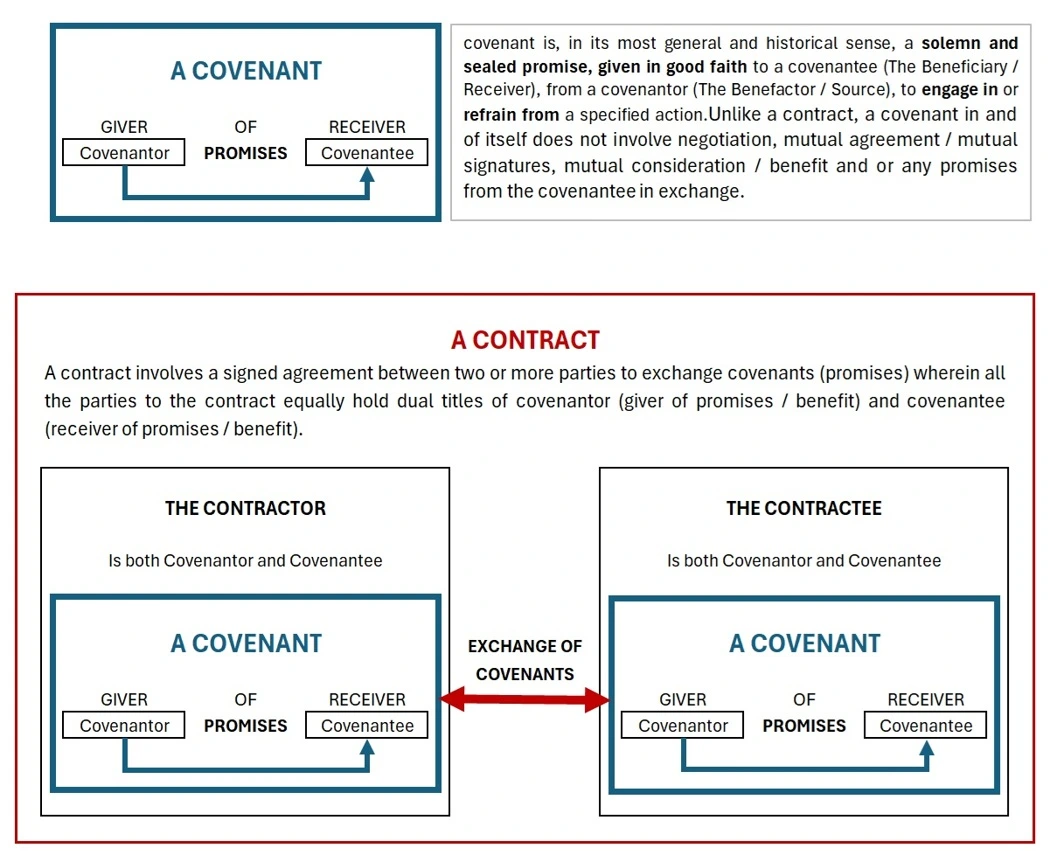
A covenant is, in its most general and historical sense, a solemn and sealed promise, given in good faith to a covenantee (The Beneficiary / Receiver), from a covenantor (The Benefactor / Source), to engage in or refrain from a specified action.
A covenant, in and of itself, does not necessarily require negotiation, mutual agreement, mutual signatures, reciprocal promises, or mutual consideration or benefit. A covenant may consist of a solemn promise undertaken by one party for the benefit of another. Although covenants can involve reciprocal obligations, such obligations are not inherent in every covenant. By contrast, a contract requires an agreement between parties, whether that agreement is formed through exchanged promises or through other legally recognized means of acceptance.
To put it simply, the covenantee is the one who receives considerations / benefits of the promises given them from the covenantor. It is the covenantor who determines and sets the contingencies / conditions (if any) as well as the considerations / benefits inclusive of their covenantal promises.
A contract involves an agreement between two or more parties to exchange covenants (promises) wherein all the parties to the contract equally hold dual titles of covenantor (giver of promises / benefit) and covenantee (receiver of promises / benefit).
This distinction of a covenantal relationship is important because the existence of a covenant and the receipt of its promised benefits are not necessarily the same thing. Although a covenantee may not receive the considerations or benefits of a covenant until or unless they meet its established conditions (if any), their failure to meet those conditions does not, in and of itself, invalidate the covenantor’s promise. The covenant remains in force according to its established terms, even though a particular covenantee may never qualify to receive its benefits.
In other words, the failure of a covenantee to meet the conditions of a promise does not necessarily constitute a failure of the covenantor to fulfill that promise.
While not all of man’s promises are considered solemn or binding, every promise God makes carries the same certainty and faithfulness as His covenants. Although Scripture may not formally identify every divine promise as a covenant, a promise from God is as trustworthy and certain as any covenant He establishes. God cannot lie, nor can He fail to fulfill what He has promised. Some of God’s promises are unconditional, while others are conditional, requiring a response of faith and obedience.
Other notable distinctions regarding covenants
- Covenants belong to the covenantor. A covenant established by God remains His covenant because He alone determines its promises, conditions, and consequences. The recipients of that covenant may be required to obey its conditions, and Scripture may describe their failure to do so as breaking the covenant. However, their disobedience does not make them the authors of the covenant, give them authority to change its terms, or make God unfaithful to His promises. They have violated the covenant’s obligations, not acquired the authority to invalidate God’s Word. God’s covenant remains subject to the terms He Himself established, including any provisions concerning judgment, restoration, or its duration.
- Entering Into God’s Covenants. God alone establishes His covenants, determines to whom they apply, and specifies their promises, conditions, and benefits. Where God requires a response, those to whom the covenant applies enter into its covenantal relationship by responding in the method and manner God Himself has established. Their response does not establish the covenant, negotiate its terms, or give them authority over its promises. Rather, they are responding to what God has already established.
This distinction is particularly important concerning salvation. God alone established salvation through the sacrificial work of Jesus Christ and determined the conditions under which salvation would be granted. We cannot establish salvation, earn it through works or merit, or independently declare ourselves saved. God has determined that those who place their faith in Christ will receive forgiveness and eternal life. Our faith does not purchase salvation or establish its terms; it is our response to God’s gracious provision. We choose whether to place our faith in Christ, but it is God who saves us according to the promise He Himself established.
What a Covenant Is, What a Dispensation Is, and Why We Need Both
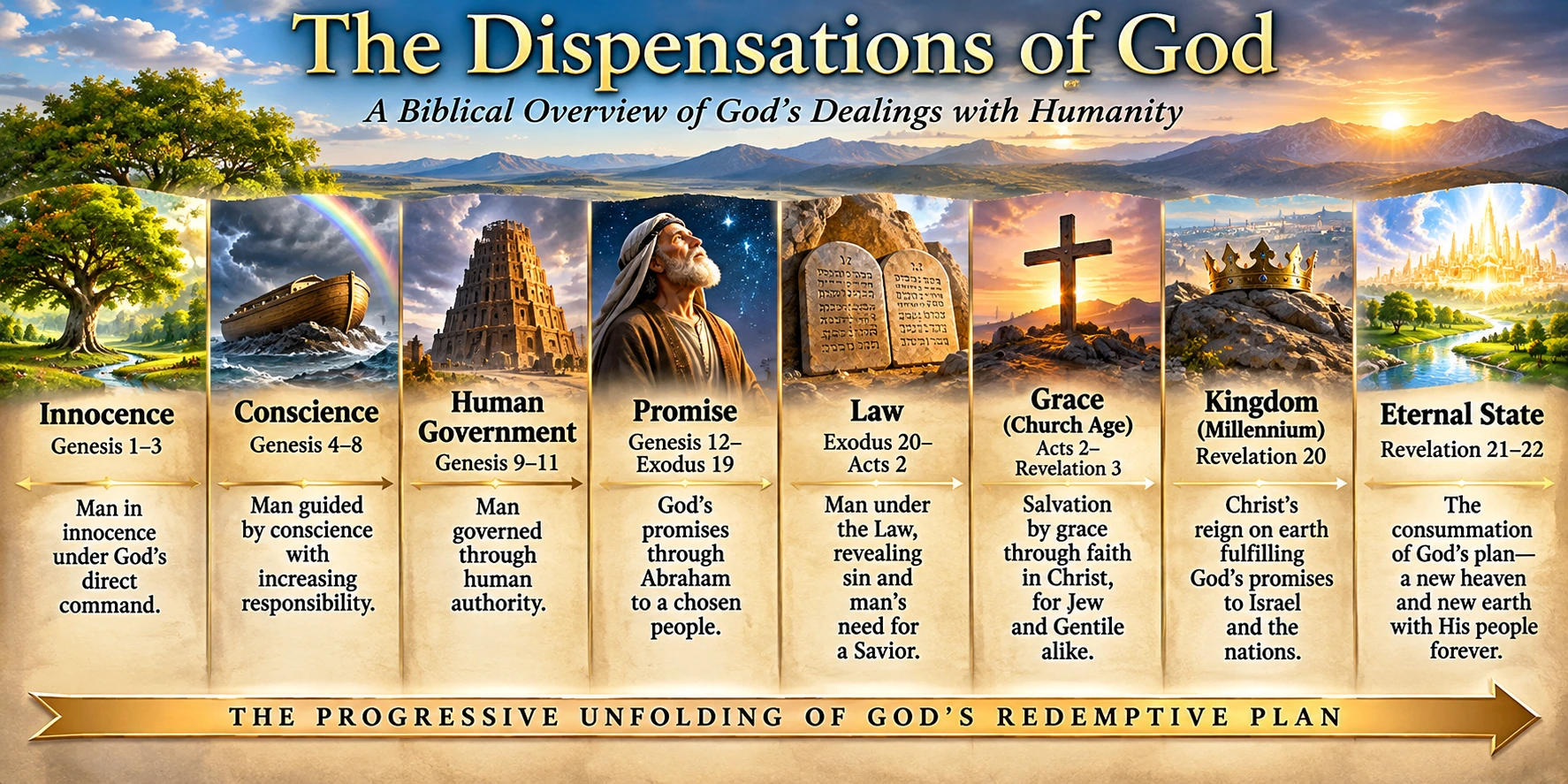
A covenant is God’s solemn, binding commitment that orders His relationship with people in history. In a covenant God promises, commands, warns, blesses, and often gives a sign. A dispensation is an administration or economy—a period in which God governs and tests humanity under a particular arrangement, highlighting specific responsibilities. The two do not compete; they complement. Covenants provide the promises and terms; dispensations provide the historical settings in which those promises and terms are displayed, tested, and advanced. Read together, they teach the same lesson: revelation increases, man’s inability is exposed, and Christ alone fulfills what God requires and provides what God promises.
A word about “in effect” and “fulfilled.”
Some covenants continue for all creation (Noahic). Some are fulfilled and therefore obsolete as covenantal administrations (Mosaic), though their moral light endures in “the law of Christ” (Romans 13:8–10; Galatians 6:2). Some are inaugurated now and await consummation (Davidic, New). Movement from one administration to another is God’s action in history—promise given, law added, Messiah come, Spirit poured out, Kingdom consummated. If a person chooses to “live by the law” as the way of righteousness, he remains under its curse (Galatians 3:10). If he comes to Christ by faith, he comes under the New Covenant—forgiven, indwelt by the Spirit, adopted (Jeremiah 31:31–34; Romans 8:1–17; Hebrews 8:6–13).
NOTE: In this context, in keeping with traditional Christian teaching and terminology, “probation” means a period of divinely appointed testing under clear terms.
Applied to Eden:
- God placed Adam (as humanity’s representative) under a simple, positive command: do not eat from the tree of the knowledge of good and evil (Genesis 2:16–17).
- Continued life in God’s blessed presence (rest, fellowship, unhindered access to the tree of life) was conditioned on trusting obedience. That testing arrangement is often called the Edenic probation (or the covenant of works).
- Adam failed the probation; the sanctions fell (death, exile from the garden). As our federal head, his failure involved us all (Romans 5:12–19).
Fulfilled in Christ:
- Jesus, the last Adam, passed the probation we failed—obeying perfectly under testing (wilderness, Gethsemane, cross), securing the righteousness and life Adam forfeited (Romans 5:18–19; 1 Corinthians 15:45–49; Hebrews 4:15).
- Hence “Edenic probation fulfilled in Christ” means the testing Adam failed has been successfully completed by Christ on our behalf. The creation mandate still stands; the probationary test is complete and its remedy accomplished in Him.
Primeval Foundations
The Creation/Edenic Covenant (Genesis 1–2) In the beginning God covenanted with humanity in Adam. He blessed them to be fruitful, to fill and rule the earth as His image-bearers, to cultivate and guard the garden, and to enter His rest (Genesis 1:26–28; 2:1–3, 15–17). The Sabbath later echoes this creational pattern (Exodus 20:8–11). The probation concerning the tree revealed that even in innocence man must live by trusting obedience. Adam fell (Genesis 3), and with that fall the Edenic probation failed. Yet the creation mandate continues, and in Christ—the last Adam—true obedience and true rest are secured (Romans 5:12–19; 1 Corinthians 15:45–49; Hebrews 4:1–11). Fulfilled in Christ and consummated in the new creation (Revelation 21–22). Dispensation: Innocence (Genesis 1–3). Under perfect conditions, man did not save or govern himself.
Included covenants/dispensations and status
- Creation/Edenic Covenant: ongoing creation mandate; Edenic probation fulfilled in Christ; consummation future (still operative in mandate; probation complete).
- Dispensation of Innocence: complete (failed by man; instructive).
The Adamic/Post-Fall Word (Genesis 3:14–19) After the fall God pronounced judgment and promise. The serpent is cursed; the ground is cursed; and a war of seeds begins, with the pledge that the woman’s seed will crush the serpent’s head (Genesis 3:15–19). Conscience now bears witness to right and wrong (Romans 2:14–15), yet the heart remains wayward; “every intention” becomes “only evil continually” (Genesis 6:5). Christ fulfills the promise by destroying the works of the devil (Hebrews 2:14–15; Colossians 2:15; Romans 16:20). The curse’s effects persist until the final renewal (Revelation 22:3). Dispensation: Conscience (Genesis 4–6). Conscience alone could not restrain evil.
Included covenants/dispensations and status
- Adamic promise (protoevangelium): fulfilled in Christ’s victory; curse effects remain until new creation (partially in effect; final removal pending).
- Dispensation of Conscience: complete (failed by man; instructive).
The Noahic Covenant (Genesis 8:20–9:17) After the flood God covenanted with Noah, his descendants, and every living creature. He promised the stability of the world’s rhythms and pledged never again to destroy all flesh by a flood (Genesis 8:20–9:17). Human life is guarded with a solemn warning against bloodshed and the institution of civil accountability (Genesis 9:6). The rainbow is the sign to all creation. This covenant still stands; it anchors the world in which redemption unfolds (Isaiah 54:9–10; Jeremiah 33:20–25; 2 Peter 3:3–13). Dispensation: Human Government (Genesis 9). Civil order can restrain violence but cannot renew the heart, as Babel quickly proves (Genesis 11).
Included covenants/dispensations and status
- Noahic Covenant: still in effect universally until the end.
- Dispensation of Human Government: historically complete as a distinct test, but civil order continues as part of common grace (Romans 13).
Patriarchal Promise and Sinai’s Law
The Abrahamic Covenant (Genesis 12; 15; 17; 22) God called Abram and swore by Himself to give him offspring, a land, and to bless all the families of the earth through his seed (Genesis 12:1–3; 15:1–21; 17:1–14; 22:15–18). Circumcision marked the covenant (Genesis 17). Abram believed the LORD, and it was counted to him as righteousness (Genesis 15:6; Romans 4). The New Testament identifies the promised Seed as Christ (Galatians 3:16), and in Him the blessing flows to Jew and Gentile alike (Galatians 3:8, 14, 29). This covenant is active in Christ now and will be consummated in the world to come (Hebrews 6:13–20; 11:8–16).
Land promise: two emphases held together by many believers. The typological/new‑creation reading sees the land as first-fruits of a greater inheritance: Joshua provides epochal fulfillment (Joshua 21:43–45), yet Abraham looked for a city whose builder is God (Hebrews 11:10, 16); Paul calls the inheritance “the world” (Romans 4:13). Thus the land points to the new creation under Christ (Isa 65–66; Revelation 21–22). The national‑future reading emphasizes God’s oath to Abraham’s physical descendants, foreseeing Israel’s future fullness and restoration under Messiah within history, including territorial blessing (Deuteronomy 30:1–10; Amos 9:11–15; Ezekiel 36–37; Zechariah 12–14; Luke 1:32–33; Romans 11:12, 26–29). These can harmonize: Christ is the goal; the new creation the horizon; Israel’s fullness a chapter toward that end.
Included covenants/dispensations and status
- Abrahamic Covenant: still in effect in Christ (blessing to nations now; inheritance consummation future; many hold a future national dimension).
- Dispensation of Promise: historically complete as a test; its saving principle (faith) abides.
The Mosaic/Sinai Covenant (Exodus 19–24; Deuteronomy) At Sinai God bound Himself to Israel in a covenant of law, priesthood, sacrifice, blessing, and curse (Exodus 19–24; Lev 16; Deuteronomy 28–30). The Sabbath and feasts marked Israel’s life (Exodus 31:13–17). The law is holy and good, but it cannot justify sinners; it exposes sin and drives us to Christ (Romans 3:19–31; Galatians 3:19–24). Jesus fulfilled the law and bore its curse to establish righteousness for those who believe (Matthew 5:17; Romans 10:4; Galatians 3:13). As a covenantal administration the Mosaic economy has been fulfilled and made obsolete (Jeremiah 31:31–34; Hebrews 8:6–13). Its moral substance continues under “the law of Christ” (Romans 13:8–10; Galatians 6:2). If one seeks righteousness by law, he remains under its curse (Galatians 3:10); by faith we die to the law as a covenant of works and live by the Spirit (Romans 7:4–6; 8:3–4). Dispensation: Law (Exodus 19—Acts 2). The best standard cannot save the worst heart.
Included covenants/dispensations and status
- Mosaic/Sinai Covenant: fulfilled/obsolete as a covenantal administration; moral light continues in Christ (no longer in effect as covenant for those in Christ; remains the standard that condemns those who seek righteousness by it).
- Levitical/Priestly Covenant (Numbers 25; Malachi 2): fulfilled and superseded by Christ’s priesthood (no longer in effect).
- Deuteronomic Restoration promise (Deuteronomy 29–30): integrated into New Covenant; heart‑circumcision realized by the Spirit (in effect within New Covenant).
- Dispensation of Law: complete (failed by man; instructive).
Royal Hope and the New Heart
The Davidic Covenant (2 Samuel 7; Psalm 89; 132) God promised David an everlasting house and throne, adopting the king in a father–son bond (2 Samuel 7:8–16; Psalm 89; 132; Isaiah 9:6–7). Human kings failed; the kingdom fractured and fell. Christ, the Son of David, now reigns by virtue of His resurrection and exaltation (Luke 1:32–33; Acts 2:30–36; Ephesians 1:20–23). His reign is present and real; its visible consummation awaits the day when all enemies are under His feet and the kingdoms of this world become “the kingdom of our Lord and of His Christ” (1 Corinthians 15:24–28; Revelation 11:15).
Included covenants/dispensations and status
- Davidic Covenant: inaugurated and in effect now in Christ’s present reign; consummation future at His return.
The New Covenant (Jeremiah 31; Ezekiel 36–37; Luke 22; Hebrews 8–10) Through Jeremiah and Ezekiel God promised a covenant unlike Sinai: forgiveness of sins, a new heart, His law written within, and His Spirit indwelling His people (Jeremiah 31:31–34; Ezekiel 36:24–27; 37:24–28). Jesus declared at the Supper, “This cup… is the new covenant in My blood” (Luke 22:20). By His cross and resurrection He secured it; by His Spirit He applies it (2 Corinthians 3; Hebrews 8–10). In this covenant Jew and Gentile are made one new humanity (Ephesians 2:11–22). It is in force now and will reach its fullness in Israel’s future turning and in the new creation where all know the Lord (Romans 11:26–27; Revelation 21–22). Dispensation: Grace (Acts 2—Second Coming). Here the lesson is plain: what law could not do, God did by His Spirit (Romans 8:3–4).
Included covenants/dispensations and status
- New Covenant: in effect now; fullness consummated in Israel’s future turning and the new creation.
- Dispensation of Grace: presently in effect until Christ’s return.
The Dispensations in the Light of Christ
Innocence (Creation to Fall). Man fails under perfect conditions (complete; instructive). Conscience (Fall to Flood). Conscience cannot cleanse the heart (complete; instructive). Human Government (Post-Flood). Civil order restrains but cannot renew (historically complete as a test; ongoing function remains). Promise (Abraham to Sinai). Salvation by promise through faith (complete as a test; saving principle abides). Law (Sinai to Pentecost). Law exposes sin and tutors to Christ (complete; moral light endures). Grace (Pentecost to Second Coming). Salvation by grace through faith; Spirit-written law (presently in effect). Kingdom (Millennial/Consummation; timing views vary). Christ’s righteous rule openly manifested; final rebellion; new creation (future).
Included covenants/dispensations and status
- Grace: in effect.
- Kingdom: not yet in final form; consummation future (already/not yet in Christ’s reign).
How We Move from One to the Next
From Promise to Law, the law was “added” because of transgressions—not to annul the promise to Abraham, but to confine and tutor us until Christ came (Galatians 3:17–24). From Law to Grace, Christ fulfilled the law and bore its curse, inaugurating the New Covenant by His blood; in union with Him we die to the law as a covenant of works and live by the Spirit (Romans 7:4–6; 10:4; Hebrews 8:6–13). From Grace to Kingdom, the risen Lord already reigns; the gospel gathers a people from all nations; the Kingdom will be openly displayed at His appearing when He hands the kingdom to the Father, having put all enemies under His feet (Acts 1:6–8; 3:19–21; 1 Corinthians 15:24–28). Personally, if one seeks to be justified “by law,” he remains where he stands—under its demands and under its curse (Galatians 3:10). If one trusts Christ, he enters the New Covenant—forgiven, indwelt, adopted—and learns to walk by the Spirit (Jeremiah 31:34; Romans 8:1–17).
What These Two Lenses Reveal Together
Taken together, covenants and dispensations reveal progressive truth with a single verdict. Innocence fails; conscience fails; government fails; kings fail; priests fail; even proximity to miracles does not save us. The law cannot justify; it exposes and condemns. Promise prevails because God swears by Himself and fulfills His word in His Son. Christ is last Adam, true Seed, Law-keeper, great High Priest, Davidic King, and Mediator of the New Covenant. He is our righteousness and our peace. The Noahic bow tells us the world holds while grace runs its course. The Abrahamic oath tells us nations will be blessed in Christ. The Davidic promise tells us a righteous King will reign. The New Covenant tells us hearts can be made new. And together they tell us what our age needs to hear: man can neither save nor govern himself; Jesus Christ can, and does.
Israel according to the flesh and Israel according to faith: replacement or fulfillment?
Not replacement but fulfillment-in-Christ
Scripture does not teach that the Church (Israel of faith) replaces Israel (according to the flesh). It teaches that God fulfills His promises in Christ and gathers one people in Him (Ephesians 2:11–22). The olive tree remains the same covenant tree; some natural branches (unbelieving Jews) were broken off because of unbelief, and Gentile believers were grafted in by faith; yet God can and will graft natural branches back in (Romans 11:17–24). That is not replacement; it is pruning, grafting, and future restoration.
One people of God, two senses of “Israel,” one way of salvation
- “Israel according to the flesh” names the historic, ethnic nation with irrevocable callings (Romans 9:4–5; 11:28–29).
- “Israel according to faith” names the believing remnant within Israel and, in Christ, believing Gentiles who share Abraham’s faith (Romans 2:28–29; 4:11–12; Galatians 3:7, 29).
- Salvation has always been by grace through faith in the promised Messiah (Romans 3–4; Acts 4:12). There are not two parallel peoples with two ways of salvation.
What continues and what is completed
- Corporate/national gifts and callings (peoplehood, the patriarchal oaths, the Davidic line) remain “irrevocable” for Israel according to the flesh (Romans 11:28–29). Scripture anticipates Israel’s future “fullness” and turning to Christ (Romans 11:12, 26–27).
- The saving core of the covenants (justification, new heart, Spirit) is already enjoyed by Israel according to faith (Jew and Gentile together) under the New Covenant (Jeremiah 31:31–34; Ezekiel 36:24–27; Hebrews 8–10).
- The Mosaic covenant as an administration is fulfilled/obsolete in Christ (Hebrews 8:6–13), though its moral light abides in “the law of Christ” (Romans 13:8–10; Galatians 6:2).
How they relate without erasure
- Continuity: One olive tree, one Messiah, one salvation; the Church shares Israel’s nourishing root (Romans 11:17–18).
- Discontinuity: Unbelief is cut off; covenant administrations change (from Law to New Covenant Grace); ethnic distinction never guarantees standing (Romans 9:6–8).
- Hope: Gentile inclusion does not erase Israel’s future mercy; it previews and provokes it (Romans 11:11, 15). The result is not replacement but reunion—“life from the dead” (Romans 11:15).
Key texts to hold together: Romans 9:6–8; 11:11–29; Ephesians 2:11–22; Galatians 3:7–9, 14, 29; Jeremiah 31:31–34; Hebrews 8:6–13.