
-
Anchoring in Christ
-
- But I Am a Good Person—Why Would God Condemn Me?
- But Christians are Hypocrites
- But Faith in God is Irrational?
- But Isn't the God of the Old Testament a Monster?
- But If God Exists, Why Does God Allow Evil?
- But is the Bible Full of Mysteries, Paradoxes, and Unknowable Things?
- But How Can You Know The Bible Is True?
- But Why Christianity And Not Some Other World Religion?
- But There Are So Many Churches and Denominations - Which One Is Right?
-
Topical Studies
-
-
- Sin: The Elephant In The Room
- But I Am a Good Person—Why Would God Condemn Me?
- What is Sin?
- Is God The Author Of Sin?
- The introduction of Sin into the World
- What Changed Because of the Fall?
- What Did Humanity Inherit from Adam?
- Personal Sin and Personal Guilt
- The Deceitfulness and Progressiveness of Sin
- The Consequences and Judgment of Sin
- Analogies of Sin
- Analogies of Repentance
- Generational Sin and the Increasing Corruption of a People
- Evangelism and the Topic of Sin
-
- Ignorance of God - No Excuse
- God’s Remedy for Sin
- Adoption as Sons: From Bondage to Glory
- Called to Glory: Understanding the Purpose of God's Call
- Those IN Christ: Elected & Predestined to Glory
- The Role of Faith in Salvation
-
- Glorification of the Saints - An Introduction
- Glorification of the Saints - First Creation
- Glorification of the Saints - Fall of Angels
- Glorification of the Saints - Fall of Man
- Glorification of the Saints - Redemption
- Glorification of the Saints - The New Creation
- Glorification of the Saints - God's Eternal Purpose
- The Glorified Body: From Adam to Christ
-
- Foreknowledge, Predestination, and Election: An Examination in Their Biblical Context
- Predestined to Glory: Why Predestination Must Be Understood Before Election
- Biblical Predestination: From Sin to Glory
-
- Articles coming soon
-
-
Book Studies
- Book Study Intro Note
- Study References, Resources, and Acknowledgments
- Hebrew Bible and Jewish Writings
- The Septuagint (LXX) - Scripture in Greek Translation
- Masoretic Text, and Why Is It Important
-
-
-
- Articles coming soon
-
- Articles coming soon
-
- Articles coming soon
-
-
- Articles coming soon
-
- Articles coming soon
-
- Articles coming soon
-
- Articles coming soon
-
- Articles coming soon
-
- Articles coming soon
-
- Articles coming soon
-
- Articles coming soon
-
- Articles coming soon
-
- Articles coming soon
-
- Articles coming soon
-
- Articles coming soon
-
-
-
- Articles coming soon
-
- Articles coming soon
-
- Articles coming soon
-
- Articles coming soon
-
-
-
- Articles coming soon
-
- Articles coming soon
-
- Articles coming soon
-
- Articles coming soon
-
-
- Articles coming soon
-
- Articles coming soon
-
- Articles coming soon
-
- Articles coming soon
-
- Articles coming soon
-
- Articles coming soon
-
- Articles coming soon
-
- Articles coming soon
-
- Articles coming soon
-
- Articles coming soon
-
- Articles coming soon
-
- Articles coming soon
-
-
-
-
-
- Articles coming soon
-
- Articles coming soon
-
- Articles coming soon
-
- Articles coming soon
-
-
- Articles coming soon
-
- Articles coming soon
-
- Articles coming soon
-
- Articles coming soon
-
-
-
- Articles coming soon
-
- Articles coming soon
-
- Articles coming soon
-
- Articles coming soon
-
- Articles coming soon
-
- Articles coming soon
-
-
-
- Articles coming soon
-
- Articles coming soon
-
- Articles coming soon
-
- Articles coming soon
-
- Articles coming soon
-
-
- Articles coming soon
-
Musings
-
Reference Tools
Masoretic Text, and Why Is It Important
0 out of 5 stars
| 5 Stars | 0% | |
| 4 Stars | 0% | |
| 3 Stars | 0% | |
| 2 Stars | 0% | |
| 1 Stars | 0% |
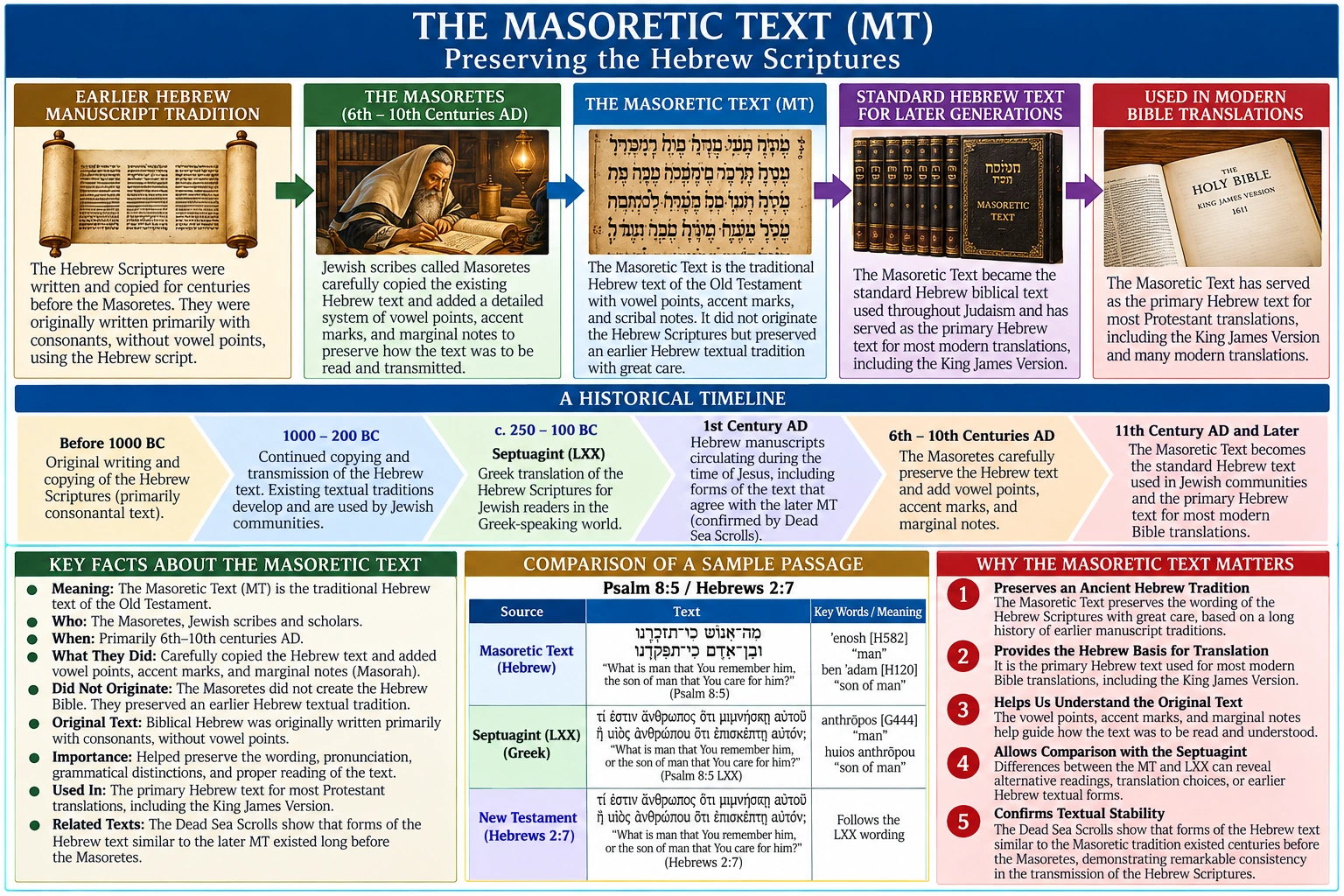
What Is the Masoretic Text, and Why Is It Important?
The Masoretic Text (MT) is the traditional Hebrew text of the Old Testament that has served as the primary textual foundation for most Protestant Bible translations, including the King James Version. Its name comes from the Masoretes, Jewish scribes and scholars who, particularly between approximately the sixth and tenth centuries AD, devoted themselves to preserving and transmitting the Hebrew Scriptures with extraordinary care. However, the Masoretes did not write or originate the Hebrew Bible. They inherited a much older Hebrew textual tradition and developed a detailed system of vowel markings, pronunciation guides, accent marks, and scribal notes to help preserve how the text was to be read and transmitted.
Originally, biblical Hebrew was written primarily with consonants, leaving readers to supply much of the pronunciation through their knowledge of the language and its reading traditions. The Masoretes added a system of vowel points and other notations without replacing the underlying consonantal text. Their work helped preserve not only the wording of the Hebrew Scriptures but also traditional pronunciations, grammatical distinctions, and methods of reading the text. The resulting Masoretic Text became the standard Hebrew biblical text used throughout much of Judaism and remains foundational to Old Testament scholarship and translation.
The importance of the Masoretic Text becomes particularly evident when comparing it with the Septuagint (LXX), the ancient Greek translation of the Hebrew Scriptures. The Septuagint was translated centuries before the Masoretes completed their work, and its Greek wording sometimes differs from the traditional Hebrew text preserved in the MT. Some differences arise from translation choices, while others may reflect variations among the ancient Hebrew manuscripts available to the translators. The Dead Sea Scrolls, which preserve biblical manuscripts from before the time of Christ and the early centuries AD, demonstrate that forms of the Hebrew text closely resembling the later Masoretic tradition were already in circulation long before the Masoretes themselves.
Neither the Masoretic Text nor the Septuagint should be dismissed simply because their wording occasionally differs. Rather, each provides valuable evidence for understanding the transmission and interpretation of the Old Testament. The Masoretic Text preserves an ancient Hebrew textual tradition, while the Septuagint provides an early Greek witness to how those Scriptures were translated and understood. By comparing the Hebrew text, the Septuagint, and the New Testament, we can better understand the words, expressions, and historical context of the biblical passages we are studying.
0 out of 5 stars
| 5 Stars | 0% | |
| 4 Stars | 0% | |
| 3 Stars | 0% | |
| 2 Stars | 0% | |
| 1 Stars | 0% |