
Glorification of the Saints – Redemption
Estimated time to read:
Read this article to me
Why Redemption Was Necessary
If God’s ultimate purpose were merely to forgive sin, redemption could rightly be viewed as the destination of His plan. Scripture, however, presents a far greater vision. Redemption is not the end of God’s work but the necessary means by which He accomplishes His eternal purpose.
God created mankind in His image, knowing that mankind would fall. Yet the Fall did not frustrate God’s purpose; rather, it became the stage upon which His wisdom, justice, mercy, grace, and love would be revealed in their fullest measure. In the fullness of time, the Creator entered His own creation.
Jesus Christ assumed our humanity, bore our sins, satisfied the righteous demands of God’s justice, conquered death through His resurrection, and opened the way for fallen mankind to be reconciled to God.
Yet reconciliation itself is not God’s final goal. Through redemption, God is preparing a people who will not merely be forgiven but glorified; not merely restored to what was but made new; not merely returned to Eden but perfected and united in Christ forever. Salvation therefore should never be viewed as the conclusion of God’s plan but as the indispensable path leading to the glorious inheritance God purposed before the foundation of the world.
The eternal Son of God did not merely become man in order to pay a legal debt. He became what He had created in order to redeem what He had created and ultimately accomplish the purpose for which mankind had been created from the very beginning. John 1:1-14: “…. And the Word became flesh and dwelt among us, and we have seen his glory, glory as of the only Son from the Father, full of grace and truth“.
The Cross was therefore never an end in itself and neither was forgiveness or justification. Each serves a far greater purpose. The Apostle Paul writes: “And we know that for those who love God all things work together for good, for those who are called according to His purpose. For those whom He foreknew He also predestined to be conformed to the image of His Son… And those whom He predestined He also called, and those whom He called He also justified, and those whom He justified He also glorified.“ (Romans 8:28–30)
Notice carefully where Paul concludes God’s redemptive work.
- He does not conclude with creation.
- He does not conclude with the Fall.
- He does not conclude with forgiveness.
- He does not even conclude with justification.
He concludes with glorification. This is the climax of God’s redemptive plan.
- Creation was the beginning.
- The Fall revealed mankind’s need.
- The Incarnation made redemption possible.
- The Cross satisfied God’s justice.
- The Resurrection conquered death.
- Glorification fulfills God’s eternal purpose.
Everything that has occurred throughout history—including the entrance of sin into the world—has unfolded within the sovereign knowledge of God, who, without becoming the author of evil or violating the moral agency He graciously bestowed upon mankind, has continually worked all things toward the fulfillment of His eternal purpose in His Son, Jesus Christ.
The question, therefore, is no longer, “Why did God allow the Fall?”, the greater question becomes, “What has God been accomplishing throughout the whole of redemptive history?”
The answer is not found merely in creation, nor merely in forgiveness, nor merely in redemption. The answer is found in Jesus Christ.
- The purpose is Christ,
- Creation is for Christ and
- Redemption is through Christ.
Glorification is the means by which God’s purpose for redeemed humanity reaches its consummation in everlasting union with Christ. From the very beginning, God’s eternal purpose has been to glorify redeemed humanity through eternal union with His beloved Son.
At this point some important questions naturally arise:
- If God is all-powerful, perfectly loving, infinitely wise, and rich in mercy, why did He not simply forgive mankind?
- Why was the Incarnation necessary? Why the Cross? Why the shedding of Christ’s blood?
- Why could God not simply restore Adam and Eve to the Garden of Eden and begin again?
These are not merely theological questions. They strike at the very heart of God’s character.
- If God is perfectly loving, why does He judge?
- If He is perfectly just, how can He forgive?
- If He desires that none should perish, why not simply pardon mankind and bring an end to sin?
The answer lies not merely in God’s love, nor merely in His justice, but in the perfect harmony of all His divine attributes.
- God cannot deny His own nature.
- He cannot cease to be just in order to be merciful.
- Nor can He cease to be holy in order to demonstrate love.
- Everything God does remains perfectly consistent with who He is.
Scripture proclaims that God created mankind in His own image and likeness. It progressively reveals that man has a tripartite nature, having a spirit, a soul and a body and that He endowed humanity with genuine moral agency. Adam and Eve were not created as machines programmed to obey, nor as irrational creatures incapable of moral choice. They were created with the God-given ability—and responsibility—to respond to God’s revelation through either obedience or disobedience.
- With moral agency came responsibility.
- With responsibility came commandments.
- With commandments came accountability.
- With accountability came liability.
The moment Adam and Eve knowingly violated God’s command, they were spiritually separated from God and had incurred a debt they could never repay. They became guilty before the righteous Judge of all creation. Justice therefore demanded satisfaction. This principle governs every just society.
A judge who simply overlooks evil is not regarded as compassionate but corrupt. Suppose a convicted murderer stood before a judge, found guilty beyond all doubt, and the judge simply declared, “I choose to forgive you. You are free to go.”. Such a judge would not be praised for mercy. He would rightly be condemned for abandoning justice and failing those who suffered because of the crime.
Likewise, God’s justice cannot simply ignore sin. If sin carried no consequence, God’s commandments would become meaningless, responsibility would cease to exist, accountability would disappear, and justice itself would be destroyed. A universe without justice would ultimately become a universe without righteousness.
Yet neither can God deny His love. Throughout Scripture He reveals Himself as compassionate, gracious, slow to anger, and abounding in steadfast love. He takes no pleasure in the death of the wicked but desires that they should turn and live.
- His justice demands that sin be judged.
- His love desires that sinners be saved.
How can both remain perfectly true? That is the dilemma redemption answers.
Left to ourselves, we possess neither the righteousness to satisfy God’s justice nor the ability to restore what sin has corrupted. We cannot redeem ourselves because the very nature that incurred the debt has itself become corrupted. Fallen mankind therefore stands not only guilty before God but utterly incapable of paying the debt he owes. This also explains why redemption could never come through another fallen human being. Every descendant of Adam stands under the same condemnation. One debtor cannot satisfy the debt of another debtor.
Neither could redemption come through an angel. Angels were not created to become mankind’s representatives, nor does Scripture reveal any provision whereby an angel could redeem fallen humanity.
Redemption required One who could truly represent mankind while remaining entirely free from mankind’s guilt. The necessity of redemption therefore reveals something remarkable about the wisdom of God. Long before mankind understood the depth of its need, God had already purposed the means by which both His justice and His love would be perfectly displayed.
The question was never whether God desired to forgive. The question was how God could remain perfectly just while fully justifying the guilty. Scripture reveals that there was only one possible answer. The Redeemer would have to become one of us.
- Not merely appear as a man.
- Not merely speak to mankind.
- Not merely teach mankind.
The Redeemer would have to enter the very creation He had made, assume the very nature He intended to redeem, satisfy every righteous demand of God’s justice on behalf of mankind, and overcome the very death that sin had introduced into the world. Only then could justice, mercy, grace, and love meet in perfect harmony without any one of them being compromised.
The question is therefore no longer simply why redemption was necessary. The question now becomes: Why did the Creator Himself become the creature? That question brings us to the very heart of the incarnation and to the One whom Scripture calls the Second Adam.
The Second Adam
Having established why redemption was necessary, another important question naturally follows. Why did the eternal Son of God become man? Why was the incarnation necessary?
The answer reaches back to the very beginning of Scripture.
God created mankind in His own image and likeness and appointed Adam to exercise dominion over the earth as His representative. Adam was not merely the first man; he stood as the representative head of the human race. Through his unbelief and disobedience, sin entered the world, bringing corruption, suffering, and death upon all his descendants.
If mankind was to be redeemed, redemption would have to come through another representative.
Scripture reveals that representative to be Jesus Christ—the Second Adam.
The Apostle Paul writes, “The first man Adam became a living being”; the last Adam became a life-giving spirit… The first man was from the earth, a man of dust; the second man is from heaven. (1 Corinthians 15:45, 47).
This comparison is deliberate.
- The first Adam stood as the representative head of the first creation.
- The Second Adam stands as the representative Head of a new creation.
- Where the first Adam brought death, the Second Adam brings life.
- Where the first Adam disobeyed, the Second Adam obeyed.
- Where the first Adam failed, the Second Adam triumphed.
Throughout more than thirty years of earthly life, Christ never sinned. Peter therefore declares, “He committed no sin, neither was deceit found in His mouth.“ (1 Peter 2:22). Likewise, the writer of Hebrews testifies, “For we do not have a High Priest who is unable to sympathize with our weaknesses, but One who in every respect has been tempted as we are, yet without sin.” (Hebrews 4:15)
Who is this Jesus Christ, the Second Adam? He is the Son of God, the Messiah, the Savior and the Redeemer of humanity. He is God Himself, who incarnate in the flesh fulfills His plan of salvation and redemption of the fallen man who will trust in Him.
Throughout the history of the Church, great emphasis has rightly been placed upon defending the deity of Jesus Christ. He is, and forever shall be, truly God. Yet, in emphasizing His divinity, some have unintentionally diminished the significance of His genuine humanity. In doing so, they risk diminishing the significance of the incarnation itself.
Likewise, some have unintentionally diminished the greatness of Christ’s earthly victory by assuming that His divinity gave Him an advantage unavailable to the first Adam. Such reasoning, however well intentioned, overlooks one of the very purposes of the incarnation. The eternal Son of God did not merely appear as a man; He truly became man in order to accomplish as the Second Adam what the first Adam failed to accomplish.
The contrast between the first Adam and the Second Adam is striking. The first Adam entered a world untouched by sin. He lived in a tranquil garden upon a blessed earth, free from corruption, suffering, sickness, and death. He enjoyed unhindered fellowship with God through his human spirit and was entrusted with dominion over God’s creation. The first Adam lacked nothing that was necessary to fulfill God’s purpose for him. Scripture records only a few explicit commands given to him, yet he fell.
The Second Adam entered a world already under the curse of sin. Rather than a tranquil garden, He was born into poverty. Rather than peace, He lived among hatred, violence, disease, and death. Rather than facing a single temptation, He endured temptation throughout His earthly life. Rather than obeying a handful of commands, He perfectly fulfilled the entire Law of God – all 613 commandments. He experienced hunger, thirst, weariness, grief, rejection, betrayal, torture, and ultimately death upon a cross. Yet throughout more than thirty years of earthly life, He never once sinned.
The contrast becomes even more striking when we consider the circumstances of each man’s testing. Adam was tempted in the midst of abundance. He had eaten freely from every tree of the garden except one. Christ, by contrast, was tempted after forty days of fasting in the wilderness. Adam fell while surrounded by every earthly blessing. Christ remained faithful while enduring hunger, weakness, and the full weight of a fallen world. The first Adam yielded to the tempter under the most favorable of circumstances; the Second Adam overcame under the most adverse.
It would diminish the significance of Christ’s victory if one were to conclude that He overcame simply because He relied upon powers unavailable to the first Adam. Scripture presents a very different picture. Although Jesus never ceased to be God, He voluntarily chose not to live independently by exercising His divine prerogatives for His own advantage. Rather, He lived the life of a true man in complete dependence upon the Father. He declared,
“The Son can do nothing of Himself, but only what He sees the Father doing.“ (John 5:19)
and again,
“The Father who dwells in Me does His works.“ (John 14:10)
Christ did not act independently for His own advantage but lived in perfect submission to the Father’s will and in the power of the Holy Spirit. Likewise, the Second Adam demonstrated what mankind was always intended to be when living in complete dependence upon God.
This understanding also helps explain why the New Testament repeatedly emphasizes that Jesus Christ truly came in the flesh. Throughout the history of the Church, many heresies sought to diminish Christ’s humanity by portraying Him as only appearing to be human or by denying that He truly shared in our humanity. Scripture responds by insisting that the incarnation was real. Redemption required more than God visiting mankind; it required that the eternal Son of God truly become man. Only then could He stand as the Second Adam, faithfully representing the very race He came to redeem.
The New Testament places remarkable emphasis upon confessing the true humanity of Jesus Christ. John writes,
“Every spirit that confesses that Jesus Christ has come in the flesh is from God.“ (1 John 4:2)
Likewise,
“Many deceivers have gone out into the world, those who do not confess the coming of Jesus Christ in the flesh.“ (2 John 7)
These warnings should not be misunderstood as minimizing Christ’s deity. Scripture abundantly affirms that Jesus Christ is truly God. Rather, they remind us that His genuine humanity is equally essential to the Christian faith. Had Christ merely appeared to be human, He could not truly represent humanity as the Second Adam. Only by becoming fully man could He obey where Adam disobeyed, overcome where Adam fell, and redeem the very race He came to save.
The incarnation therefore was not merely the means by which Christ could die. It was an indispensable part of God’s eternal purpose. The Creator entered His own creation. The Son of God became the Son of Man. Only then could the Second Adam accomplish what the first Adam failed to accomplish.
Yet even His perfect obedience, glorious though it was, did not by itself satisfy the righteous demands of God’s justice. Mankind’s guilt still remained. The debt of sin still required payment. The wages of sin was still death.
The obedient life of the Second Adam therefore leads inevitably to the Cross, where justice, mercy grace and love would meet in perfect harmony.
The Incarnation
The Incarnation stands at the very heart of the Christian faith. Everything God had promised from the beginning of redemptive history now converged in one extraordinary event. The eternal Son of God entered His own creation. John writes, “And the Word became flesh and dwelt among us, and we have seen His glory, glory as of the only Son from the Father, full of grace and truth.” (John 1:14)
The One who had eternally existed with the Father did not merely appear to be human. He truly became man. This truth is so central to Christianity that the Apostle John warns believers to test every spirit by its confession concerning Jesus Christ. He writes, “Every spirit that confesses that Jesus Christ has come in the flesh is from God.” (1 John 4:2). Again, “Many deceivers have gone out into the world, those who do not confess the coming of Jesus Christ in the flesh.” (2 John 7)
It is remarkable that Scripture repeatedly emphasizes Christ’s genuine humanity. This emphasis should never be understood as minimizing His deity. Rather, it underscores how essential His humanity is to God’s plan of redemption.
Had Christ merely appeared to be human, He could never truly have represented humanity. Had He not become one of us, He could not redeem us. The Church has therefore rightly confessed throughout the centuries that Jesus Christ is one Person possessing two complete and distinct natures.
- The eternal Son—the Logos—did not become half God and half man.
- Neither did He exchange His deity for humanity.
- Nor did His divine nature absorb His human nature.
Rather, the one Person of Jesus Christ possesses both a fully divine nature and a fully human nature.
- His divine nature remained everything that God eternally is.
- His human nature consisted of everything that genuine humanity is.
- He possessed a true human body.
- He possessed a rational human soul.
- He possessed a genuine human spirit.
- He experienced genuine human development.
Luke tells us, “Jesus increased in wisdom and in stature and in favor with God and man.” (Luke 2:52). The writer of Hebrews likewise declares, “Therefore He had to be made like His brothers in every respect, so that He might become a merciful and faithful High Priest in the service of God.” (Hebrews 2:17). Again, “For because He Himself has suffered when tempted, He is able to help those who are being tempted.” (Hebrews 2:18)
These passages reveal something profoundly important. Jesus did not merely observe human life. He entered it completely.
- He experienced genuine human weakness.
- He experienced genuine human growth.
- He experienced genuine human temptation.
- He experienced genuine human suffering.
- He experienced genuine human sorrow.
Yet throughout His entire earthly life He remained completely without sin. His humanity was therefore not less than ours. It was humanity as God intended humanity to be. This distinction becomes extremely important.
- If Christ’s humanity were incomplete, then His representation of mankind would likewise be incomplete.
- If His humanity merely appeared genuine, then His obedience would likewise become only apparent.
But Scripture allows no such conclusion. The Redeemer became fully man because mankind required a true human Representative.
- Everything Adam was created to be, Christ became.
- Everything Adam failed to accomplish, Christ fulfilled.
- Everything Adam lost, Christ restored.
Yet Christ came not merely to restore. He came to accomplish something greater. The Incarnation therefore was not simply the means by which Christ could die. It was an indispensable part of God’s eternal purpose.
- Only by becoming truly man could He faithfully represent mankind.
- Only by becoming truly man could He obey where Adam disobeyed.
- Only by becoming truly man could He suffer on behalf of mankind.
- Only by becoming truly man could He become the merciful and faithful High Priest of His people.
The mystery of the Incarnation therefore reveals not only the love of God but also His astonishing wisdom.
- The Creator became part of His own creation.
- The eternal Son entered time.
- The Lord of Glory humbled Himself to become the servant of all.
Yet another set of questions immediately arise:
- If Jesus remained fully God while becoming fully man, how are we to understand Paul’s remarkable statement that He “emptied Himself”?
- Did the Son somehow cease to possess His divine attributes?
- Did He surrender His deity?
- Or does Scripture intend something altogether different?
To answer these questions, we must now consider one of the most profound doctrines of the Incarnation—the doctrine commonly known as Kenosis.
Kenosis: The Self-Emptying of the Son
One of the most remarkable truths revealed in Scripture is that the eternal Son of God voluntarily chose to enter His own creation as a true man. This voluntary self-emptying, commonly referred to by the Greek term kenosis, has often been misunderstood. Some have concluded that Christ laid aside His deity or surrendered certain divine attributes. Scripture, however, teaches no such thing.
The eternal Son never ceased to be God. He did not become less divine, nor did He exchange His deity for humanity. Throughout His earthly life He remained fully God while simultaneously possessing a complete human nature. The Incarnation was therefore not the subtraction of deity but the addition of genuine humanity. The one Person of Christ possessed two complete and distinct natures united without confusion or division.
The two natures of Jesus refer to the doctrine that the one person Jesus Christ has two natures, divine and human. In theology this is called the doctrine of the hypostatic union, from the Greek word hypostasis (which came to mean substantive reality). While Scripture progressively reveals Christ to have two natures, it does not explicitly address the question of whether Jesus Christ has two natures or only one. However, understanding that Christ has two natures is the most Scripturally consistent and theologically sound position.
The New Testament clearly attests that Jesus is a real man, born into the human race. It also clearly attests that Jesus is God. John 1:1 states that the Word is God and then in John 1:14 we see that the Word John is speaking of is Jesus who “tabernacled” among us. Matthew and Luke both tell of Jesus’ birth to the Virgin Mary and provide His human lineage.
Some members of the early Church councils grappling with heresies regarding the divinity and humanity of Christ tried to explain the nature of Christ by saying:
- That the divine Spirit came upon the man Jesus at His baptism and left Him at the crucifixion. However, in this scenario, it might seem as though Jesus had two natures, but He would be two persons, Jesus the man and Christ the divine, each with their own nature sharing the one body.
- That Jesus Christ was only one person and that He only had one nature. The problem with this explanation is that His nature would be something of an amalgamation of divine and human. He would not be fully human because the divine nature has mixed with the human nature, making Him something more than human. He would not be wholly God because the human nature has mixed with the divine nature, making Him something less than divine.
Therefore, and as described in the Chalcedon (AKA Chalcedonian) creed the council of 451 AD believed that the only way to adequately explain the nature of Christ was to say that Jesus is one Person with two natures—a human nature and a divine nature. He is both God and Man. His two natures are inseparably united (not mixed) in what theologians term the “hypostatic union.” Hypostatic union is basically having two distinct natures (a Union) in one person. ‘God and Man in two distinct natures and one person forever. Thus, Jesus was / is fully a member of the human race with a fully functioning human nature (without sin) and simultaneously Jesus was / is wholly God.
“… according to the Manhood; one and the same Christ, Son, Lord, only begotten, to be acknowledged in two natures, unconfusedly, unchangeably, indivisibly, inseparably; the distinction of natures being by no means taken away by the union, but rather the property of each nature being preserved, and concurring in one Person and one Subsistence, not parted or divided into two persons, but one and the same Son …”
This angle of interpretation – known as perichoresis – was brought in to explain that which was otherwise a fundamental difficulty in understanding both Kenosis and the Trinity. For example, how could the three Persons be totally equal, yet distinct; for once they are distinct, they can surely not be equal? Perichoresis or in its closest English equivalent, “inter-penetration” / “mutual indwelling.”, represents the idea that the Persons are mutually involved in one another to such a degree that they are equal. Although the word itself is not found in the Bible, many believe this term is supported by Jesus’s prayer for mutual intimacy.
“That they all may be one; as thou, Father, art in me, and I in thee, that they also may be one in us: that the world may believe that thou hast sent me. And the glory which thou gavest me I have given them; that they may be one, even as we are one: I in them, and thou in me, that they may be made perfect in one; and that the world may know that thou hast sent me, and hast loved them, as thou hast loved me“ (John 17:21-23 KJV).
This brings us to the moment of “ah ha“, for if Jesus had a real human nature – spoiler alert, He did – then as much as Jesus had a real human body so too did He have a real human soul and a real human spirit. This will become one of the most vital pieces to understanding how Jesus was glorified and perfected and how we will become perfected and glorified in Him – how we will share not in Christ’s divine nature but in His perfect human nature.
Hebrews 2:14: “Since therefore the children share in flesh and blood, he himself likewise partook of the same things…“
Hebrews 10:5: “A body have you prepared for me.”
Matthew 26:38: “My soul is very sorrowful, even to death.“
John 12:27: “Now is my soul troubled.“
Mark 2:8: “Jesus, perceiving in his spirit…“
John 13:21: “Jesus was troubled in his spirit.“
Luke 2:40 “The child grew…“
Luke 2:52 “Jesus increased in wisdom and in stature and in favor with God and man.“
Hebrews 2:17: “Therefore he had to be made like his brothers in every respect...“
Hebrews 4:15 “One who in every respect has been tempted as we are, yet without sin.” SEE James 1:13-15
Hebrews 5:8–9 “Although he was a Son, he learned obedience through what he suffered. And being made perfect...“
Hebrews 7:28 “…the Son who has been made perfect forever.“
John 4:6 He became tired.
John 19:28 He became thirsty.
Matthew 4:2 He became hungry.
Mark 4:38 He slept.
John 11:35 He wept.
Hebrews 5:7 He cried.
Hebrews 2:18 He suffered.
Hebrews 5:8 He learned obedience.
Colossians 2:9: “For in him the whole fullness of deity dwells bodily.“
Taken together, these passages provide a strong biblical foundation for the doctrine of Kenosis. That the eternal Son remained fully God while assuming a complete human nature—body, soul, and spirit—and that the perfecting described in Hebrews pertains to His incarnate humanity rather than to His eternal divine nature. This aligns closely with the historic doctrine of the Incarnation while supporting the distinction this article develops between Christ’s eternal deity and the perfection of His human vocation through suffering, obedience, death, and resurrection.
Thus, when Scripture speaks of Christ emptying Himself, it does not mean that Jesus gave up or set aside His divine nature but that He took on a human nature and it was through this human nature and manner in which He chose to live during His earthly ministry. Rather than exercising His divine prerogatives independently for His own advantage, He willingly assumed the position of a servant and lived in complete dependence upon the Father. Throughout His ministry He repeatedly testified that His works were performed in obedience to the Father’s will. Everything He did flowed from that perfect relationship of trust and obedience.
In this respect, Christ succeeded precisely where the first Adam failed. Adam had been created with everything necessary to fulfill God’s purpose for him, yet he chose independence over dependence. The Second Adam likewise possessed everything necessary to fulfill the Father’s purpose, yet He never acted independently. Every temptation was met with obedience. Every trial became another opportunity to trust the Father completely. In doing so, He revealed what humanity was always intended to be—a life lived in perfect fellowship with God.
Christ Perfected
The doctrine of Kenosis also prepares us to understand one of the most profound statements found in the book of Hebrews. Twice the writer declares that Christ was “made perfect.”
“It was fitting that He, for whom and by whom all things exist, in bringing many sons to glory, should make the founder of their salvation perfect through suffering.” (Hebrews 2:10)
Again,
“Although He was a Son, He learned obedience through what He suffered. And being made perfect, He became the source of eternal salvation to all who obey Him.” (Hebrews 5:8–9)
At first reading, these verses may seem surprising. How can the eternal Son of God, who is perfect in every respect, be said to have been “made perfect”? The answer lies in the distinction already established between Christ’s two natures. Scripture never teaches that Christ’s divine nature required perfection.
- God is eternally perfect.
- His wisdom is perfect.
- His holiness is perfect.
- His righteousness is perfect.
- His glory is perfect.
Nothing can be added to the perfection of God, nor can God become more perfect than He already is. Consequently, the perfection spoken of in Hebrews cannot refer to Christ’s deity. Rather, it concerns His humanity and the completion of His incarnate mission.
The eternal Son assumed a true human nature so that He might accomplish, as the Second Adam, what the first Adam failed to accomplish. Throughout His earthly life He faithfully fulfilled every obligation placed upon Him by the Father. He resisted every temptation. He remained obedient under every trial. He willingly embraced suffering, rejection, betrayal, and finally death itself.
In this sense, Christ was “made perfect” because His earthly calling reached its appointed goal. The Greek word teleioō carries the idea of bringing something to its intended end, completion, or fulfillment. It is closely related to telos, meaning “goal,” “purpose,” or “appointed end.”
From the beginning, God has worked according to an eternal purpose. Creation had a purpose. The Fall did not destroy that purpose. Redemption serves that purpose. Now, in the Incarnation, Christ fulfills that purpose by perfectly completing the mission the Father entrusted to Him.
- The first Adam was placed in a tranquil garden and entrusted with God’s purpose for humanity. The Second Adam entered a fallen world and fulfilled God’s purpose for humanity.
- Where Adam’s obedience ended in failure, Christ’s obedience continued all the way to the Cross.
- Where Adam sought his own will, Christ continually sought the Father’s will.
- Where Adam brought death to those he represented, Christ brought life to those united with Him.
His perfection, therefore, was not a movement from moral imperfection to moral perfection. He was without sin from the very beginning. Rather, it was the completion of His vocation as the incarnate Son.
- Every temptation resisted.
- Every act of obedience rendered.
- Every prophecy fulfilled.
- Every suffering endured.
- Every sacrifice accepted.
- Every step brought Him nearer to the completion of the work the Father had given Him to accomplish.
Even His death did not conclude that work. His resurrection completed it. The resurrection was not merely the restoration of life. Nor was it merely the public vindication of His innocence. It marked the completion of His incarnate mission.
The humanity He had assumed now entered its glorified condition. The obedient Servant was openly exalted. The Second Adam stood victorious. The Founder of our salvation had completed the work entrusted to Him. Here we again distinguish carefully between Christ’s two natures.
The divine Son did not receive a glory He previously lacked. From all eternity the Son possessed the glory of God. Rather, it was His assumed humanity that completed its earthly mission and entered its glorified state. The One who had entered the world in humility now stood as the glorified Man—the firstfruits of the new creation and the representative Head of redeemed humanity.
This is why the writer of Hebrews can immediately speak of Christ as the One who perfects others. Having completed His own incarnate mission, He now becomes the Perfecter of those who belong to Him. The writer declares: “For by a single offering He has perfected for all time those who are being sanctified.” (Hebrews 10:14)
Notice the order carefully.
- Christ first completed His own mission.
- Only then does He perfect His people.
- He is not merely the Savior who rescues sinners from judgment.
- He is not merely the Redeemer who purchases mankind from the bondage of sin.
- He is also the Perfecter, bringing to completion the very purpose for which mankind was originally created.
This truth may be summarized in the following way: The first Adam was created sinless but not perfected. He possessed everything necessary to fulfill God’s purpose for him, yet remained capable of failure. The Second Adam was likewise born without sin. Yet through His perfect obedience, suffering, sacrifice, death, and resurrection, He brought His incarnate humanity to the perfection required to become not only the Savior and Redeemer of mankind, but also its Perfecter.
The eternal Son became what He had created so that what He had created might ultimately be perfected in Him. This brings us to the next glorious truth. If Christ has become the Perfecter of redeemed humanity, how do those who believe participate in His perfected life?
The answer is found in one of the most beautiful expressions in the entire New Testament: the believer is “in Christ.”
The Cross: Where Justice, Mercy, Grace & Love Meet
Having seen that Jesus Christ fulfilled the vocation of the Second Adam and completed the earthly mission entrusted to Him by the Father, we now arrive at the central event toward which His entire incarnate life had been moving.
The Cross. The Cross was not an unforeseen tragedy. Neither was it merely the cruel execution of an innocent man. From before the foundation of the world, God had purposed that His Son would become the Lamb who takes away the sin of the world. Every sacrifice under the Old Covenant, every drop of blood shed upon Israel’s altars, every Passover lamb, and every prophecy concerning the suffering Messiah pointed forward to this single event in history.
The Cross stands at the very center of God’s redemptive plan. Yet to understand its significance we must ask another question. Why was the Cross necessary?
Could God not simply forgive mankind? This question was introduced in the previous chapter, but it finds its answer here. Throughout Scripture, God reveals Himself as perfectly holy, perfectly righteous, perfectly just, perfectly merciful, perfectly gracious, and perfect in love. These attributes are not independent qualities that compete with one another. They exist in perfect harmony because they belong to the very nature of God Himself.
- God cannot deny His holiness in order to express love.
- Neither can He abandon justice in order to demonstrate mercy.
- Nor can He overlook sin in order to display grace.
- Everything God does must remain perfectly consistent with who He is.
- Had God simply ignored mankind’s rebellion, justice would have been abandoned.
- Had He judged mankind without providing redemption, His mercy would never have been revealed.
At the Cross, however, every divine attribute shines together in perfect harmony.
- Justice is satisfied.
- Mercy is extended.
- Grace is freely given.
- Love is perfectly demonstrated.
Paul writes, “God shows His love for us in that while we were still sinners, Christ died for us.” (Romans 5:8). Likewise, “God put Christ forward as a propitiation by His blood, to be received by faith. This was to show God’s righteousness… so that He might be just and the justifier of the one who has faith in Jesus.” (Romans 3:25–26)
These words reveal the astonishing wisdom of God. The Cross did not require God to choose between justice and mercy. Instead, justice and mercy meet together in perfect agreement.
- Sin is judged.
- The sinner may be forgiven.
- Justice is upheld.
- Grace is bestowed.
- Love is revealed.
- The righteous Judge Himself provides the sacrifice His own justice requires.
Here the Old Testament sacrificial system reaches its fulfillment. For centuries, Israel brought lambs, goats, and bulls before the altar. Yet Scripture repeatedly teaches that the blood of animals could never truly remove sin. Those sacrifices pointed beyond themselves. They anticipated the coming of the true Lamb of God.
John the Baptist therefore declares, “Behold, the Lamb of God, who takes away the sin of the world!” (John 1:29). Unlike every sacrifice that preceded Him, Christ offered Himself once for all.
No further sacrifice remains necessary. The perfect High Priest became the perfect Sacrifice. The One who offered the sacrifice was Himself the sacrifice.
- Everything pointed to Him.
- Everything found its fulfillment in Him.
Yet the Cross reveals more than God’s justice. It reveals the immeasurable depth of His love.
- The Creator willingly endured the judgment deserved by His own creatures.
- The Holy One bore the penalty incurred by sinners.
- The sinless One suffered in the place of the guilty.
Isaiah had foretold this centuries before. “He was pierced for our transgressions; He was crushed for our iniquities; upon Him was the chastisement that brought us peace, and with His wounds we are healed.” (Isaiah 53:5)
At Calvary, justice was not ignored. It was exhausted. The debt incurred by Adam’s race was fully satisfied. Nothing remained to be paid. Christ Himself declared, “It is finished.” (John 19:30)
These words announce far more than the end of Christ’s suffering. They proclaim the completion of the redemptive work the Father had entrusted to the Son.
- The sacrifice was complete.
- The debt was paid.
- Justice had been satisfied.
- Redemption had been accomplished.
The veil separating God and man had been torn from top to bottom, declaring that through the blood of Christ a new and living way into the presence of God had been opened. Yet even the Cross does not stand alone. Had Christ remained in the tomb, death would still reign.
- The Cross required the Resurrection.
- The sacrifice required vindication.
- The Redeemer who died must also conquer death itself.
The Cross therefore accomplished everything necessary for mankind’s redemption. But redemption accomplished at Calvary must now be personally applied to those who believe.
This raises another vital question. How does the death and resurrection of Jesus Christ become life for fallen mankind?
The answer is found in the salvation God freely offers through His Son.
Salvation: From Death to Life
Having established that the Cross fully satisfied the righteous demands of God’s justice, another question naturally arises. How does the finished work of Christ become the possession of those who believe?
Scripture answers this question with one glorious word: Salvation.
Salvation is far more than the forgiveness of sins. Neither is it merely rescue from the penalty of hell. Rather, salvation is God’s gracious work by which He delivers fallen mankind from the power and consequences of sin and restores them to fellowship with Himself through Jesus Christ. From beginning to end, salvation is God’s work.
- It originates in His eternal purpose.
- It is accomplished through His Son.
- It is applied by the Holy Spirit.
- It reaches its consummation in the glorification of the believer.
The Apostle Paul writes, “For by grace you have been saved through faith. And this is not your own doing; it is the gift of God.“ (Ephesians 2:8–9). Likewise, Peter declares, “According to His great mercy, He has caused us to be born again to a living hope through the resurrection of Jesus Christ from the dead.“ (1 Peter 1:3)
These passages remind us that salvation is not something mankind achieves.
- It is something God gives.
- No amount of moral effort can erase the guilt of sin.
- No accumulation of good works can satisfy the justice of God.
- No religious ceremony can restore what Adam lost.
Salvation is possible only because Christ has already accomplished everything necessary for redemption. When the sinner hears the Gospel and responds in faith, God immediately performs what fallen humanity could never accomplish.
- The guilty are justified.
- The condemned are forgiven.
- The alienated are reconciled.
- The enemies of God become His children.
- Those who were spiritually dead are made alive together with Christ.
Paul describes this transformation in striking language: “And you were dead in the trespasses and sins in which you once walked… But God, being rich in mercy, because of the great love with which He loved us… made us alive together with Christ.” (Ephesians 2:1–5)
Notice that Paul describes fallen humanity as spiritually dead. Death in Scripture signifies separation.
- Physical death is the separation of the soul and spirit from the body.
- Spiritual death is the separation of mankind from the life of God.
The Fall brought both. Adam did not cease to exist when he sinned. Rather, his fellowship with God was broken. The human race inherited that same condition. Separated from God, mankind became incapable of restoring himself to the life for which he had originally been created.
Salvation reverses this separation. Through Christ, fellowship with God is restored. The believer is reconciled to the Father.
- His sins are forgiven.
- He is adopted into God’s family.
- The Holy Spirit comes to dwell within him.
- He passes from death to life.
Jesus Himself declared, “Whoever hears My word and believes Him who sent Me has eternal life. He does not come into judgment, but has passed from death to life.” (John 5:24). This new life is not merely a future promise.
- It begins the very moment a person believes.
- The believer does not wait until death to become God’s child.
- He becomes God’s child now.
- He does not wait until heaven to possess eternal life.
- He possesses eternal life now.
Yet, while salvation is complete in its accomplishment, it is progressive in its application.
- The believer has been justified.
- He is being sanctified.
- He shall be glorified.
These three aspects of salvation must never be confused.
- Justification declares the believer righteous before God.
- Sanctification progressively conforms the believer to the image of Christ throughout this present life.
- Glorification brings God’s work to its final and perfect completion.
Each depends entirely upon the finished work of Christ. Each unfolds according to God’s eternal purpose. Salvation, therefore, is not merely an event. It is the beginning of a new life. Everything changes because the believer has been brought into a new relationship with God through His Son.
This naturally raises another important question. If salvation restores mankind to God, how is the believer now related to Christ? Scripture answers with one of the richest expressions found anywhere in the New Testament.
The believer is in Christ.
In Christ
Having seen that salvation is God’s gracious work accomplished through the death and resurrection of Jesus Christ, we are now prepared to consider one of the greatest truths revealed in the New Testament. How does everything Christ accomplished become the possession of those who believe?
The answer is found in one of the Apostle Paul’s favorite expressions: “In Christ.”
Throughout his letters Paul repeatedly speaks of believers being “in Christ,” “in Him,” “with Christ,” or “through Christ.” These are not merely poetic expressions. They describe the believer’s new relationship with the risen Lord and form the foundation upon which every aspect of salvation rests.
God has not merely chosen to bless believers through Christ. He has chosen to unite believers to Christ. This distinction is profound. Salvation is not merely receiving gifts from Christ. It is being brought into living union with Christ Himself. Everything God purposes to give His redeemed people is found in His Son.
Paul opens his letter to the Ephesians with these remarkable words: “Blessed be the God and Father of our Lord Jesus Christ, who has blessed us in Christ with every spiritual blessing in the heavenly places.“ (Ephesians 1:3)
Notice carefully where every blessing is found.
- Not beside Christ.
- Not apart from Christ.
- Not merely because of Christ.
Every spiritual blessing is found in Christ.
- Outside of Christ there is no justification.
- Outside of Christ there is no reconciliation.
- Outside of Christ there is no adoption.
- Outside of Christ there is no eternal life.
- Outside of Christ there is no resurrection.
- Outside of Christ there is no glorification.
Everything God has purposed for redeemed humanity is found in His Son. This truth has been foreshadowed throughout Scripture.
- Noah and his family were preserved only because they were within the ark.
- Israel escaped judgment only because they remained beneath the blood of the Passover lamb.
- The cities of refuge provided safety only for those who entered them.
Each of these points beyond itself. Each illustrates the same glorious truth. Safety is found within God’s appointed provision. Likewise, salvation is found only in Christ. The believer therefore does not merely believe certain truths about Jesus. He is united to Jesus.
Paul writes, “I have been crucified with Christ. It is no longer I who live, but Christ who lives in me.“ (Galatians 2:20). Again, “If anyone is in Christ, he is a new creation.“ (2 Corinthians 5:17). And again, “For you have died, and your life is hidden with Christ in God.“ (Colossians 3:3)
These passages reveal that union with Christ is not symbolic language alone. It is the believer’s new spiritual reality. Everything Christ accomplished as the Second Adam now becomes the inheritance of those united to Him by faith.
- His righteousness becomes our righteousness.
- His sonship becomes our adoption.
- His inheritance becomes our inheritance.
- His life becomes our life.
- His victory becomes our victory.
Because we are united with Christ, God no longer regards us as we once were in Adam. He now regards us according to His Son. This truth also explains why Paul repeatedly contrasts Adam with Christ.
- The first Adam became the representative head of fallen humanity. All who remain in Adam share in the consequences of Adam’s disobedience.
- The Second Adam becomes the representative Head of redeemed humanity. All who are in Christ share in the blessings secured by His obedience.
Paul writes, “For as in Adam all die, so also in Christ shall all be made alive.“ (1 Corinthians 15:22). Notice the two spheres of existence. Humanity is either in Adam or in Christ. There is no third position.
- To remain in Adam is to remain under sin and death.
- To be united with Christ is to enter into life.
Yet another important distinction must be maintained.
- Union with Christ does not mean believers become Christ.
- Neither does it mean believers become divine.
Scripture never teaches that redeemed humanity becomes God or shares in God’s divine essence. The distinction between Creator and creature remains forever.Our union with Christ is real.
- It is intimate.
- It is eternal.
But it never abolishes our humanity. Rather, we remain fully human while eternally united to the One who is both fully God and fully man. This distinction is essential to the Christian hope. Christ remains forever the unique Son of God. Believers remain forever His redeemed brothers and sisters.
- He is the Head.
- We are His body.
- He is the Bridegroom.
- We are His bride.
- He is the Vine.
- We are the branches.
Each illustration preserves both union and distinction. The believer therefore participates in everything Christ accomplished, not because he possesses these blessings by nature, but because he is united to the One who accomplished them.
Yet this raises another set of important questions.
- If believers are truly united with Christ, why do they continue to struggle with sin?
- Why does Scripture continue to speak of sanctification?
- Why does Paul confess, “For I do not do the good I want, but the evil I do not want is what I keep on doing.“ (Romans 7:19)
The answer lies in understanding the believer’s present condition. Although believers have been united with Christ, they have not yet experienced the full completion of everything that union will ultimately accomplish.
- They have been justified.
- They are being sanctified.
- They shall be glorified.
God has already declared them righteous because they are united with His Son. Yet He continues preparing them for the day when redemption reaches its glorious completion. That present reality—and the hope toward which it points—forms the subject of our next chapter.
Clothed in Christ
Righteous Yet Awaiting Perfection
Having established that believers are united with Christ, another important question naturally arises. If believers are truly in Christ, why do they continue to struggle with sin? Why does the Apostle Paul confess, “For I do not do the good I want, but the evil I do not want is what I keep on doing.“ (Romans 7:19). Why does Scripture continually exhort believers to pursue holiness if they have already been declared righteous before God?
The answer lies in distinguishing between the believer’s standing before God and his present condition. Through faith in Jesus Christ, the believer’s standing before God is complete. His condition, however, is still being transformed. This distinction is beautifully illustrated by one of our Lord’s own parables. Jesus describes a king who prepared a wedding feast for his son. Every guest was expected to wear the wedding garment graciously provided by the king himself. One man attempted to enter wearing his own clothing. Because he rejected the garment the king had provided, he was cast out into outer darkness (Matthew 22:1–14).
The lesson is unmistakable.
No one enters the Kingdom of God clothed in his own righteousness. Every believer must be clothed in the righteousness of Christ. Paul writes, “For our sake He made Him to be sin who knew no sin, so that in Him we might become the righteousness of God.“ (2 Corinthians 5:21). Again, “There is therefore now no condemnation for those who are in Christ Jesus.“ (Romans 8:1)
This is the glorious doctrine of imputed righteousness. God no longer regards the believer according to his own righteousness but according to the perfect righteousness of His Son. Christ Himself becomes the believer’s righteousness.
The believer therefore stands fully accepted before God—not because he has already become perfect, but because he is clothed in the perfect righteousness of Christ.
Yet this immediately raises another question. If believers already possess Christ’s righteousness, why does sin remain such a present reality?
The answer is that justification does not immediately complete everything God purposes to accomplish in His children. The believer has been declared righteous. He has not yet been made perfect. That work awaits its final completion in glorification. This understanding also sheds light upon an important question concerning the nature of mankind.
Throughout the history of the Church, some have understood man to consist of two parts—body and soul—treating the terms soul and spirit as interchangeable. Others have understood Scripture to describe man as consisting of body, soul, and spirit. Without attempting to question the sincerity of those who hold the bipartite view, I believe Scripture consistently presents mankind as tripartite.
At creation God formed man’s body from the dust of the earth, breathed into him the breath of life, and man became a living soul (Genesis 2:7). Elsewhere, Scripture distinguishes between soul and spirit (1 Thessalonians 5:23; Hebrews 4:12), suggesting that together they form distinct yet inseparable aspects of one human person. More importantly, I believe the Fall explains why some Christians conclude otherwise.
Before the Fall, man’s human spirit existed in living communion with God. The spirit fulfilled the very purpose for which God had created it. When Adam sinned, that communion was broken. Man became spiritually dead—not in the sense that his human spirit ceased to exist, but because it no longer functioned as God had intended. Separated from fellowship with God, the human spirit no longer exercised the role for which it had been created.
Consequently, fallen humanity gives little outward evidence of this distinction. From observation alone, man appears to consist only of body and soul. In that sense, one can understand why many conclude that the biblical terms soul and spirit describe the same reality.
I would respectfully suggest another explanation. The distinction becomes evident once again through the saving work of Christ. The Gospel does more than announce forgiveness. It restores what the Fall had broken. The writer of Hebrews describes the Word of God as, “living and active, sharper than any two-edged sword, piercing to the division of soul and spirit…” (Hebrews 4:12)
I understand this passage to describe more than mere discernment. Through the Gospel, God restores the proper relationship between the believer’s human spirit and Himself. The human spirit once again enters into living communion with God through the indwelling Holy Spirit.
The believer therefore possesses something the unbeliever does not. His spirit has been made alive toward God. Yet even now the believer has not reached perfection. The body still bears the effects of the Fall. The flesh continues to oppose the things of God. The restored spirit delights in God and longs for obedience.
The soul finds itself between these opposing influences. Paul describes this inward conflict throughout Romans 7 and Galatians 5. The Christian life therefore becomes a continual struggle—not because redemption has failed, but because redemption has not yet reached its appointed completion.
This reality may be pictured as a continual tug-of-war. The flesh seeks to draw the soul toward the desires of the fallen world. The restored spirit draws the soul toward God. The believer experiences this conflict daily.
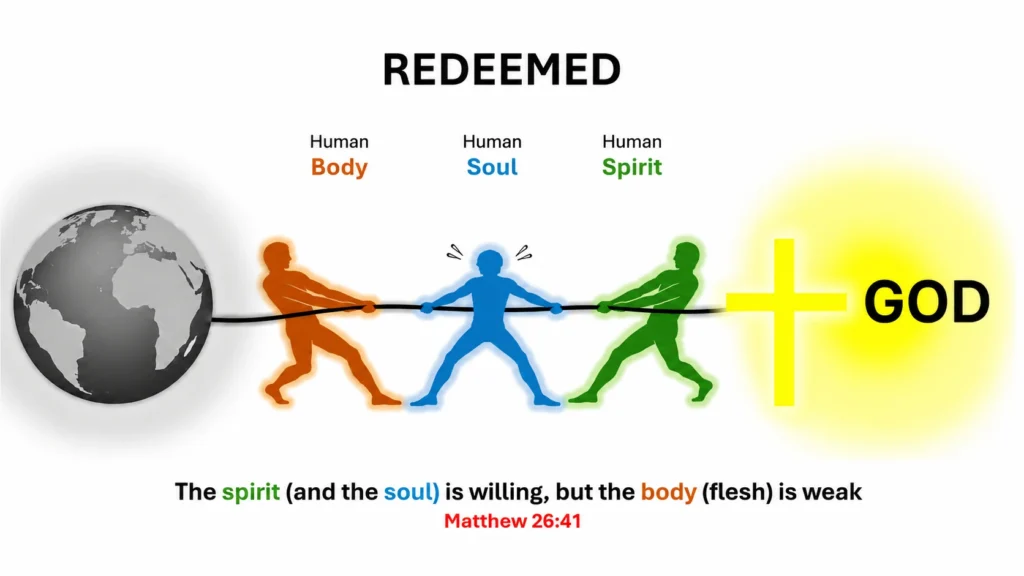
The struggle itself is evidence, not of spiritual failure, but of spiritual life. Before conversion there was no such conflict, for the spirit lay estranged from the life of God. Now, because the believer has been brought into communion with God through Christ, the struggle begins. This explains why sanctification is progressive. God has already declared the believer righteous because he is clothed in Christ. He now progressively conforms the believer to the image of His Son while he awaits the completion of salvation. Paul captures this tension beautifully when he writes, “Not that I have already obtained this or am already perfect, but I press on to make it my own, because Christ Jesus has made me His own.” (Philippians 3:12). Likewise, the writer of Hebrews declares, “For by a single offering He has perfected for all time those who are being sanctified.” (Hebrews 10:14)
Notice the glorious paradox. The believer has already been perfected in one sense because he stands clothed in the perfect righteousness of Christ. Yet he is simultaneously being sanctified as God prepares him for the day when redemption reaches its full completion.
- Our present righteousness is therefore both real and graciously imputed.
- Our future righteousness will be real, complete, and fully realized.
- Today we are accepted because we are clothed in Christ.
- Tomorrow we shall be perfected because we shall be united forever with the perfected Christ.
The believer therefore lives between two realities. He looks back to the Cross where redemption was accomplished. He looks upward to Christ in whom every spiritual blessing is found. And he looks forward to the day when faith shall become sight, sanctification shall give way to glorification, and what is now imputed shall be brought to its glorious completion.
For this reason, the Christian’s greatest hope is not merely forgiveness.
- Nor merely justification.
- Nor even sanctification.
- His hope is glorification.
For the work God began in redemption shall finally reach its appointed end when those who are in Christ are conformed perfectly to the image of the Son and forever share in His glorified humanity.
Reflection & Takeaway
Throughout this section we have seen that redemption is one of the greatest demonstrations of God’s wisdom, justice, mercy, grace, and love. Yet redemption itself was never God’s final destination. Rather, it is the indispensable means by which He accomplishes the eternal purpose He established before the foundation of the world.
We have seen why redemption was necessary. Because God is perfectly holy and perfectly just, He could not simply overlook sin. Justice demanded satisfaction. Yet because God is also perfect in love, mercy, and grace, He purposed from eternity to provide the very sacrifice His own justice required.
We have seen that this redemption required far more than the death of an innocent man. It required the eternal Son of God to enter His own creation as the Second Adam. Possessing both a complete divine nature and a complete human nature, Christ faithfully fulfilled the human vocation entrusted to Adam. He obeyed where Adam disobeyed. He trusted where Adam doubted. He remained faithful where Adam fell.
We have also seen that Scripture speaks of Christ being made perfect. This perfection did not concern His divine nature, for God is eternally perfect and cannot become more perfect than He already is. Rather, through His incarnation, suffering, obedience, sacrifice, death, and resurrection, Christ brought His incarnate human mission to its appointed completion. Having fulfilled everything the Father gave Him to accomplish, He became not only the Savior and Redeemer of mankind but also its Perfecter.
Through faith, believers are united with Christ. They are justified before God, clothed in Christ’s perfect righteousness, reconciled to the Father, adopted as His children, and brought into living communion with God through the indwelling Holy Spirit. These blessings belong to every believer because they are found in Christ.
Yet the believer’s present experience reminds us that God’s work is not yet complete.
- Although declared righteous, believers continue to struggle with sin.
- Although restored to fellowship with God, they still inhabit mortal bodies affected by the Fall.
- Although their human spirit has once again been brought into communion with God, the soul continues to experience the conflict between the desires of the flesh and the desires of the Spirit.
The believer therefore lives between two glorious realities.
- He looks back to the Cross, where redemption was accomplished once for all.
- He lives in the present, clothed in Christ’s righteousness and being progressively conformed to His image.
- And he looks forward with confident hope to the day when God’s work shall reach its glorious completion.
This distinction is essential.
- Redemption restores.
- Glorification perfects.
- Justification declares the believer righteous.
- Sanctification progressively transforms the believer.
- Glorification completes the purpose for which God created mankind from the beginning.
The first Adam was created very good according to God’s purpose for him, yet he was capable of falling. The Second Adam fulfilled God’s purpose for mankind through His perfect obedience and became the Perfecter of redeemed humanity.
Those who are united with Christ shall one day share fully in the perfected humanity of their risen Lord—not by becoming divine, but by being perfectly conformed to His glorified human nature through everlasting union with Him. Thus, redemption is not the conclusion of God’s eternal purpose. It is the bridge that leads to its consummation. The story that began in Genesis has not yet reached its final chapter.
- One glorious work still remains.
- The completion of salvation.
- The perfection of redeemed humanity.
- The New Creation.
Reflection: Redemption accomplished everything necessary to save mankind. Glorification will accomplish everything God intended mankind to become.