
Glorification of the Saints – The New Creation
Estimated time to read:
Read this article to me
The New Creation is Not Restoration, But Transformation
Having considered creation, the Fall, redemption, and salvation, an important question remains.
- What exactly has God accomplished through Jesus Christ?
- Has God merely restored mankind to the condition Adam enjoyed before the Fall?
- Is salvation simply God’s means of returning redeemed humanity to the Garden of Eden?
- If so, another question immediately presents itself.
- What would prevent history from repeating itself?
Adam was created without sin and declared by God to be “very good.” He lived in a tranquil garden upon a blessed earth, enjoyed unhindered fellowship with God, and lacked nothing necessary to fulfill God’s purpose for him. Yet Adam still chose unbelief and disobedience.
Nor was Adam’s failure an isolated event. The Book of Judges records Israel’s continual cycle of blessing, comfort, apathy, apostasy, bondage, repentance, deliverance, and restoration, only for the same cycle to begin again. Likewise, every dispensation recorded throughout Scripture demonstrates mankind’s repeated inability to remain faithful to God. Though God’s dealings with humanity differ throughout redemptive history, the outcome remains remarkably consistent. Left to himself, mankind continually falls short of God’s glory.
These observations should cause us to ask whether God’s ultimate purpose has ever been merely to restore mankind to Adam’s original condition.
Suppose, for a moment, that redemption simply returned mankind to the exact state Adam enjoyed before the Fall. Adam himself demonstrates that such a restoration, glorious though it would be, could never guarantee that another fall would not occur. History has already answered that question. Scripture therefore directs our attention toward something far greater than restoration.
The Apostle Paul writes, “Therefore, if anyone is in Christ, he is a new creation. The old has passed away; behold, the new has come.“ (2 Corinthians 5:17). Notice carefully what Paul does not say. He does not say believers have merely been restored. He says they have become a new creation.
Likewise, writing to the Galatians, Paul declares, “For neither circumcision counts for anything, nor uncircumcision, but a new creation.“ (Galatians 6:15). Again, the emphasis is not upon returning to what once existed, but upon something entirely new.
The Apostle John likewise looks beyond restoration. Writing concerning the future of God’s children, he says, “Beloved, we are God’s children now, and what we will be has not yet appeared; but we know that when He appears we shall be like Him, because we shall see Him as He is.“ (1 John 3:2). John acknowledges that believers are already God’s children, yet he also declares that God’s work in them has not reached its completion.
Something still awaits the people of God. The same expectation appears throughout the writings of Paul. Believers await:
- the redemption of their bodies,
- their heavenly inheritance,
- conformity to the image of Christ,
- glorification,
- and the revealing of the sons of God.
Each of these points forward rather than backward. They direct our attention:
- beyond forgiveness.
- Beyond justification.
- Beyond restoration.
- Toward a future work that God has purposed for all who belong to Christ.
This should not surprise us. From the opening pages of Scripture, God’s purposes unfold progressively. Creation unfolded in stages. Redemption likewise unfolds progressively. The first creation prepared the way for redemption. Redemption now prepares the way for something even greater.
Throughout this work we have repeatedly observed that God’s purposes always move forward rather than backward. Scripture never presents God’s plan as merely recovering what was lost in Eden. Rather, every major movement of redemptive history advances toward a glorious consummation that surpasses the beginning.
- The Garden of Eden was wonderful. Yet Scripture concludes not with another garden, but with a New Heaven and a New Earth.
- Adam walked with God. The redeemed will dwell with God forever.
- Adam possessed life that could be lost. The redeemed inherit life that is eternal and incorruptible.
- Adam was created very good according to God’s perfect purpose and design. The redeemed are promised conformity to Jesus Christ Himself.
These are not merely restored blessings. They are greater blessings. This observation should profoundly shape how we understand salvation itself.
- Forgiveness is glorious.
- Justification is glorious.
- Reconciliation is glorious.
- Adoption is glorious.
Yet none of these appears in Scripture as God’s final objective. Rather, each serves as a necessary step leading toward the consummation of His eternal purpose. Redemption should therefore never be viewed as the destination of God’s plan, but as the bridge leading to its fulfillment. The question is no longer whether God intends to do something greater than restore Eden. Scripture clearly indicates that He does.
- The question now becomes: What is this new creation?
- More specifically, What does it mean to be “in Christ”?
For it is only in Christ that the New Testament declares this new creation becomes a reality.
In Christ
Having established that God’s purpose is greater than merely restoring mankind to Adam’s original condition, we must now ask an even more important question. How does God accomplish this new creation?
The answer is found throughout the New Testament in one of its most repeated and profound expressions:
“In Christ.”
The significance of this phrase can scarcely be overstated.
- Believers are chosen in Christ.
- Redeemed in Christ.
- Justified in Christ.
- Sanctified in Christ.
- Made alive in Christ.
- Raised with Christ.
- Heirs with Christ.
- Glorified with Christ.
Again and again, the New Testament directs our attention away from ourselves and toward the person of Jesus Christ. Every spiritual blessing God has purposed for His people is found in union with His Son. This language is neither accidental nor merely poetic. It reveals the very heart of God’s eternal purpose.
The Christian life is never presented as an independent relationship in which forgiven sinners simply attempt to imitate Christ from a distance. Rather, believers are repeatedly described as being in Him, while Christ Himself dwells in them.
Jesus declared, “Abide in Me, and I in you. As the branch cannot bear fruit by itself, unless it abides in the vine, neither can you, unless you abide in Me.“ (John 15:4)
This illustration is both simple and profound. A branch possesses no independent life apart from the vine. Its life, nourishment, fruitfulness, and continued existence all depend upon its union with the vine. Likewise, the believer’s life is not self-generated. It is derived entirely from Christ.
The Apostle Paul expresses this truth with remarkable simplicity: “It is no longer I who live, but Christ who lives in me.“ (Galatians 2:20). Again, “Christ in you, the hope of glory.“ (Colossians 1:27). Notice carefully what Scripture emphasizes. Our hope is not merely that Christ died for us. Glorious though that truth is, Scripture goes further. It declares that Christ now lives in His people.
Likewise, Paul writes, “Anyone who does not have the Spirit of Christ does not belong to Him.“ (Romans 8:9). Again, “Because you are sons, God has sent the Spirit of His Son into our hearts…“ (Galatians 4:6).
These expressions deserve careful consideration. The New Testament presents something even greater. Believers are united with the risen and glorified Christ. This union is not a participation in His divine essence but a living union with the incarnate Son, whose perfected humanity has become the prototype of the new creation.. This distinction is vital.
Adam possessed a human spirit through which he enjoyed genuine fellowship and communion with God. Yet Adam remained a created being whose fellowship with God could be broken through unbelief and disobedience. The New Testament presents something greater. Believers are united with Christ Himself. Scripture clearly says that we will be united, in His body and His Spirit.
This does not mean that believers become Christ. Neither does it mean that believers become God, become gods, or somehow acquire God’s divine essence. Scripture teaches none of these things. The distinction between Creator and creature remains forever. God alone possesses life in Himself. God alone is eternal, self-existent, incorruptible, and inherently perfect. Everything created derives its existence and life from Him.
It is Christ’s perfected human body and spirit in which we will be united and of which we will be partakers. Notice that Scripture never says believers will be united to Christ’s soul. The soul is where personhood resides, and we will not become the person of Christ. Nor will we possess two natures—one human and one divine—like Christ. Rather, we will be partakers and sharers of Christ’s human nature, and partakers of His intimate relationship with the Father.
Through union with Christ, believers participate in blessings that could never belong to them apart from Him. Paul writes that we are “heirs of God and fellow heirs with Christ.“ (Romans 8:17). Peter declares that believers become “partakers of the divine nature.“ (2 Peter 1:4).
I believe however this expression should not be understood to mean that believers become divine in essence or share God’s incommunicable attributes. Rather, through union with Christ, believers participate in the life God graciously imparts through His Son while forever remaining creatures. It is because we are united with the incarnate, risen, and glorified Christ that we share in everything He accomplished as the Second Adam.
John writes, “…when He appears we shall be like Him, because we shall see Him as He is.“ (1 John 3:2). Paul likewise declares, “…who will transform our lowly body to be like His glorious body.“ (Philippians 3:21). Notice carefully what Paul says. Our lowly body is transformed to be like His glorious body. The pattern is not His divine nature but His glorified humanity. The resurrected body of Christ is the firstfruits and prototype of the redeemed humanity God has purposed from the beginning. Through union with the glorified Man, believers are conformed to His perfected human nature while forever worshipping Him as the eternal Son of God.
Notice the pattern.
- Every promise is centered upon Christ.
- Every blessing flows through Christ.
- Every future hope is realized in Christ.
- Nothing is accomplished apart from Him.
The New Testament employs several illustrations to reinforce this truth.
- Christ is the Vine.
- Believers are the branches.
- Christ is the Head.
- The Church is His Body.
- Christ is the Bridegroom.
- The Church is His Bride.
Though each illustration differs, every one teaches the same reality. The redeemed are inseparably joined to Jesus Christ. This union is not merely positional.
- It is living.
- It is personal.
- It is eternal.
Indeed, it is the foundation upon which every aspect of the believer’s future hope rests.
- It is because we are in Christ that we are justified.
- It is because we are in Christ that we receive eternal life.
- It is because we are in Christ that we are called sons and daughters of God.
- It is because we are in Christ that we shall be glorified.
Everything God has purposed for redeemed humanity is found in His Son. The New Testament therefore presents Christ not merely as the means by which sins are forgiven, but as the very sphere in which God’s eternal purpose is accomplished. The question is no longer whether believers are united with Christ. Scripture repeatedly declares that they are.
The remaining question is this: Why is this union so essential to God’s ultimate purpose? Why does Scripture continually direct our attention to being in Christ rather than simply being restored to what Adam once possessed?
The answer leads us to the climax of God’s redemptive plan. It is through union with Christ that God accomplishes what the first creation alone never could.
Perfected Through Union with Christ
Throughout this work we have followed the progressive unfolding of God’s eternal purpose.
- We observed that mankind was created in the image of God.
- We saw that Adam’s unbelief and disobedience brought corruption, separation, and death into the human race.
- We saw that redemption through Jesus Christ reconciles fallen mankind to God.
Yet one important question still remains.
If Adam himself, though created without sin and declared “very good,” nevertheless fell from his original condition, what assurance is there that redeemed mankind would not simply repeat the same tragedy if restored to Adam’s original state?
Scripture’s answer is both profound and glorious. God’s eternal purpose has never been merely to restore mankind to what Adam once possessed. Rather, He is bringing redeemed mankind into something infinitely greater through His Son.
Earlier in this work we observed that Adam possessed a human spirit through which he enjoyed genuine fellowship and communion with God. Yet Adam remained a created being. His fellowship with God, though real, could nevertheless be broken through unbelief and disobedience.
The New Testament now reveals something far greater. It repeatedly speaks, not merely of fellowship with Christ, but of believers being in Christ, Christ being in them, and believers possessing the Spirit of Christ.
This distinction should not be overlooked. Jesus Himself prayed, “I do not ask for these only, but also for those who will believe in Me through their word, that they may all be one, just as You, Father, are in Me, and I in You, that they also may be in Us… I in them and You in Me, that they may become perfectly one.“ (John 17:20–23)
Likewise Paul declares, “Christ in you, the hope of glory.“ (Colossians 1:27). Again, “Anyone who does not have the Spirit of Christ does not belong to Him.“ (Romans 8:9). And again, “Because you are sons, God has sent the Spirit of His Son into our hearts…“ (Galatians 4:6)
The language of Scripture is unmistakable. Adam possessed a human spirit through which he communed with God. The redeemed are said to possess the Spirit of Christ. This does not mean that believers become Christ. Neither does it mean that they become God, become gods, or somehow partake of God’s divine essence. Scripture teaches none of these things. The New Testament repeatedly speaks of believers possessing the Spirit of Christ, Christ dwelling in them, and believers abiding in Him. This language does not suggest that believers become divine or are absorbed into God’s essence. Rather, it describes the living union established by the Holy Spirit between redeemed humanity and the risen Christ. Because the One to whom believers are united is the incarnate Son whose humanity has been perfected and glorified, His perfected humanity becomes both the pattern and the destiny of all who belong to Him.
The distinction between Creator and creature remains forever. God alone possesses life in Himself. God alone is eternal, self-existent, incorruptible, and inherently perfect. Everything created derives its existence and life from Him.
Yet Scripture also reveals that through union with Christ believers participate in blessings that could never belong to them apart from Him. Paul declares that believers are “heirs of God and fellow heirs with Christ.“ (Romans 8:17). Peter writes that we become “partakers of the divine nature.“ (2 Peter 1:4). John declares, “…when He appears we shall be like Him…“ (1 John 3:2). Paul adds, “…who will transform our lowly body to be like His glorious body…“ (Philippians 3:21).
Notice what every one of these passages has in common.
- Every blessing is found in Christ.
- Every promise is fulfilled in Christ.
- Every future hope is realized in Christ.
- Nothing is accomplished apart from Him.
Earlier we observed that Adam’s sin brought separation between God and mankind. The human spirit no longer functioned according to God’s original design, and the soul increasingly looked to the body and its physical senses for its perception of reality.
The New Testament presents the exact opposite movement. Through the indwelling Spirit of Christ, the believer is progressively transformed as the soul once again learns to walk according to the Spirit rather than according to the flesh. This work begins in salvation and continues throughout sanctification.
Yet even sanctification is not God’s final purpose. Scripture continually directs our attention beyond the present life. Paul writes that believers have been “predestined to be conformed to the image of His Son.“ (Romans 8:29). Notice the goal:
- Not merely forgiveness.
- Not merely justification.
- Not merely restoration.
- But conformity to Jesus Christ.
At this point it is important to recognize a principle that has guided this work from the beginning. Scripture often reveals what God has done without fully explaining how He has done it. For example, the opening words of Genesis simply declare, “In the beginning God created the heavens and the earth.“ (Genesis 1:1)
Scripture plainly reveals that God created all things ex nihilo—out of nothing. Yet it nowhere attempts to explain the infinite mechanics by which the eternal God brought the universe into existence by His word. The process itself remains beyond human comprehension. The fact that God created all things does not. The same principle appears throughout Scripture.
- We know that Christ was conceived by the Holy Spirit and born of a virgin.
- We know that Christ was raised from the dead in a glorified body.
- We know that believers will likewise be raised and transformed.
Scripture clearly reveals these truths, even though it does not explain the infinite manner by which God accomplishes them. The same is true concerning glorification.
Scripture repeatedly declares that believers are in Christ, that Christ dwells in them, that they possess the Spirit of Christ, that they will be conformed to His image, and that they will become a new creation in Him.
These truths are not speculative. They are the plain testimony of Scripture. Exactly how God accomplishes this glorious union has not been fully revealed. That mystery belongs to God. What has been revealed belongs to us.
Therefore, our confidence rests not in our ability to explain the infinite workings of God, but in the certainty of what God has promised. Just as we confidently affirm that God created the heavens and the earth ex nihilo without fully comprehending how He accomplished that work, so we likewise affirm that God will perfect His redeemed people through eternal union with Jesus Christ, even though the glorious mechanics of that transformation remain beyond our present understanding. Everything now begins to converge:
- Creation pointed forward to Christ.
- The Fall revealed mankind’s need for Christ.
- Redemption was accomplished by Christ.
- Salvation brings us to Christ.
- Sanctification conforms us to Christ.
Finally, God’s eternal purpose reaches its glorious consummation as redeemed mankind is perfected through eternal union with Christ.
- The redeemed will forever dwell in Christ,
- Christ will forever dwell in them.
Through this eternal union, believers shall share in His glorified human life while forever worshipping Him as the eternal Son of God. The distinction between Creator and creature remains eternal, yet the communion between Christ and His redeemed people will never again be broken.
The redeemed will not merely possess the communion with God that Adam once enjoyed. They will forever be united with Jesus Christ. It is this union—not merely restoration—that accomplishes what the first creation alone never could. It is this union that forever secures redeemed mankind against another fall. It is this union that fulfills God’s eternal purpose.
Christ the Perfecter
Having seen that every blessing of salvation is found in Christ, we must now ask how Christ becomes the One through whom redeemed humanity is perfected.
Scripture is careful to teach that Jesus Christ is truly God and truly man. As God, He possesses absolute perfection eternally. His divine nature needed no improvement, no completion, no correction, and no maturing. God cannot become more perfect than He already is, for perfection belongs inherently to His very nature.
Therefore, when Scripture speaks of Christ being made perfect, it must not be understood as though He were ever morally flawed or deficient in His deity. The perfection spoken of concerns His incarnate mission as the Son of Man. The eternal Son of God became man, entered the conditions of our existence, suffered, obeyed, died, and rose again, thereby fully completing the work the Father had given Him to accomplish.
The writer of Hebrews declares:
“For it was fitting that He, for whom and by whom all things exist, in bringing many sons to glory, should make the founder of their salvation perfect through suffering.” (Hebrews 2:10) Again: “Although He was a Son, He learned obedience through what He suffered. And being made perfect, He became the source of eternal salvation to all who obey Him.” (Hebrews 5:8–9)
These passages do not suggest that Christ moved from sinfulness to holiness. Rather, they teach that through His suffering and obedience, Christ became the perfectly qualified Redeemer, Mediator, High Priest, Sacrifice, and Savior of His people.
He became what we are in order to redeem what we are.
He entered our humanity in order to perfect humanity in Himself.
As the Second Adam, Christ submitted to every condition necessary to faithfully represent mankind. He was tempted, yet without sin. He suffered, yet remained obedient. He died, yet conquered death. Through His incarnation, obedience, suffering, sacrifice, resurrection, and exaltation, He brought His redemptive mission to its appointed completion.
Christ is therefore not merely the One who forgives. He is the One who perfects. He is the One who glorifies.
The same book of Hebrews declares: “For by a single offering He has perfected for all time those who are being sanctified.” (Hebrews 10:14)
This verse beautifully holds together the believer’s present standing and ongoing transformation. In Christ, believers have been perfected in the sense that His completed sacrifice fully secures their acceptance before God. Yet they are also “being sanctified,” showing that God’s work in them continues until final glorification.
Christ is both the perfected Redeemer and the Perfecter of the redeemed.
- He is the perfect Prophet, revealing God fully.
- He is the perfect Priest, offering the perfect sacrifice.
- He is the perfect King, ruling in righteousness.
- He is the perfect Sacrifice, without spot or blemish.
- He is the perfect Mediator, truly God and truly man.
- He is the perfect Savior, able to save completely those who draw near to God through Him.
This truth is central to the doctrine of glorification. Redeemed humanity is not perfected independently of Christ. Nor is mankind perfected by returning to Adam’s original condition. Mankind is perfected only in the One who first entered our humanity and brought it to completion through perfect obedience.
- The first Adam failed in a garden.
- The Second Adam triumphed through suffering.
- The first Adam brought corruption and death.
- The Second Adam brings righteousness and life.
- The first Adam showed that created goodness could fall.
- The Second Adam reveals that perfected humanity is found only in union with Himself.
This is why Christ is not merely the beginning of salvation but also its goal. He does not simply rescue sinners from judgment; He brings them into the perfection God purposed for them from the beginning.
Paul writes: “Not that I have already obtained this or am already perfect, but I press on to make it my own, because Christ Jesus has made me His own.” (Philippians 3:12)
Paul understood that salvation had already begun, but its completion still lay ahead. He belonged to Christ, yet he still pressed forward toward the goal. Present maturity pointed toward future perfection.
That future perfection is not achieved by human effort. It is accomplished by Christ, in Christ, and through Christ.
- He became man so that mankind could be redeemed.
- He suffered so that mankind could be restored.
- He obeyed so that mankind could be represented.
- He died so that mankind could be forgiven.
- He rose so that mankind could receive life.
He was perfected in His incarnate mission—not because His deity lacked perfection, but because the humanity He assumed faithfully completed the vocation entrusted to the Second Adam. Having brought His humanity through perfect obedience, suffering, sacrifice, death, resurrection, and glorification, He now becomes the Perfecter of all who are united to Him. Believers are therefore perfected, not by participation in His divine nature, but by everlasting union with the glorified humanity of the risen Christ.
Therefore, the believer’s hope is not merely that Christ has done something for him, but that Christ will complete something in him. The perfected Redeemer is also the Perfecter of all who belong to Him.
This prepares us to understand the final question. If Christ is the perfected Redeemer and the Perfecter of His people, how does He bring redeemed humanity into the perfection God has purposed?
The answer is found in eternal union with Christ.
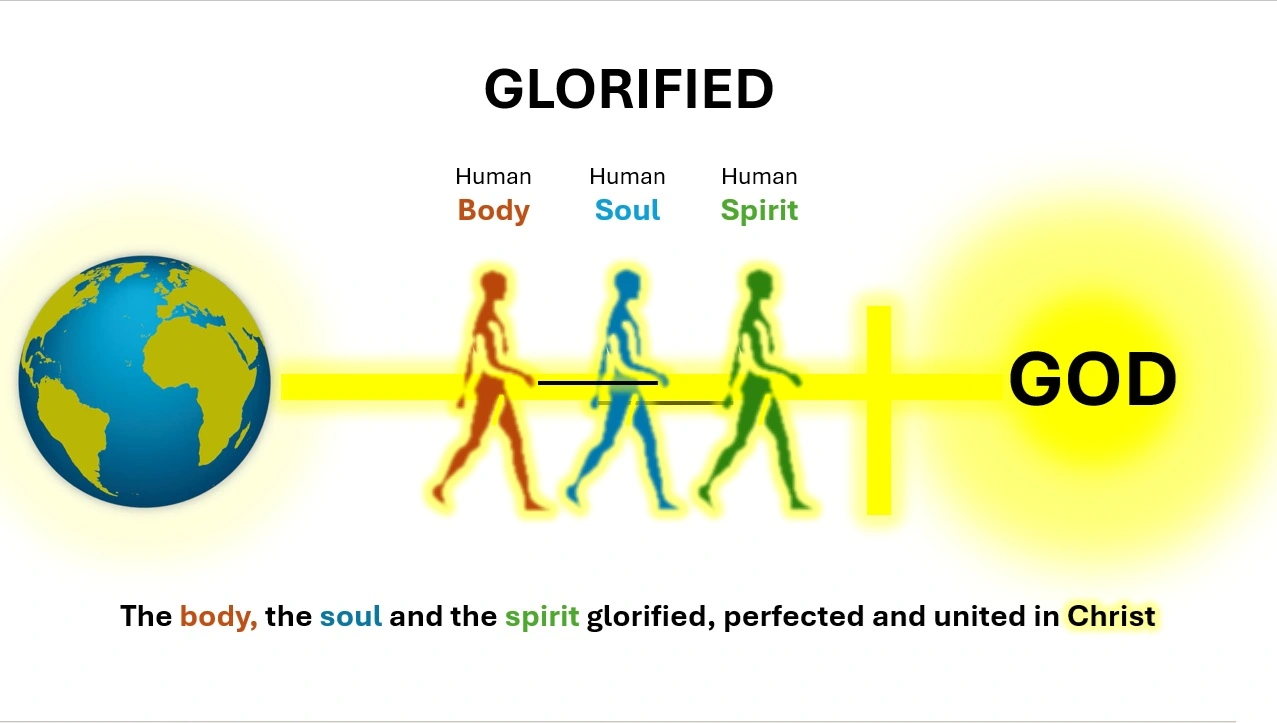
Prepared for His Presence, To See His Full Glory
Throughout this work we have traced the unfolding of God’s eternal purpose from creation to glorification. We have seen that mankind was created in the image of God, that sin brought corruption and separation, that redemption was accomplished through Jesus Christ, and that God’s ultimate purpose extends far beyond merely restoring mankind to Adam’s original condition.
One final question now remains. Why has God done all of this?
- Why create?
- Why allow the Fall?
- Why redemption?
- Why the incarnation?
- Why the Cross?
- Why sanctification?
- Why glorification?
Scripture’s answer is remarkably consistent. From beginning to end, God has been preparing a redeemed people to dwell forever in His presence through His Son. This truth begins to emerge even in the earliest pages of Scripture. When Moses desired to behold God’s glory, the Lord replied, “You cannot see My face, for man shall not see Me and live.“ (Exodus 33:20).
God’s holiness was never the problem. Mankind was. The limitation did not lie in God’s willingness to reveal Himself but in mankind’s inability to stand in the fullness of His unveiled presence.
The same truth appears throughout the Old Testament. The tabernacle and later the temple were carefully designed around separation. The Most Holy Place remained hidden behind a veil. Only the high priest could enter. Only once each year. Only with sacrificial blood.
Every aspect of Israel’s worship testified that sinful mankind could not freely dwell in the immediate presence of a perfectly holy God. Yet even there, God was revealing something greater. The veil was never intended to be permanent. It pointed forward to Christ.
When Jesus gave His life upon the Cross, “The curtain of the temple was torn in two, from top to bottom.“ (Matthew 27:51). Access to God had been opened. Yet even this was not the end. The tearing of the veil marked the beginning of something far greater. The Apostle Paul writes, “For now we see in a mirror dimly, but then face to face. Now I know in part; then I shall know fully, even as I have been fully known.“ (1 Corinthians 13:12). Likewise John declares, “Beloved, we are God’s children now, and what we will be has not yet appeared; but we know that when He appears we shall be like Him, because we shall see Him as He is.“ (1 John 3:2).
These promises reveal the glorious destiny awaiting every believer. The redeemed are not merely forgiven. They are not merely justified. They are not merely restored.
They are being prepared for something infinitely greater. The humanity that once could not behold God’s unveiled glory without perishing shall, through union with the glorified Christ, be perfectly fitted to dwell forever in the full presence and full glory of God.
This, I believe, helps explain the entire movement of redemptive history.
- Adam enjoyed fellowship with God. The glorified believer will dwell forever in God’s unveiled presence.
- Adam possessed life that could be lost. The redeemed receive life that can never perish.
- Adam walked with God. The redeemed will reign with Christ.
- The first creation revealed God’s wisdom. The new creation reveals the fullness of His wisdom, His justice, His mercy, His grace, and His love.
Earlier in this work we observed that Scripture frequently reveals what God has accomplished without fully explaining how He accomplishes it. The same principle applies here. Scripture clearly teaches that redeemed believers will be conformed to the image of Christ, that they will become a new creation, that they will possess the Spirit of Christ, and that they will dwell forever in His presence.
Exactly how God accomplishes this glorious transformation has not been fully revealed. That mystery belongs to Him. What He has revealed is sufficient.
Just as Scripture simply declares that God created the heavens and the earth ex nihilo without explaining the infinite mechanics of creation, so Scripture declares that redeemed humanity will be glorified in Christ without fully explaining the infinite manner by which God accomplishes that work.
Faith therefore rests, not upon complete explanation, but upon the certainty of God’s promises. The final pages of Scripture reveal the glorious fulfillment of those promises. John writes, “Behold, the dwelling place of God is with man. He will dwell with them, and they will be His people, and God Himself will be with them as their God.“ (Revelation 21:3). Again, “They will see His face…“ (Revelation 22:4).
The significance of these words should not be overlooked.
The Bible begins with mankind walking in fellowship with God. It ends with redeemed humanity dwelling forever in His immediate presence. The separation introduced by sin has forever disappeared. The veil is gone. Death is gone. The curse is gone. Sin is gone. Nothing remains to separate God from His redeemed people.
The believer will not merely survive in God’s presence. He will rejoice in it forever. Here, at last, God’s eternal purpose reaches its glorious consummation. Creation has become the new creation. Redemption has accomplished its purpose. Glorification is complete. The Bride is united with her Bridegroom.
Christ is all in all.
The redeemed behold the glory of God—not from afar, not dimly, not through shadows and types, but face to face. Everything that began in Genesis now finds its fulfillment in Jesus Christ. God’s eternal purpose has reached its glorious completion. Believers are not glorified by becoming participants in Christ’s deity. They are glorified through everlasting union with the glorified and perfected humanity of the incarnate Son, who remains forever one Person possessing both a complete divine nature and a complete human nature.
Key Takeaways
- God’s eternal purpose was never merely to restore Eden.
- Christ is both the Perfecter and the believer’s perfection.
- Union with Christ accomplishes what the first creation alone never could.
- Redemption reaches its consummation in glorification.
- God’s purpose culminates in redeemed humanity dwelling forever in His presence.
- The new creation fulfills God’s eternal purpose.
Looking Ahead
Rather than another doctrine, the reader is now invited simply to behold the unity and beauty of God’s completed work.
Epilogue
The Beginning and the End
The opening pages of Scripture record the beginning of creation. The closing pages reveal its glorious consummation. Between those two bookends unfolds one continuous story. Not the story of man’s search for God. But the story of God’s eternal purpose accomplished through His Son.
In the beginning, God created the heavens and the earth. In the end, He reveals a new heaven and a new earth.
In the beginning, darkness covered the deep. In the end, “night will be no more.”
In the beginning, God planted a garden. In the end, He reveals a holy city descending from heaven.
In the beginning, mankind walked with God. Then sin brought fear. Shame. Separation. Death. Adam hid among the trees of the garden. In the end, the redeemed hide no longer. “They will see His face.”
In the beginning, cherubim guarded the way to the Tree of Life. In the end, the Tree of Life stands freely accessible to all who belong to Christ.
In the beginning, the ground was cursed because of sin. In the end, “No longer will there be anything accursed.”.
In the beginning, death entered the world through one man. In the end, “Death shall be no more.”
In the beginning, sorrow began. In the end, “He will wipe away every tear from their eyes.”
In the beginning, the Creator walked among His creation. In the fullness of time, the Creator entered His creation. In the end, God dwells forever with His redeemed people.
The story that began in Genesis was never simply about creation. Neither was it merely about the Fall. Nor only about redemption. Every page has pointed toward Jesus Christ.
- He is the Creator.
- He is the promised Seed.
- He is the Lamb.
- He is the Second Adam.
- He is the Redeemer.
- He is the Bridegroom.
- He is the Head of the Church.
- He is the Firstborn of the New Creation.
- He is the Alpha and the Omega.
- The Beginning and the End.
Throughout this work we have sought to follow the unfolding of God’s eternal purpose.
- We observed that mankind was created in the image of God.
- We observed that creation, though declared “very good,” was never the final destination of God’s purpose.
- We observed that Adam’s fall revealed the inability of anything less than God’s own perfection to remain forever secure.
- We observed that redemption through Christ did far more than merely restore what had been lost.
It opened the way for something entirely new.
- The believer is not merely forgiven.
- He is not merely justified.
- He is not merely restored.
- He is being conformed to Christ.
- He is becoming a new creation.
- He is being prepared for everlasting union with the Son of God.
The purpose has always been Christ.
- Election is in Christ.
- Redemption is through Christ.
- Sanctification is by Christ.
- Glorification is with Christ.
- The consummation is the Bride united to Christ.
From beginning to end, everything finds its meaning in Him.
One day faith shall become sight.
Hope shall give way to fulfillment.
The work God began will be complete.
The redeemed shall stand before Him—not because they have attained perfection by their own merit, but because God has perfected them in His Son. Then the words spoken by the Apostle Paul shall reach their fullest realization: “For now we see through a glass, darkly; but then face to face. Now I know in part; then shall I know fully, even as I have been fully known.“ (1 Corinthians 13:12).
And the promise given to the Apostle John shall likewise be fulfilled: “Beloved, we are God’s children now, and what we will be has not yet appeared; but we know that when He appears we shall be like Him, because we shall see Him as He is.“ (1 John 3:2)
Finally, the voice from heaven will proclaim the glorious fulfillment of God’s eternal purpose: “Behold, the dwelling place of God is with man. He will dwell with them, and they will be His people, and God Himself will be with them as their God.“ (Revelation 21:3)
Then shall every purpose of God stand complete. The Bride shall dwell forever with her Bridegroom. The glory of God shall fill all things. Christ shall be all in all. And the story that began with, “In the beginning…” shall never end.