
Glorification of the Saints – Fall of Man
Estimated time to read:
Read this article to me
THE FALL OF MAN
Having become God’s adversary, Lucifer now became known as Satan, the devil and or the evil one who, in the futility of his rebellion against God, was cast out of heaven and confined to the earth along with those angels who followed him. Jesus Himself testified to this event, declaring, “I saw Satan fall like lightning from heaven.“ (Luke 10:18)
The details of that fall are revealed more fully in passages such as Isaiah 14, Ezekiel 28, and Revelation 12, which together describe Satan’s rebellion against God and his expulsion from the heavenly realm. Having become God’s adversary, Satan entered God’s newly created world, appearing in the Garden of Eden in the form of a serpent—not merely to deceive mankind, but to oppose God’s purposes by corrupting the very creature created in His image.
Yet before Satan ever entered the Garden, God had already prepared the means by which Adam and Eve could exercise the moral agency He had entrusted to them. By creating the Tree of the Knowledge of Good and Evil and commanding Adam and Eve not to eat of its fruit lest they die, God provided them with the opportunity to exercise moral agency. The forbidden tree served as both the means and the mechanism by which God enabled them to demonstrate obedience or disobedience. It gave them the capacity—and therefore the responsibility and accountability—to freely choose between doing what was right and doing what was wrong.
While it may be said that God created the potentiality for Adam and Eve to disobey, He did not create the necessity of their disobedience. Nor did He tempt, compel, coerce, or cause them to sin. Rather, as moral agents created in God’s image, Adam and Eve possessed the ability to make genuine choices and were therefore fully responsible and fully accountable for the actions they freely chose to take.
God had provided them the option, the awareness (and even warning) of the option, and therefore the ability (God enabled them) to freely act in obedience or to freely act in disobedience, and sin. Thus, while God created the potentiality for Man to act in sin, never did He necessitate, nor did He cause Man to act in sin. It was by Adam and Eve’s disobedient and free action, (not God’s) that they brought the catastrophic consequences of corrupted physical and spiritual natures, death, a cursed world, and separation from God, not only upon themselves but that has ever since, been visited upon, and inherited by all of Adam’s posterity, each born with the propensity to commit sin and fall under judgement and penalty of sin.
The act of eating the forbidden fruit from the Tree of the Knowledge of Good and Evil is commonly referred to as the original sin. Yet this act involved more than the violation of a single command. In that same moment, Adam and Eve also failed in the responsibility God had entrusted to them from the beginning. God had given mankind dominion over the earth and commanded them to “subdue it“ and exercise authority over every living thing that moved upon it (Genesis 1:26–28).
When Satan entered the Garden in the form of the serpent, he did so as a rebel already judged in heaven and now in open defiance of God’s authority upon the earth. Adam and Eve were therefore confronted not merely by a talking serpent, but by God’s adversary himself. They were not simply called to resist temptation; they had already been entrusted with dominion over the earth and over every living creature that moved upon it. The serpent, being one of those creatures within the created order, fell within the authority God had already delegated to mankind “subdue … every living thing that moved …“.
The serpent therefore fell within the scope of that God-given dominion in which Adam should have exercised the authority entrusted to him by subduing rather than submitting to him. Yet this authority was never intended to rest in Adam’s own human strength. Created a little lower than the angels (Hebrews 2:7–9), Adam was naturally no match for Satan. His ability to subdue the serpent was never to be found in the power of his humanity, but in the power, authority, blessing, and ordination of God.
Throughout Scripture, God consistently chooses what the world considers weak in order to display the greatness of His own power. Adam was of no exception. As the Apostle Paul writes, “God chose what is weak in the world to shame the strong” (1 Corinthians 1:27–29). Gideon conquered the Midianites with only three hundred men. David, a shepherd boy, defeated Goliath. Jehoshaphat prevailed through worship rather than military might.
Likewise, when the seventy-two disciples returned rejoicing, they acknowledged that “even the demons are subject to us in Your name” (Luke 10:17). Their authority did not reside in themselves but in the One who had sent them. Adam stood in the same position. His victory over the serpent was never to be achieved through his own strength, but through complete dependence upon the God who had entrusted him with dominion. This is why Jesus said: Luke 10:18-19 ESV “… ‘I saw Satan fall like lightning from heaven. [19] Behold, I have given you authority to tread on serpents and scorpions, and over all the power of the enemy, and nothing shall hurt you‘“. In other words, Jesus was saying that Adam had at one time been given that same authority, it was not new.
However, instead of exercising that God-given authority and rejecting the serpent’s deception, Adam and Eve submitted themselves to him. Rather than ruling over the creature as God’s appointed vice-regents, they allowed the creature—and the adversary working through it—to rule over them. As Genesis records, the serpent said, “You will not surely die. For God knows that when you eat of it your eyes will be opened, and you will be like God, knowing good and evil.” (Genesis 3:4–5). Enticed by the serpent’s words, Eve took of the fruit and ate, and Adam, who was with her, likewise ate in direct violation of God’s command.
In disobeying God, Adam and Eve became like Satan in the very thing that defined his rebellion: unbelief and disobedience toward God. Instead of ruling over the serpent, they allowed the serpent to rule over them. Instead of exercising dominion, they surrendered it. Instead of standing in freedom under God, they entered into bondage through sin. In yielding to the serpent rather than ruling over him, Adam and Eve abandoned the role God had appointed for them. The Fall, therefore, was not merely the breaking of a commandment, but also the forfeiture of a responsibility. The very authority they were created to exercise under God was surrendered through unbelief and disobedience.
Satan did not overpower Adam by force, nor did he possess the authority to bind him against his will. Adam and Eve voluntarily surrendered the position God had given them through their own disobedience. The serpent’s weapon was deception; his power lay in temptation. Satan merely presented the temptation. Adam and Eve bound themselves by willingly rejecting God’s command and eating from the tree of the knowledge of good and evil (Genesis 2:17).
Thus, the Fall was not the result of Satan conquering Adam through superior power or authority, but of Adam relinquishing through unbelief and disobedience the authority God had entrusted to him. Adam’s defeat was not imposed upon him—it was self-inflicted.
A Bad Decision Despite Good Intention Remains A Bad Decision
While we should take lessons from Adam and Eve, we should not judge them. It is important to understand that neither Adam nor Eve were deceitful, malicious, or possessed sinful intentions prior to disobeying God’s command concerning the Tree of the Knowledge of Good and Evil.
Eve did not desire wickedness; she desired wisdom. Yet there is nothing inherently sinful in desiring to be wise like God. Indeed, throughout Scripture God’s people are encouraged to seek wisdom, and wisdom itself is repeatedly presented as a virtue rather than a vice. Nor did the serpent promise Eve that she would become God. Rather, he promised that she would be “like God, knowing good and evil“ (Genesis 3:5). Likewise, Eve never expressed a desire to be God, but only that the tree “was to be desired to make one wise“ (Genesis 3:6).
If the mere desire to be wise like God were itself sinful, then Eve would necessarily have become sinful before eating the forbidden fruit. Likewise, if the desire to be like God were inherently evil, then mankind would never have been created in the image and likeness of God (Genesis 1:26–27). Such conclusions are not only contrary to the testimony of Scripture but they also defer from the lesson to be learned from it.
The sin, did not lie in Eve’s desire for wisdom, but in the means by which she chose to obtain it. Rather than trusting – having faith – in God’s wisdom and obeying His command, she sought wisdom through an act of disobedience. Thus, the Fall teaches an enduring principle: a bad decision made even with the best of intention is still a bad decision. A person may sincerely desire something that is good, noble, and even God-honoring, yet if that desire is pursued contrary to God’s revealed will, the decision remains a bad decision. Good motives cannot sanctify disobedience, nor can noble intentions transform what God has declared wrong into something right.
One of the great tragedies of the Fall is that Adam and Eve were not driven by hatred for God or by a desire for evil. Rather, they were deceived into believing that a good end could be obtained through the wrong means. Their intentions may well have seemed reasonable, but sincerity does not determine righteousness—God’s Word does. A decision made contrary to God’s revealed will remains a bad decision regardless of how sincere, noble, or well-intentioned the motive behind it may be. In the end, it was not their desire for wisdom that condemned them, but their unbelief – their lack of faith in the words of God – expressed through the willful act of disobeying the command of God.
THE CATASTROPHE OF THE FALL
The tragedy of the Fall should never be minimized to the mere act of eating forbidden fruit. The fruit itself possessed no mystical power. Rather, it was Adam and Eve’s unbelief and disobedience toward God that brought about the true catastrophe.
When Adam and Eve sinned, they did not simply become guilty before God. Sin affected every aspect of their being. Their fellowship with God was broken. Their thoughts, desires, affections, and actions became corrupted. The harmony that had existed between body, soul, and spirit was profoundly altered. Spiritual death entered the human race, and with it came corruption, suffering, and physical death.
The consequences of the Fall therefore extended far beyond the Garden of Eden. Every descendant of Adam would thereafter be conceived into a world already under the curse of sin, inheriting a corrupted nature while living amid the sorrow, suffering, injustice, and death that consequently accompanies separation from God.
Like a Hereditary condition – emphasizing a consequential condition that is passed from parent to child, sin is an inherited (consequential) condition of corruption that is most commonly understood to be passed to the child through the seed of the male human parent. Just as a child may inherit a genetic condition from his parents without having personally caused it, so every descendant of Adam inherits the corruption of humanity’s fallen – sinful – condition without having personally committed Adam’s sin.
Personal guilt, however, arises when each morally accountable individual willingly acts in unbelief and disobedience toward God. Thus, inherited corruption explains why every accountable person sins, while personal guilt explains why every accountable person stands accountable before God.
It is important to understand the progression of moral accountability:
- God created mankind in His image and likeness, giving him moral agency—the God-given ability and responsibility to respond to God’s revelation through obedience or disobedience.
- With moral agency comes responsibility, for every moral agent has a duty to respond rightly to the revelation and commands of God.
- God’s commandments establish accountability by defining both His righteous standard and mankind’s obligation to obey it.
- Temptation presents the opportunity to choose, but it does not compel the choice.
- Satan is guilty of tempting mankind, but he is not guilty of mankind’s sin.
- Adam was guilty of his own sin because he willingly responded to Satan’s temptation with unbelief and disobedience.
- Every descendant of Adam inherits a corrupted (sinful) nature that separates mankind from God, but the inherited sinful nature itself does not constitute personal guilt.
- Personal guilt is incurred when a morally accountable individual falls short of God’s glory through his own sins of commission or omission.
- Thus, corruption is inherited; guilt is personal.
- Corruption brings separation from God, Guilt brings judgement from God.
- With guilt comes liability—the obligation to answer before God’s righteous judgment and to bear the just penalty for sin.
- Thus, corruption is inherited; guilt is personal. Responsibility arises from moral agency, accountability is established by God’s commandments, and liability follows when those commandments are knowingly violated.
God created mankind with moral agency. Moral agency brings responsibility. Responsibility under God’s commandments establishes accountability. Accountability, when violated through unbelief and disobedience, results in guilt. Guilt incurs liability before God’s justice, and liability demands a just penalty. This is precisely why mankind cannot redeem himself and why redemption through Jesus Christ became necessary.
Spiritual Death & Separation From God
Before Adam sinned, God warned him: “…for in the day that you eat of it you shall surely die.“ (Genesis 2:17, ESV). Yet Adam did not die physically on that very day. He continued living for many centuries before eventually experiencing physical death.
This immediately raises an important question. In what sense did Adam die on the very day he sinned?
Scripture consistently answers that question by describing fallen mankind as spiritually dead.
Paul writes: “And you were dead in the trespasses and sins…” (Ephesians 2:1, ESV)
Likewise, “…even when we were dead in our trespasses, made us alive together with Christ…” (Ephesians 2:5, ESV).
This death should not be understood as the annihilation of the human spirit. Neither should it be understood to mean that mankind ceased bearing the image of God. Rather, it describes the loss of the living fellowship with God for which mankind’s spirit had originally been created.
Isaiah describes the same reality when he writes: “Your iniquities have made a separation between you and your God…” (Isaiah 59:2, ESV). The separation was spiritual, the human spirit that had once enjoyed unhindered communion with God was broken. It no longer functioned according to God’s original design and the authority that they were to exercise under His rule was surrendered.
Reversal of God’s Design
With that separation came the loss of mankind’s living fellowship with God. Although man’s spirit continued to exist, it was no longer in communion with the One from whom it was created to receive life, truth, wisdom, and direction.
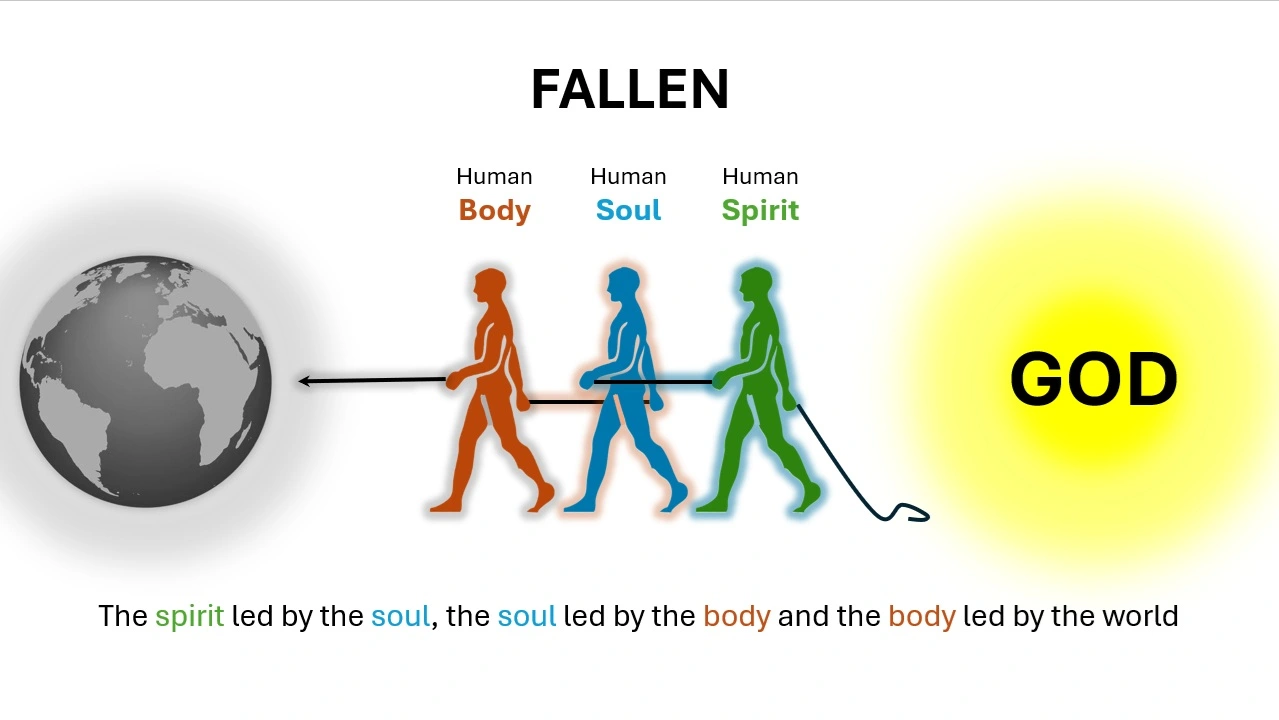
The result was a complete reversal of the order God had established. The spirit now looked to the soul, the soul looked to the body and the body looked to the world.
Before the Fall, the spirit, in fellowship with God, directed the soul, and the soul directed the body. After the Fall, the soul, no longer receiving its proper guidance from God through the conduit of the human spirit, increasingly looked instead to the testimony of the physical body—its sight, hearing, touch, taste, and smell—to interpret reality and determine its course. Rather than living from God’s perspective outward, mankind now began living from the world’s perspective inward. This reversal became one of the defining consequences of spiritual death.
It marked the entrance of spiritual death into the human race and provided Satan with the foothold he sought within God’s creation. The one whom Adam had been commissioned to subdue instead became the one to whom mankind submitted. Instead of exercising dominion under God, mankind entered into bondage under God’s adversary.
Scripture therefore describes Satan as “the ruler of this world” (John 12:31), “the god of this age” (2 Corinthians 4:4), and “the prince of the power of the air” (Ephesians 2:2). These titles do not imply that Satan possesses authority equal to God’s, but they do reveal the dreadful consequences of Adam’s surrender. Although mankind remains morally responsible for every sinful thought, word, and deed, Satan delights in exploiting that fallen condition through deception, temptation, violence, suffering, and destruction. No enemy of God has ever been a friend of man.
The history of the world stands as undeniable testimony to the consequences of that surrender. Every war, every genocide, every act of terrorism, every murder, every rape, every abuse, every slave trade, every dictatorship, every famine born of human greed, every persecution of God’s people, every broken family, every addiction, every disease, every funeral, and every cemetery bear witness to the devastating effects of mankind’s separation from God. Since Adam’s fall, every human being—without exception—has ultimately succumbed to death. Some have perished peacefully after long lives, while countless others have suffered unimaginable horrors at the hands of wicked men under the influence of the evil one. The twentieth century alone witnessed atrocities claiming well over one hundred million lives. Yet even these staggering numbers fail to capture the true magnitude of the Fall, for every grave that has ever been dug, every tear that has ever been shed, and every life that has ever ended ultimately trace their origin back to mankind’s rebellion in Eden.
The repeated failures recorded throughout human history and Scripture should not be viewed as isolated events unique to particular people or particular dispensations. Rather, they reveal a consistent pattern that spans the whole of redemptive history.
- Adam was created without sin and declared by God to be “very good.” Yet Adam fell.
- Lucifer likewise was created blameless according to God’s perfect purpose and design, yet Lucifer rebelled.
- The Book of Judges records Israel’s repeated cycle of faithfulness, blessing, comfort, apathy, apostasy, bondage, suffering, repentance, deliverance, and restoration, only for the same cycle to begin again.
- Likewise, every dispensation recorded throughout Scripture exhibits the same general pattern. Whether under innocence, conscience, human government, promise, law, or even the present administration of grace, mankind continually falls short of God’s glory. The outward administration changes, yet the same recurring pattern remains.
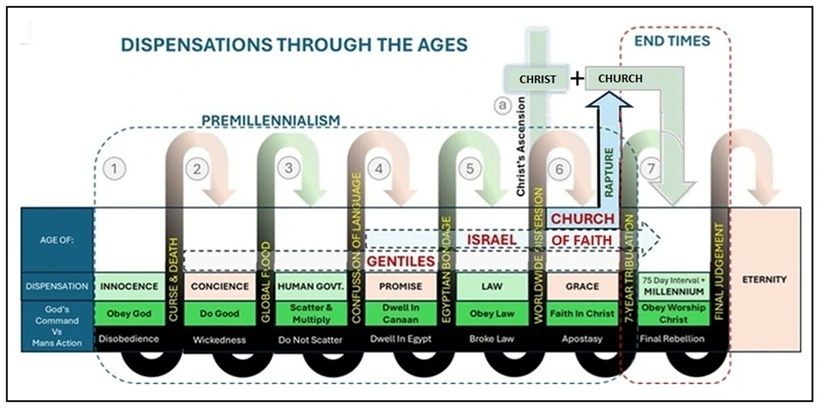
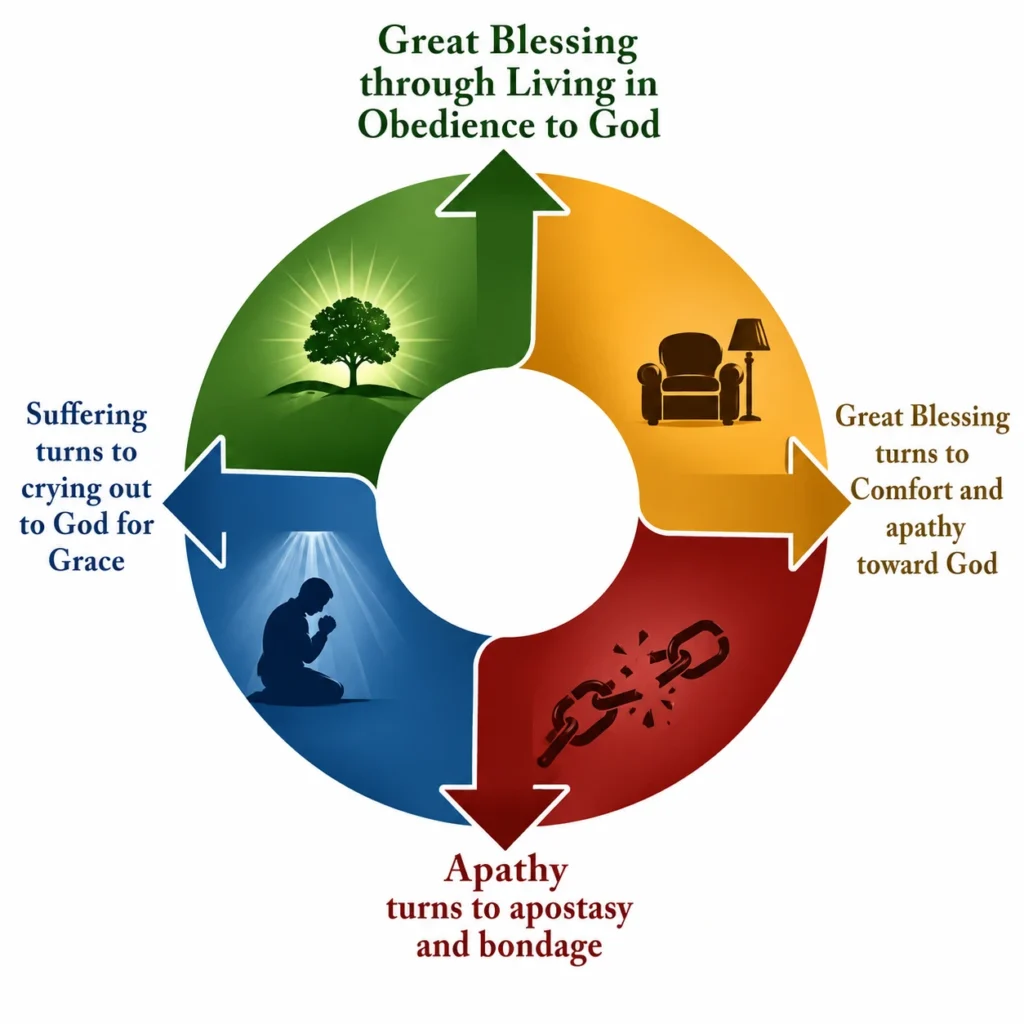
These repeated failures should cause us to pause and consider an important observation.
Adam did not fall because he possessed a sinful nature. He did not fall because he lived in a fallen world. He did not fall because God withheld His fellowship, His blessing, or His provision. Adam fell while living in a perfect environment, enjoying unhindered fellowship with God, and possessing a nature free from sin.
If even the first Adam, created “very good” according to God’s perfect purpose and design, could fall from such a privileged position, then it becomes far easier to understand why fallen mankind continues to repeat the same cycle of unbelief and disobedience throughout history. The repeated failures recorded in the Book of Judges and throughout the various dispensations are therefore not surprising anomalies; they simply reinforce a pattern already established in Eden.
Prophecy tells us that during Christ’s thousand-year reign upon the earth (Revelation 20:1–6), Satan will be bound and unable to deceive the nations. Humanity will live under the righteous rule of the Lord Jesus Christ in a world where justice prevails, peace flourishes, and the curse upon creation is greatly restrained. Never before in human history will mankind experience such perfect external conditions. Yet even in the presence of the visible reign of Christ Himself, the unglorified human heart will remain unchanged in its fundamental capacity to rebel.
At the close of the thousand years, Satan will be released for a short time and will once again deceive the nations. Astonishingly, countless people will willingly join him in one final rebellion against the very King who has ruled them in perfect righteousness (Revelation 20:7–10). This final revolt demonstrates that sin does not arise merely from a corrupt environment or satanic temptation. Rather, it reveals that fallen humanity possesses an inward disposition that remains capable of rejecting God even under the most perfect outward circumstances. The Millennium therefore becomes God’s final public demonstration that external righteousness cannot produce inward perfection.
This is entirely consistent with the testimony of Scripture. Adam sinned in a perfect garden. Some angels rebelled in the very presence of God. Israel repeatedly rebelled despite witnessing God’s mighty works. Likewise, at the conclusion of Christ’s Millennial reign, multitudes will still choose rebellion over submission. The consistent biblical pattern is that sin originates from within the creature rather than from the circumstances surrounding the creature.
The final rebellion also confirms that God’s ultimate purpose was never merely to restore humanity to ideal external conditions. His purpose is far greater—to transform redeemed humanity through union with Jesus Christ. Salvation forgives sin and restores fellowship with God, but glorification completes God’s work by perfecting believers in Christ. Only those who have been glorified in union with Christ’s perfected humanity are forever established in righteousness, incapable of falling away, and able to dwell in the unveiled presence of God throughout eternity.
These observation does not yet explain why the pattern exists, but they do demonstrate that the problem cannot be attributed merely to environment, government, covenant, or outward administration or even Satan. Nor can the ultimate answer simply be the restoration of mankind to Adam’s original condition. History itself (and prophecy) repeatedly demonstrates that something more is required.
Not Abandoned By God
Yet God’s purpose for mankind was not abandoned by the Fall. Although the human spirit no longer functioned in living communion with God as it had been created to do, God did not leave mankind without witness. From the beginning, through His creation, His providence, the testimony of conscience, and ultimately through His Word. God repeatedly reveals Himself and graciously invites men and women everywhere to repent and believe. His invitations are universal, His commands are universal, and His desire is that none should perish but that all should come to repentance. Although fallen mankind now interpreted reality primarily through the testimony of the physical senses, those same senses remained instruments through which God continually reveals Himself and calls mankind to seek after Him. The tragedy is not that God has ceased calling mankind, but that mankind has so often refused to listen.
Yet, every sunrise, every star in the heavens, every act of genuine love, every awareness of right and wrong, every longing for justice, every desire for meaning and purpose, and every recognition that something is profoundly missing bear witness to the Creator for whom mankind was made.
Separated from God, mankind has sought throughout history to fill that emptiness with wealth, power, pleasure, fame, knowledge, religion, possessions, relationships, drugs, and countless other substitutes. Yet none of these can restore what was lost in Eden, because the void is ultimately spiritual rather than material.
As Augustine famously observed, “You have made us for Yourself, and our hearts are restless until they rest in You.” That very restlessness bears witness to the fact that mankind was created for fellowship with God. Thus, although the Fall disrupted the proper order of man’s nature, it did not eliminate God’s continual revelation of Himself, nor did it remove mankind’s God-given responsibility and ability to seek the One who first sought him.
As Paul declared to the Athenians, God ordered the nations and the times in which they live “that they should seek God, and perhaps feel their way toward Him and find Him. Yet He is actually not far from each one of us” (Acts 17:27).
Although mankind’s spirit no longer functioned in living communion with God, the body and the soul continued to serve God’s purpose. Through the eyes, ears, mind, and conscience that God Himself had given, mankind could still observe His creation, hear His truth, consider His works, and respond to His revelation. The spirit had lost its proper communion with God, but God had not ceased making Himself known.
Scripture reveals an important principle concerning the human heart. Every response to God’s revelation shapes the heart that responds. Just as repeated acts of obedience cultivate greater sensitivity to God’s voice, repeated acts of unbelief cultivate increasing resistance. Habits are formed through repetition. What begins as a deliberate choice gradually becomes a settled disposition.
This helps explain God’s commission to the prophet Isaiah:
“Keep on hearing, but do not understand; keep on seeing, but do not perceive. Make the heart of this people dull, and their ears heavy, and blind their eyes…” (Isaiah 6:9–10)
God was not arbitrarily preventing the people from believing. Rather, knowing they would continually reject His Word, He sent Isaiah to preach despite their persistent unbelief. With every repeated refusal to listen, their hearts became increasingly hardened. They became so accustomed to ignoring God’s warnings that they gradually ceased to hear them altogether. The problem was not that God had stopped speaking; the problem was that they had formed the habit of refusing to listen.
The same principle appears throughout Scripture. Pharaoh repeatedly hardened his own heart before Scripture speaks of God hardening it. The writer of Hebrews repeatedly warns, “Today, if you hear His voice, do not harden your hearts.” These warnings would be meaningless if mankind were incapable of responding. Instead, they reveal that every response to God’s revelation either softens or hardens the heart.
This principle should not be underestimated. Every decision makes the next similar decision easier. Repeated obedience strengthens faith. Repeated unbelief strengthens unbelief. Just as habits of righteousness are formed through practicing righteousness, habits of disobedience are formed through practicing disobedience. Eventually what began as a series of choices becomes the settled character of the individual.
God therefore continues to call sinners, not because they possess the ability to save themselves, but because He, in His grace, continues to reveal Himself and graciously invites them to respond. The tragedy is not that God has ceased calling mankind. The tragedy is that mankind so often becomes accustomed to ignoring His voice.
Why Doesn’t God Simply Set Things Right?
To many, the greatest obstacle to believing in God is not the lack of evidence for His existence, but the existence of evil itself. They cannot understand how a God who hates sin, injustice, suffering, and death, and who possesses the power to bring them all to an end, could allow such things to continue. To them, the tragic realities of this present world appear incompatible with the existence of an all-powerful and perfectly good God.
Yes, God is perfectly holy, He hates evil, He delights in mercy, and He takes no pleasure in the suffering of His creatures. However, God has nevertheless permitted the untold atrocities, diseases, wars, oppression, and death that have marked human history to occur. This naturally raises the question:
If God is all-powerful, why does He not simply appear in His full glory, destroy Satan, judge evil, and restore the world to the way it was before sin entered creation?
To many, such a solution appears obvious. If God truly loves mankind, why allow sin, suffering, disease, injustice, and death to continue? Why not simply intervene, remove evil forever, and establish His righteous kingdom upon the earth?
The answer, however, is far more sobering than many realize.
Throughout Scripture, God repeatedly reveals that sinful mankind cannot stand in the unveiled presence of His full glory. When Moses asked to behold God’s glory, the Lord replied, “You cannot see my face, for man shall not see me and live.“ (Exodus 33:20)
Likewise, whenever God revealed even a measure of His majesty, men instinctively fell upon their faces, overwhelmed by His holiness and acutely aware of their own unworthiness. God’s holiness is not merely one of His many attributes; it is the absolute perfection of His very being. That which is finite, corrupted by sin, and separated from God cannot endure the unveiled presence of the infinite Creator.
This reality should cause us to reconsider the question and instead ask :
If God allows such temporal suffering in order to extend to mankind every opportunity to escape His judgement, how much more dreadful must that final judgment be?
In answer, the present world, grievous though it is, is not the fullest expression of God’s judgment upon sin. Rather, it stands as a solemn reminder that a far greater judgment yet awaits those who remain separated from Him. Every moment that God delays that final day is not evidence of indifference, but of extraordinary patience, mercy, and grace, “not wishing that any should perish, but that all should reach repentance” (2 Peter 3:9).
Were God to appear today in the fullness of His unveiled glory, then yes, Satan’s rebellion would indeed come to an end. Every act of wickedness would cease. Every injustice would immediately be judged. Yet so too would every man and woman who remains separated from God. Justice would be perfectly satisfied, but mercy would cease. The opportunity for repentance would forever end.
It is therefore by God’s grace—not by His absence—that the present world continues. God has not turned His back upon mankind. Rather, in His longsuffering mercy He has turned His face, He has veiled the fullness of His glory, allowing time for sinners to repent, believe, and be reconciled to Him before the day when Christ shall return to judge the living and the dead.
This also explains why God could not simply overlook Adam’s sin.
Many imagine forgiveness to be nothing more than the cancellation of a debt. If that were the case, God could simply have declared mankind forgiven without requiring the Incarnation, the Cross, or the Resurrection. Such a view, however, fails to appreciate both the nature of sin and the righteousness of God.
Throughout this work I have carefully distinguished between mankind’s inherited corrupted nature and the personal guilt incurred through one’s own sins. These two realities are not identical and should never be confused. Nevertheless, although distinct, both result in the same tragic reality: separation from God.
Every descendant of Adam inherits a corrupted nature and is therefore conceived into a state of spiritual separation from God. As each morally accountable individual responds to that corrupted nature through his own unbelief and acts of disobedience, he likewise becomes personally guilty before God.
This distinction should never be misunderstood as suggesting that inherited corruption is somehow insignificant or that personal guilt is limited to only a few. Scripture leaves no room for either conclusion.
- On the one hand, mankind is born separated from God through Adam’s fall;
- on the other, “all have sinned and fall short of the glory of God” (Romans 3:23).
- We are not sinful because we sin, we sin because we are sinful.
Every morally accountable person confirms through his own sins the very corruption he inherited. Thus, both mankind’s inherited condition and his personal guilt testify to the same reality: apart from Jesus Christ, all stand in desperate need of reconciliation with God.
Every accountable individual will one day give an account of himself to God. This explains why redemption required far more than the simple cancellation of sin’s penalty. Had Christ come merely to pay the debt of mankind’s transgressions, redemption itself would remain incomplete. Forgiveness alone could never accomplish God’s ultimate purpose.
Suppose, for a moment, that God simply restored redeemed mankind to the same condition Adam enjoyed before the Fall. What would ultimately be accomplished?
- Adam was created very good, according to God’s perfect purpose and design, yet Adam fell.
- Lucifer likewise was created blameless according to God’s perfect purpose and design, yet Lucifer rebelled.
Returning mankind to a pre-fallen state would not guarantee that history could never repeat itself. It would merely restore mankind to the same position from which mankind had already fallen.
Clearly, God’s purpose must be something infinitely greater than simply reversing the Fall. The Incarnation itself points to that greater purpose.
Key Takeaways
- Adam’s fall confirms what the fall of Lucifer already demonstrated.
- The problem cannot simply be explained by environment.
- The Garden was not enough.
- Sin corrupted every aspect of mankind’s existence.
- Fallen humanity cannot restore itself.
- God’s purpose was not defeated by the Fall but advanced toward redemption.
Looking Ahead
If mankind cannot restore himself, redemption must come from outside mankind.
That Redeemer is Jesus Christ.