
T = Total Depravity
Estimated time to read:
Read this article to me
Suggested prerequisite reading:
Calvinism – An Introduction
Calvinism – Dangers of
Calvinism – History Of
Supporting Articles:
Glorification – First Creation
Glorification – Fall of Man
Analogies of Sin
Calvinism Total Depravity: A Familiar Term With a Hidden Redefinition
No Debate: Fallen Man is Totally Depraved
The term Total Depravity sounds straightforward. To most Christians, it suggests the extent of humanity’s sinful condition—namely, that sin affects every part of human nature, the mind, the will, the emotions, and the body.
To be clear, the use of the word “Total” does not infer that the unbeliever cannot do good acts, or that all unbelievers act as badly as they could act, but instead, the word “total” refers to the scope (not depth) of the problem of sin. It is equally important to understand that TULIP does not hold any copyright on the Scriptural truth in terms of the effectual and depraving scope of original sin upon the unbeliever. Thus, in keeping with Scripture and most, if not all, Protestant Christian confessions of faith (Lutheranism, Anglicanism, Methodism, Calvinism and Arminianism), TULIP affirms that there is not a single area or part of our nature that remains untouched by the Fall or that has not been subject to sin’s corrupting influence.
Under this natural reading, “total depravity” describes the pervasiveness of sin, not the “total incapacity” of the sinner. But in Calvinism, the term carries a very different meaning—one that is not obvious from the words themselves.
The Common Meaning: A Condition of Universal Sinfulness
Outside of Calvinist theology, “total depravity” simply means:
- all humans are sinful,
- sin affects every aspect of human nature,
- no one is morally perfect,
- and no one can save themselves by their own righteousness.
This is the meaning most Christians assume when they hear the term. It describes a condition, not an inability.
The Calvinist Meaning: Total Inability
In Calvinism, however, Total Depravity = Total Inability. It does not merely describe the extent of sin but asserts a specific incapacity:
- humans are unable to respond to God,
- unable to believe the gospel,
- unable to repent,
- unable to seek God,
- and unable to exercise faith— unless God first regenerates them.
This is why Calvinists often pair Total Depravity with Irresistible Grace. If humans are totally unable to believe, then God must unilaterally regenerate them before they can respond.
Thus, in Calvinism: Total Depravity is not about how sinful humans are. It is about what humans are supposedly unable to do.
This is a theological redefinition—not a linguistic one.
Why the Term Is Misleading
The phrase “total depravity” does not naturally imply:
- inability,
- incapacity,
- or spiritual paralysis.
It describes a moral condition, not a functional impossibility. Calvinism imports the idea of inability into the term, even though:
- the Bible never uses “depravity” to mean “inability,”
- the early Church did not define depravity this way,
- and the term itself does not linguistically suggest it.
This is why many Christians mistakenly think they agree with Calvinism when they affirm human sinfulness—without realizing that Calvinism means something far more specific and far more restrictive.
The Biblical Problem: Depravity ≠ Inability
Scripture consistently teaches:
- humans are sinful (Romans 3:23)
- humans are responsible (Romans 14:12)
- humans are commanded to repent (Acts 17:30)
- humans can resist God (Acts 7:51)
- humans can seek God when they hear the gospel (Romans 10:17)
If humans were unable to respond to God, then:
- commands to repent would be meaningless,
- warnings would be pointless,
- judgment would be unjust,
- and the gospel call would be incoherent.
The Bible portrays humans as morally corrupt but still capable of responding to God’s revelation.
The Real Issue: A Shift From Moral Condition to Metaphysical Determinism
Calvinism’s version of Total Depravity is not about sinfulness—it is about determinism. It asserts that:
- humans cannot believe unless God regenerates them,
- regeneration precedes faith,
- and faith is not a human response but a divine implantation.
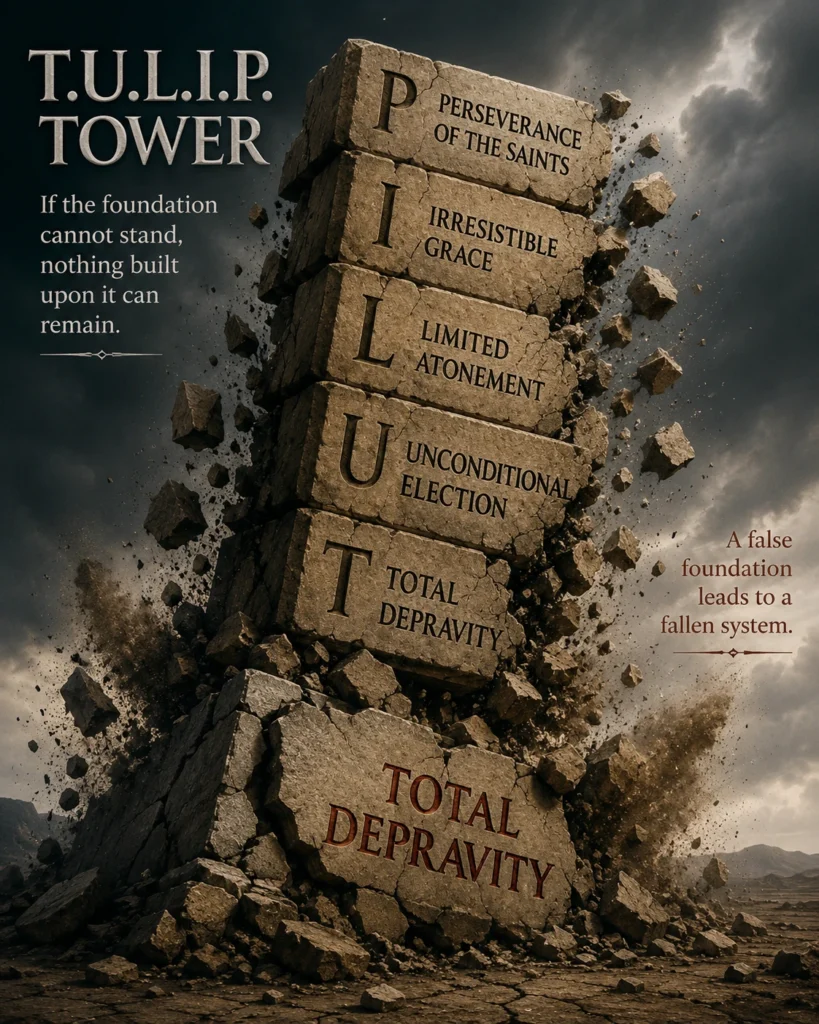
Conclusion
- This is not the biblical doctrine of depravity. It is a metaphysical system rooted in Augustinian determinism, later systematized by Calvin and the Reformed tradition. As the foundational doctrine of Calvinism’s TULIP, Total Depravity is not merely the first point in a sequence—it is the load‑bearing pillar upon which all subsequent doctrines depend. If this doctrine falters, the entire Calvinist system collapses with it.
- The term Total Depravity sounds familiar, but in Calvinism it carries a meaning that the words themselves do not convey. Instead of describing the extent of human sinfulness, it is used to assert a doctrine of total spiritual inability—a doctrine that must be imported into the text rather than derived from it.
In short: There should be no dispute that the unbeliever is anything less than Totally / Completely Depraved / Corrupt. Scripture clearly teaches that as a consequence of original sin, all are conceived – possibly by the seed of the male human parent – in corruption, depraved with sin, and thus rendered incapable of being in the presence of, or in relationship with God, the giver, and the sustainer of life. Scripture clearly teaches that we are not sinful because we sin, but rather, we sin because we are sinful, slaves to sin.
God’s perfect Justness demands penalty of death for the wages of sin, and so like the walking dead, the unregenerate, completely, and totally depraved in sin is without any leverage or foothold whereby they in and of themselves might reach up to God or present any merit and escape punishment. Nor is there any impulse or instinct that is not subject to correction from God’s Word. Thus, it is impossible for the unbeliever to have within themself the ability to know of God, to know of their sinful condition, to know of their impending fate, or to know of the possibility of salvation or to obtain salvation but through and by God’s revelation through Creation, Conscience, Scripture, Law, Jesus, the Gospel, all manifested by the Holy Spirit, and by God’s gracious gift of forgiveness through faith alone in the substitutionary, sacrificial, and sanctifying works of Christ.
Total Depravity describes a condition. Calvinism turns it into an inability. Understanding this distinction is essential for evaluating the claims of TULIP and the broader Reformed tradition.
The Biblical Pattern of Seeking and Forsaking God
Calvinists frequently appeal to Romans 3:11—”There is none who seeks after God”—as proof that fallen mankind is constitutionally incapable of seeking God unless first regenerated by an irresistible work of the Holy Spirit. While all Christians agree that mankind is fallen, sinful, and wholly dependent upon God’s grace, the question remains whether this passage is describing an inherent inability to seek God or the moral condition of sinful humanity as it repeatedly manifests itself throughout history.
See popup on Generational Sin and the Increasing Corruption of a People
Before answering that question, it is important to recognize that Paul is not introducing a new doctrinal statement concerning the mechanics of conversion. Rather, he is quoting Psalm 14 as part of a chain of Old Testament passages demonstrating that both Jews and Gentiles alike stand guilty before God. His purpose throughout Romans 1–3 is to establish the universal guilt of mankind, not to explain the order of salvation.
David’s original context is equally significant. Psalm 14 begins by describing “the fool” who says in his heart, “There is no God.” It portrays a people who have become corrupt, turned aside, and practice evil. These are descriptions of a people living in rebellion against God. David is describing what sinful people do, not explaining that God has withheld from them the God-given capacities necessary to seek Him.
This pattern appears repeatedly throughout Scripture. The generation before the Flood became so corrupt that “every intention of the thoughts of his heart was only evil continually” (Genesis 6:5). Yet the emphasis is upon what that generation had become through persistent rebellion, not upon a divine declaration that mankind had been created incapable of responding to God’s revelation. Likewise, throughout Israel’s history we repeatedly observe the same covenant cycle. The people seek the Lord, receive His blessing, become prosperous, grow spiritually complacent, neglect to teach the next generation, drift into idolatry and rebellion, suffer judgment and bondage, cry out to the Lord, and once again seek Him. The book of Judges repeatedly records this pattern, and the same cycle continues throughout Kings and Chronicles.
This historical pattern becomes especially significant when we remember the circumstances into which both John the Baptist, Jesus, and later Paul ministered. Israel was once again living under foreign domination—this time beneath the authority of Rome. Throughout the Old Testament, foreign bondage repeatedly served as God’s judgment upon a people who had forsaken Him, while deliverance repeatedly followed when they humbled themselves, repented, and sought the Lord. The Roman occupation therefore represented yet another chapter in Israel’s long history of covenant unfaithfulness and its consequences. It formed the historical backdrop against which John the Baptist appeared preaching, “Repent, for the kingdom of heaven is at hand,” and Jesus Himself proclaimed, “Repent and believe the gospel.” Neither John nor Jesus preached, “Wait until God irresistibly regenerates you.” Rather, both proclaimed God’s call to repentance to a nation that had once again wandered from Him, just as the prophets had done throughout Israel’s history.
If Romans 3:11 were teaching that no fallen person is capable of seeking God in any meaningful sense, this repeated biblical pattern would become exceedingly difficult to explain. Scripture continually describes people who forsake God, return to God, seek the Lord, abandon Him again, and later cry out to Him in repentance. The problem is never presented as the absence of God-given capacities but as the misuse of those capacities through unbelief, hardheartedness, and rebellion.
Even more significantly, Scripture repeatedly commands sinners to seek the Lord. Isaiah declares, “Seek the LORD while He may be found” (Isaiah 55:6). Amos proclaims God’s invitation, “Seek Me and live” (Amos 5:4). Jeremiah promises, “You will seek Me and find Me, when you seek Me with all your heart” (Jeremiah 29:13). In the New Testament, Paul explains that God has sovereignly ordered the nations, their appointed times, and the boundaries of their habitation “that they should seek God, and perhaps feel their way toward Him and find Him” (Acts 17:26–27). These commands and declarations are directed toward sinful people, not merely toward those who have already been regenerated.
The broader context of Romans itself points in the same direction. Romans 1 does not portray mankind as lacking revelation but as suppressing the truth God has already made known. Men know God through His creation, yet refuse to honor Him as God. Their condemnation rests not upon an absence of revelation but upon their rejection of the revelation they have received.
Romans 3 should therefore be understood as describing the universal moral corruption and guilt of humanity rather than establishing a doctrine of constitutional inability. Paul is proving that all stand condemned under sin and therefore all stand equally in need of the righteousness that comes through faith in Jesus Christ. To transform his statement, “There is none who seeks after God,” into a comprehensive doctrine that no fallen person can ever seek God in response to God’s gracious revelation extends the passage beyond Paul’s stated purpose, beyond the original context of Psalm 14, and beyond the consistent testimony of Scripture as a whole.
The repeated pattern throughout Scripture is never that God first regenerates a people so that they can seek Him. Rather, God reveals Himself, sends prophets, issues calls to repentance, and holds people accountable for whether they humble themselves or harden their hearts. The biblical problem is consistently presented as moral rebellion against divine revelation—not the absence of God-given capacities necessary to respond to that revelation.
With this said lets look at some of the Scriptural Proof Texts used by Calvinism to support their doctrine of Total Depravity.
Click to open or close: Frequently cited passages used to support the Calvinist doctrine of Total Depravity
Romans 3:10–12 — Universal Sinfulness, Not Total Inability
Romans 3:10–12 is one of the most frequently cited passages used to support the Calvinist doctrine of Total Depravity—specifically the Calvinist redefinition of depravity as Total Inability. But a careful reading of Paul’s argument, the Old Testament texts he quotes, and the context of Romans 1–3 reveals something very different.
Paul is not teaching that humans are metaphysically incapable of seeking God. He is teaching that all humanity is sinful, and therefore no one is righteous on their own merit.
This distinction is crucial.
1. Paul Is Quoting Psalms About the Wicked—Not All Humanity Without Exception
Romans 3:10–12 is a string of quotations from:
- Psalm 14:1–3
- Psalm 53:1–3
In both psalms, David is describing the fool, the corrupt, the violent, the wicked—not every human being in every moment of life. In fact, in Psalm 14, after saying “there is none who does good,” David immediately contrasts the wicked with: “the generation of the righteous” (Psalm 14:5)
If “none” meant “absolutely no one in existence,” then David would be contradicting himself in the same psalm. Paul’s point is not that every human is incapable of seeking God. His point is that Jews and Gentiles alike are under sin, and therefore no one can claim righteousness by the Law.
2. Romans 3 Is the Conclusion of Paul’s Argument in Romans 1–3
Paul has spent three chapters arguing:
- Gentiles are sinful (Romans 1)
- Jews are sinful (Romans 2)
- Therefore all are under sin (Romans 3)
Romans 3:10–12 is Paul’s summary, not a metaphysical statement about human ability. He is saying: “No one is righteous by the Law. No one can claim salvation by works. All need grace.” This is about universal guilt, not universal inability.
3. “No One Seeks God” Is a Description of Humanity’s Condition—Not a Statement of Human Capacity
Calvinism reads “no one seeks God” as “no one can seek God.” But the text does not say “cannot.” It says “does not.” There is a difference between:
- what humans do in their sinfulness vs.
- what humans are capable of doing when confronted with God’s revelation
Paul himself says:
- People can seek God (Acts 17:27),
- Faith comes by hearing (Romans 10:17),
- God commands all people everywhere to repent (Acts 17:30),
- People resist the Holy Spirit (Acts 7:51),
- People refuse to love the truth (2 Thess. 2:10)
If humans were incapable of seeking God, none of these statements would make sense.
4. Calvinism Imports “Inability” Into the Text
The Calvinist interpretation assumes: “If no one seeks God, it must be because they are unable to seek God.” But this is not what Paul says. Paul’s point is:
- All are sinful.
- All fall short.
- All need grace.
- No one can claim righteousness by works
This is the opposite of the Calvinist claim that humans are spiritually paralyzed until regenerated. Paul is describing moral corruption, not metaphysical incapacity.
5. The Bible Repeatedly Shows Unregenerate People Seeking God
Scripture gives many examples of people seeking God before regeneration:
- Cornelius seeks God (Acts 10),
- The Ninevites repent (Jonah 3),
- People “fear God” before conversion (Acts 13:16, 26),
- Pagans seek God through creation (Romans 1:19–21),
- “Those who seek the Lord” (Psalm 9:10; 22:26; 34:4)
If “no one seeks God” meant “no one can seek God,” these passages would be impossible.
6. John 6:44 Does Not Teach Total Inability
Calvinists often pair Romans 3 with John 6:44 (“No one can come unless the Father draws him”).
But Jesus is speaking to:
- hardened Jews,
- who have rejected the Father
- and therefore cannot come to the Son
This is judicial hardening, not universal inability. Jesus says in John 12:32: “I will draw all people to myself.” The drawing is universal; the response is not.
7. Romans 3 Teaches Universal Sinfulness, Not Total Inability
Paul’s conclusion in Romans 3 is:
- All are sinners,
- All are guilty,
- All need grace,
- No one is righteous by works,
- Salvation is by faith in Christ
This is the opposite of the Calvinist doctrine that:
- no one can believe,
- no one can repent,
- no one can seek God,
- unless God regenerates them first
Paul never says this.
8. Total Depravity ≠ Total Inability
Your insight is exactly right: Total Depravity describes a condition. Calvinism turns it into an inability. Romans 3 describes:
- universal sin
- universal guilt
- universal need for grace
It does not describe:
- universal inability
- metaphysical paralysis
- pre-faith regeneration
Those ideas come from Augustine, not Paul.
Conclusion
Romans 3:10–12 is a powerful declaration of humanity’s universal sinfulness—but it is not a statement of Total Inability. Calvinism imports a philosophical concept into a text that is speaking about moral corruption, not metaphysical incapacity. Paul’s point is:
- All are sinners.
- None are righteous by works.
- All need grace.
- Salvation is by faith in Christ.
This is the gospel—not the deterministic system later constructed by Augustine and the Reformers.
Calvinism’s Total Depravity: Its Problem of Free Will
The most admirable tenet of Calvinism is its unwavering commitment to uphold the supreme sovereignty of God, a goal that deserves genuine respect. Yet in order to preserve this vision of sovereignty as absolute, Calvinist theology must remove the possibility of meaningful human free will. This is why the Calvinist doctrine of Total Depravity is not merely a description of humanity’s sinful condition but is redefined into a doctrine of total spiritual inability.
To sustain this system, Calvinism incorporates the philosophical framework of the Necessitarian theory of nature—the idea that all events occur by necessity—and the philosophical model of Compatibilism, which redefines “free will” to mean acting according to desires that are themselves determined by one’s nature. These philosophical commitments ensure that human beings cannot genuinely choose otherwise, thereby supporting the Calvinist claim that God’s sovereignty requires exhaustive determinism. Thus, Total Depravity becomes the indispensable foundation for a system in which human free will is eliminated in order to protect a particular understanding of divine sovereignty.
Before examining these philosophical systems more closely, an important distinction must first be made. The issue is not whether Compatibilism or Necessitarian theory possess explanatory value. Both offer important insights into the nature of created reality and, when confined to their proper scope, explain many observable aspects of creation. The difficulty arises only when these philosophical systems are extended beyond the limits established by Scripture. It is therefore not philosophy itself that is under examination, but whether Scripture permits philosophy to govern the moral nature of man in the same manner that it governs the physical order of creation.
Likewise, the discussion is not fundamentally about what has commonly become known as “free will.” The expression itself is often misleading because it suggests that the human will exists as an independent faculty capable of creating its own possibilities. Scripture presents a very different picture. Man does not create moral possibilities, nor does he invent the choices set before him. Only God, who alone creates ex nihilo, possesses the authority and ability to establish genuine moral possibilities. Human beings do not create these possibilities; they merely act upon those which God, in His sovereignty, has already provided. The issue, therefore, is not one of “free will” but of the genuine freedom to act upon the moral choices and opportunities that God Himself has established.
This distinction is foundational because willing, desiring, possessing ability, and acting are not identical concepts. A person may will something without possessing the ability to accomplish it. Likewise, one may possess the ability to act only upon those choices that actually exist. The human will cannot create possibilities where none exist; it can only respond to those possibilities God has first made available. Throughout Scripture, it is always God who sovereignly establishes the realm of moral possibility, while mankind remains responsible for how he responds to the opportunities God graciously places before him.
Compatibilism in Calvinism: A Philosophical Inheritance, Not a Biblical Necessity
In following its predecessors—Augustine and John Calvin—Calvinism and the broader Reformed Tradition have adopted the philosophical framework of Compatibilism in an attempt to reconcile human “free will” with their theological conviction that fallen humanity is so depraved and so unable to respond to God’s general revelation and the gospel that God must sovereignly, causally, and selectively determine who will and will not be saved. In this system, God’s sovereignty is defined in strictly determinative terms, and therefore human freedom must be redefined to fit within that determinism.
Compatibilism becomes the philosophical glue that holds together the doctrines of Total Depravity (reinterpreted as Total Inability) and theistic determinism.
Compatibilism is the theological and philosophical view that God’s sovereign determination of all events and genuine human responsibility are compatible with one another. Within Reformed theology, compatibilism teaches that although God has eternally ordained every human choice and historical event, people are still morally accountable because they act voluntarily according to their own desires rather than being externally coerced. Critics argue that if every desire and decision is ultimately predetermined by God, then human freedom is only compatible with determinism in a limited sense, while proponents maintain that voluntary choices remain sufficient to establish moral responsibility.
In many respects Compatibilism correctly describes how individuals act upon the desires they possess. It recognizes that people ordinarily act voluntarily rather than by external coercion, and in this regard it offers a meaningful description of human behaviour. Yet this observation alone does not resolve the more fundamental question that Scripture repeatedly addresses. Compatibilism explains how choices are exercised, but it does not explain how the moral possibilities themselves originate, nor whether those possibilities have been genuinely provided by God. Scripture consistently presents God as the One who establishes the alternatives before mankind, while human beings remain responsible for responding to those alternatives. Consequently, Compatibilism explains an aspect of human behaviour, but it cannot by itself explain the entirety of biblical moral responsibility.
Analogy of a Dog
To illustrate this concept, compatibilists often use the analogy of a dog in a fenced backyard. The dog is free to roam anywhere within the boundaries of the yard and chooses its actions according to its own desires, yet it cannot go beyond the fence. In the same way, compatibilists argue that human beings freely make choices according to their own wills, even though those choices always remain within the limits of God’s sovereign decree. Thus, while a person’s decisions are considered genuinely voluntary, they are never understood to exist outside the boundaries of what God has eternally ordained.
While this analogy succeeds in illustrating that one’s actions are exercised within established boundaries, it does not address the more fundamental issue of whether genuine moral possibilities have been provided within those boundaries. The existence of a fence explains limitation, but it does not explain responsibility. If the owner were to stand outside the fence and command the dog to come, the dog’s inability to obey would no longer concern its willingness but its ability. The question has shifted from acting according to desire to possessing the genuine ability to respond to the command given. It is precisely this distinction that becomes central in Scripture’s discussion of moral responsibility and one that Compatibilism, by itself, does not adequately address.
The Roots of Compatibilism and the Scope of Necessitarian Theory
The roots of Compatibilism stretch back to the Hellenistic era, particularly to the Greek Stoics, whose metaphysical worldview was shaped by the Necessitarian theory of nature. In Stoic ontology, the universe is governed by a rational, divine, immanent principle—the logos—which orders all events down to their smallest detail.
Nature is not random but governed by unbreakable causal laws. Everything that happens, happens necessarily. This framework did not apply only to physical nature but also to moral nature—the realm of rational beings such as God, angels, and humans. Under this view, a being can only “will” according to its nature; its choices are determined by the internal moral structure of that nature. This philosophical inheritance provided Augustine, Calvin, and later Reformed theologians with a metaphysical justification for teaching that the unregenerate human will is incapable of choosing anything contrary to its sinful nature.
When confined to the physical order, Necessitarian theory provides a remarkably useful explanation of created reality. The movements of the heavenly bodies, the laws of gravity, the growth of living organisms, and countless other natural processes all occur according to established laws that God Himself has ordained. In this respect, necessity accurately describes much of the created order. The difficulty arises only when this same philosophical framework is extended beyond the physical realm and applied without qualification to the moral realm. Scripture consistently distinguishes between what creation must do according to the laws of nature and what moral agents ought to do when confronted with the choices God has placed before them. Physical laws govern necessity; moral laws govern responsibility. Though related, they are not identical categories and should not be treated as though they are.
While this may be true of God who is by His inherent nature perfect, neither man nor angel, by the very fact that they were created ex nihilo, possess an inherently perfect nature (For further explanation see Glorification – An Introduction). Created beings are, by definition, dependent beings. They do not possess self-existence nor do they possess the divine ability to create possibilities for themselves. Every genuine moral opportunity originates with God. Consequently, the human will does not create the choices upon which it acts; it simply responds to those which God, in His sovereignty, has already established.
This distinction is critical because the question is not whether mankind possesses an autonomous “free will” capable of inventing its own moral alternatives. Scripture never presents the human will in this manner. Rather, the consistent biblical pattern is that God sovereignly establishes the available alternatives, while mankind bears responsibility for responding to those alternatives. God alone created the possibility of obedience and disobedience in the Garden. Adam and Eve did not invent the possibility of sin; they merely acted upon a genuine moral alternative that God Himself had sovereignly placed before them. Likewise, fallen humanity did not create the possibility of redemption. God alone established that possibility through the person and work of Jesus Christ. In every case, the possibilities originate with God while man’s responsibility lies in how he responds to what God has graciously provided.
Thus, in Calvinism, “free will” is redefined through Compatibilism: the natural man is “free” only in the sense that he acts according to his desires—but those desires are themselves determined by his corrupted nature. The unregenerate person “freely” chooses sin because he cannot desire anything else.
This is why Calvinism must move from Total Depravity (a condition) to Total Inability (a metaphysical incapacity). The natural man is said to be “dead in sin,” unable to respond to God’s call, unable to believe the gospel, and unable to exercise faith unless God first sovereignly, effectually, and selectively regenerates him. Because Scripture does not teach universal salvation, Calvinism concludes that God must make His saving grace irresistible for the elect and withhold it from the non-elect.
The central question, however, is not whether fallen mankind can create the possibility of his own salvation. Scripture nowhere suggests that he can. Fallen humanity possesses no ability to create life, just as it possessed no ability to create the possibility of sin in the beginning. The issue is whether, once God Himself has graciously established the genuine possibility of life through Jesus Christ, mankind possesses the freedom to respond to that divinely provided opportunity. This is where Scripture and Compatibilism fundamentally part company. Compatibilism focuses primarily upon the origin of human desires, whereas Scripture repeatedly focuses upon God’s sovereign provision of genuine moral choices and mankind’s responsibility to respond to those choices.
Compatibilism’s Incompatibility With Scripture
The greatest challenge for Compatibilism is not philosophical—it is biblical. The system collapses under its own weight as early as Genesis 3, where both Adam and Eve, created with sinless natures, nevertheless act contrary to their nature and sin. According to Necessitarian theory and Compatibilism, this should be impossible. If moral choices are governed by necessity in precisely the same manner as physical laws, then a perfectly sinless moral nature should necessarily produce only righteous moral actions. A being with a sinless nature should be unable to will evil because such willing would contradict the very philosophical principle upon which Compatibilism rests. Yet Scripture plainly records exactly the opposite.
The significance of the Fall therefore extends far beyond the first act of human disobedience. It demonstrates that moral agency cannot simply be reduced to metaphysical necessity. Adam and Eve did not sin because they possessed sinful natures. They sinned while possessing sinless natures. The very event upon which all Christian theology depends therefore demonstrates that moral agents created by God are capable of acting contrary to their existing moral condition whenever God Himself has genuinely placed that moral alternative before them. The Fall does not merely present a challenge to Compatibilism; it exposes the limitations of applying Necessitarian theory to the moral realm without the qualifications imposed by Scripture.
Even more problematic is the implication that God Himself must have caused their sin—an idea Scripture explicitly rejects. James 1:13 states: “God cannot be tempted by evil, nor does He tempt anyone.” If Compatibilism were true, Adam and Eve could not have sinned unless God determined their sin. But Scripture denies this outright. When confronted with this contradiction, leading Calvinist theologians acknowledge the problem but cannot resolve it:
- R.C. Sproul: “Adam and Eve were not created fallen… Yet they chose to sin. Why? I don’t know nor have I found anyone yet who does know.”
- John Piper: “How a sinful disposition arises in a good heart… the Bible does not tell us.”
But Scripture does tell us. The Fall occurred through temptation, deception, and volitional choice, not through divine causation or metaphysical necessity. Adam and Eve were not determined to sin—they were genuinely presented with the opportunity to obey or to disobey. The possibility of death did not originate within Adam’s will but within God’s sovereign provision. God Himself established the genuine moral alternatives before Adam and Eve. Their responsibility was not to create those alternatives but to act upon the choice God had graciously placed before them.
This distinction is of profound importance because it demonstrates that moral agency does not consist in creating possibilities but in responding to the possibilities God has established. Adam did not create sin. Eve did not invent rebellion. Neither possessed the divine ability to create new moral realities. Rather, they exercised their wills upon a genuine choice that God Himself had sovereignly made available. Scripture therefore presents God’s sovereignty, not as the elimination of meaningful choice, but as the very foundation upon which meaningful moral choice becomes possible.
The same principle continues throughout Scripture. Following the Fall, mankind likewise possesses no ability to create the possibility of redemption. Fallen humanity cannot manufacture righteousness, remove its own guilt, satisfy divine justice, or liberate itself from the bondage of sin. Those possibilities belong exclusively to God. Just as God alone established the possibility of death in Eden, so also God alone established the possibility of life through Jesus Christ. Christ is therefore not merely the object of saving faith but the God-ordained means by which salvation itself becomes a genuine possibility.
Analogy of a Minnow
This distinction may be illustrated by a simple analogy. Consider a minnow swimming freely in a stream. It voluntarily enters a fish trap. Nothing compels it to enter against its will. It follows its natural desires and willingly swims inside. In this respect, Compatibilism accurately describes what has taken place. The minnow acted voluntarily according to its own desire. Yet once inside the trap, the entire discussion changes. The question is no longer why the fish entered but whether it possesses the ability to free itself.
The trapped minnow may or may not desire to escape. It may or may not will to escape. It may or may not expend every ounce of effort attempting to free itself. Yet regardless of whether it desires freedom, wills to escape, or struggles with all its strength, it remains unable to liberate itself from its bondage. Its inability does not arise because it lacks desire, nor because it lacks will, but because it lacks the ability to accomplish what it desires. No amount of desire, willing, or effort can create the means of escape. That ability must come from outside the trap.
NOTE: Whether the minnow desires escape or not is not the issue presently under consideration. The issue is simply that no desire, however strong or sincere, possesses the ability to create the means of its own deliverance. The question of whether fallen humanity retains God-given capacities of desire, response, and action will be examined from Scripture in a later chapter.
The bondage of sin described throughout Scripture is remarkably similar. Adam and Eve voluntarily entered into sin, but neither they nor their descendants possess the ability to free themselves from its bondage. Fallen humanity cannot, through greater effort, stronger desire, or greater determination, create the righteousness necessary to restore itself to fellowship with God. Total inability, properly understood, is therefore not primarily an inability of the human will to exercise choice whenever God genuinely provides that choice. Rather, it is humanity’s complete inability to rescue itself from a condition into which it voluntarily entered and from which it cannot escape by its own merit.
This distinction explains why Scripture continually presents salvation as the work of God from beginning to end. Christ does not merely command sinners to escape their bondage; He becomes the very means by which escape is made possible. He alone satisfies divine justice. He alone conquers sin and death. He alone opens the prison door that mankind could never open for itself. The gospel is therefore not simply God’s command to repent but God’s gracious provision of the very means by which repentance, faith, forgiveness, and reconciliation become possible. Christ is both the means and the method by which God has sovereignly established the genuine possibility of life.
When understood in this manner, Scripture preserves both God’s absolute sovereignty and genuine human responsibility. God alone creates the possibilities of both judgment and redemption. Man creates neither. Yet because God Himself has genuinely established those possibilities, mankind remains fully accountable for how it responds to the gracious provision God has made. The issue is therefore not whether fallen humanity possesses the ability to save itself—it unquestionably does not—but whether God has genuinely provided the opportunity to receive the salvation He Himself has accomplished in Christ. Scripture consistently answers that question in the affirmative.
The discussion thus far has not been an attempt to dismiss Compatibilism or Necessitarian theory outright. Both offer meaningful explanations within their proper sphere. The question, however, is whether these philosophical systems are sufficiently comprehensive to explain the whole of Scripture’s teaching concerning moral agency. Having considered both their explanatory strengths and their limitations, we now turn to Scripture itself to determine how God describes the moral nature of man, human responsibility, and the basis upon which divine judgment is ultimately rendered.
Distinguish Between Freedom of will, Freedom of Action and Freedom of Response
The distinction becomes clearer once we recognize that Scripture speaks of moral agency somewhat differently than philosophy. For this reason, I distinguish between freedom of will, freedom of action, and freedom of response. Human beings have never possessed absolute autonomy, nor have they ever existed independently of God or outside the constraints of His creation. Every genuine moral possibility, every opportunity for obedience, every provision for salvation, and every human capacity necessary to respond to God’s revelation originates with God alone as part of His sovereign creative design. These capacities have not been selectively bestowed upon only certain individuals but have been graciously and universally given to mankind according to God’s creative purpose.
God created mankind with eyes to see, ears to hear, a mind capable of reason, a conscience capable of conviction, emotions capable of love and sorrow, and a will capable of acting upon the opportunities God Himself provides. Man creates none of these faculties; they are all gifts of God’s creative work. Nor does the absence or impairment of one faculty render God’s revelation ineffective, for God has provided multiple complementary means through which His truth may be received. The one who cannot see may still hear; the one who cannot hear may still perceive through sight; and the one deprived of both sight and hearing still possesses the God-given capacity to reason, to recognize moral obligation through conscience, and to respond to the revelation God has made available. Scripture consistently presents these God-given capacities as sufficient for the purposes for which God intends them.
Yet Scripture consistently portrays human beings as genuine moral agents who hear God’s commands, receive His revelation, deliberate, believe or disbelieve, obey or rebel, repent or harden their hearts. These repeated biblical appeals presuppose that God’s commands are addressed to persons whom He Himself has universally endowed with the God-given capacities necessary to respond to the revelation and opportunities He graciously provides.
These God-given faculties do not operate independently of their Creator, nor do they diminish His sovereignty. On the contrary, they exist precisely because God created and continually sustains them. Consequently, affirming meaningful moral agency is not an exaltation of man but an acknowledgment of the wisdom and purpose of God’s creative design.
Accordingly, my concern is not to defend an autonomous or self-originating conception of free will, but to preserve the practical reality of moral agency exactly as Scripture presents it. Neither do I advocate what philosophers commonly describe as libertarian free will, whereby human choices originate independently of God or exist free from His sovereign governance. Every genuine moral capacity exercised by mankind—including the capacities to perceive, reason, desire, deliberate, and act—exists only because God created and continually sustains those faculties. My concern is not the autonomy of man, but the integrity of the moral agency that Scripture consistently attributes to those whom God Himself created.
Perhaps the clearest way to illustrate this distinction is to compare the moral agency God provided to Adam and Eve before the Fall with the moral agency He provides fallen humanity in response to the Gospel. In both cases, man does not create the possibilities available to him, nor does he create the capacities necessary to act upon them. God provides both the opportunity and the ability to respond, while man remains responsible for the action he takes in response to what God has provided.
However, it would be as equally problematic to believe that Man has unconstrained free will, for will itself in all practicality, is somewhat of an abstract thing that depends in part on factors wholly beyond Man’s control. There are always external constraints on the range of known possible options that man can freely undertake. Therefore, it is important to make a distinction between freedom of will and freedom of action.
Adam and Eve had no more the ability to sin than they had the ability to grow physical wings without God providing them the ability to not only act on the option to do so, but also awareness of it. In creating the tree of Knowledge of Good and Evil and commanding Adam and Eve to not eat of its fruit, lest they die, God had provided them the option, the awareness (and even warning) of the option, and therefore the ability (God enabled them) to freely act in obedience or to freely act in disobedience, and sin. Thus, while God created the potentiality for Man to act in sin, never did He necessitate, nor did He cause Man to act in sin. It was by Adam and Eve’s disobedient and free action, (not God’s) that they brought the catastrophic consequences of corrupted physical and spiritual natures, death, a cursed world, and separation from God, not only upon themselves but that has ever since, been visited upon, and inherited by all of Adam’s posterity, each born with the propensity to commit sin and fall under judgement and penalty of sin.
Being sinful, mankind now has no more the ability to be free of sin and its consequences then he has the ability to grow physical wings, without God providing man the ability to not only act on the option to be free of the judgement of sin, but also awareness of the option. God has made salvation possible by providing man the option, as well as awareness not only of the option but our need of it. Therefore, God has given man the ability (God has enabled man) to freely act in obedience of God’s command to repent of sin and accept by faith the substitutionary and sacrificial works of Christ, or to freely act in disobedience, reject Christ and remain under judgement of sin.
Seen in this way, neither Adam’s original moral agency nor fallen man’s response to God’s provision requires an autonomous will operating independently of God. In both cases, God remains the sovereign source of the possibilities, the revelation of those possibilities, and the capacities necessary to act upon them. What remains genuinely man’s is his response to what God has sovereignly provided.
God alone creates the possibilities upon which man acts. God alone establishes the moral alternatives. God alone provides the means of salvation through Jesus Christ. Even the human capacities by which man hears, reasons, desires, and acts are themselves gifts of God’s creative design. Thus, the issue is not whether man possesses an independent will that operates apart from God, but whether the capacities God Himself has created function as genuine moral faculties through which man is held accountable for his response to God’s revelation.
If exhaustive theistic determinism ultimately reduces freedom of action and freedom of response to nothing more than the inevitable outworking of an immutable decree, then moral responsibility becomes little more than a descriptive label attached to predetermined actions. Under such a system, responsibility no longer rests upon a meaningful response to God’s gracious provision but upon the unavoidable execution of what could never have been otherwise. In such a case, the practical distinction between acting voluntarily and acting necessarily becomes increasingly difficult to maintain, and the biblical concepts of responsibility, accountability, justice, reward, and punishment are correspondingly diminished.
Conversely, if responsibility and accountability are genuine—as Scripture consistently presents them to be—then the response God requires must itself be genuinely meaningful. God’s commands cannot merely describe the inevitable outworking of an immutable decree. Rather, they presuppose that God has sovereignly established genuine moral opportunities and that mankind remains accountable for how he responds to those opportunities. Responsibility does not require autonomous independence from God; it requires that the response God commands be genuinely capable of being rendered by those to whom He addresses His commands through the capacities He Himself has sovereignly created and sustained.
Having considered the philosophical foundations by which Calvinism explains the operation of the fallen human will, an equally important question naturally follows. If mankind is indeed born with a corrupted nature, how is that fallen nature transmitted from Adam to every subsequent generation? The answer no longer lies primarily in philosophy but in theological anthropology. Throughout church history, several theological explanations have been proposed to answer this question. Among them, Traducianism has historically provided the most widely accepted explanation for the propagation of mankind’s fallen nature and, consequently, has become another significant component in the broader theological framework from which Calvinism develops its doctrine of Total Depravity. Before examining where Calvinism extends this doctrine beyond Scripture, it is first necessary to understand what Traducianism itself teaches.
Click to open or close: Traducianism, Original Sin, and the Misinterpretation of Imputed Guilt
Traducianism: The Transmission of Human Nature
Traducianism is a long‑standing Christian doctrine explaining the origin of the human soul. It teaches that both the material and immaterial aspects of human nature are propagated through natural generation at conception. In this view, the soul is not created ex nihilo for each person but is derived from the parents, just as the body is.
Psalm 51:5 expresses this reality: “Behold, I was brought forth in iniquity, and in sin did my mother conceive me.”
This does not mean the act of conception is sinful; rather, it means that human nature itself, since Adam’s fall, is corrupted. Many theologians have held that the immaterial nature is transmitted through the father, which explains why Christ—conceived by the Holy Spirit and born of a woman—was fully human yet without sin.
Traducianism is essentially the biblical principle that: A bad tree cannot produce good fruit.
Since Adam’s fall, all his descendants inherit a corrupted nature. We are not sinful because we sin; we sin because we are sinful. From conception, every human being possesses a fallen nature that cannot exist in the presence of a holy God without redemption.
Imputed Guilt: Augustine’s Theological Misstep
Calvinism’s doctrine of Total Depravity goes beyond Traducianism. It teaches not only that humans inherit a sinful nature but also that they inherit Adam’s guilt—a doctrine known as Imputed Guilt or Mediate Imputation.
This idea originated with Augustine, who—though brilliant—made a critical interpretive error. His argument rested on the Latin Vulgate translation of Romans 5:12:
“in quo omnes peccaverunt” (“in whom all have sinned”)
Augustine concluded that all humanity literally sinned in Adam, and therefore inherited Adam’s guilt.
But the Latin translation was incorrect.
The original Greek reads:
ἐφ’ ᾧ (eph’ ho) — meaning “because.”
Thus Romans 5:12 actually says:
“Death spread to all men because all sinned.”
This means:
- Humanity inherits mortality and a fallen nature from Adam.
- Humanity does not inherit Adam’s personal guilt.
- Each person becomes guilty for their own sins, not Adam’s.
This interpretation aligns with the clear teaching of Scripture:
- Deuteronomy 24:16
- 2 Kings 14:6
- Ezekiel 18:19–20
- Ezekiel 18:17
These passages explicitly state that no one bears the guilt of another person’s sin. Augustine’s misreading of Romans 5:12—combined with 1 Corinthians 15:22—became the foundation for the later Calvinist doctrine of inherited guilt. But the foundation was built on a translation error, not the Greek text.
Inherited Consequence: The Biblical Alternative
The doctrine of Inherited Consequence affirms the biblical truth that all humans inherit:
- a corrupted body,
- a corrupted soul,
- and a fallen world.
But it rejects the idea that humans inherit Adam’s guilt. Ezekiel 18:20 makes this unmistakably clear: “The soul who sins shall die. The son shall not suffer for the iniquity of the father.” Exodus 20:5 is often misunderstood. The phrase “visiting the iniquity” uses the Hebrew avon [H5771], which means:
- perversity, depravity,
- the consequences of iniquity,
- not the guilt itself.
Thus Exodus 20:5 means:
“visiting the consequences of the fathers’ iniquity…”
This harmonizes perfectly with Ezekiel 18:20. Inherited Consequence teaches:
- We inherit a sinful nature from Adam.
- We inherit the effects of our parents’ and society’s sins.
- But we do not inherit their guilt.
- We become guilty when we personally sin (Romans 7:9).
This preserves both God’s justice and human responsibility.
Age of Accountability and the Nature of Sin
Inherited Consequence explains why (see article: Infant Salvation):
- infants,
- young children,
- and those mentally incapable
are not condemned for Adam’s sin. They inherit a sinful nature, but not guilt. Guilt arises only when a person knowingly violates God’s law. Romans 7:9 supports this: “I was once alive apart from the law, but when the commandment came, sin came alive and I died.” This verse makes no sense under Imputed Guilt, but fits perfectly with Inherited Consequence.
Creationism: An Alternative View With Serious Problems
Some early church fathers held to Creationism, the belief that God creates each soul directly at conception. But this view faces major difficulties:
- Genesis 2:2–3 says God ceased creating.
- If God creates each soul, how does that soul become sinful?
- Does God create sinful souls? Impossible.
- Does God create pure souls that become sinful instantly? How?
Traducianism avoids these problems by explaining sin’s transmission through natural generation, not divine creation.
Summary
- Traducianism: We inherit a sinful nature from Adam.
- Inherited Consequence: We inherit corruption, not guilt.
- Imputed Guilt: A doctrine built on Augustine’s mistranslation.
- Scripture: Each person is judged for their own sin, not Adam’s.
- ,Calvinism: Builds Total Inability on Augustine’s error.
- Biblical truth: We are conceived sinful, but become guilty when we personally sin.
When Experience Shapes Emotion—and Emotion Shapes Interpretation
Augustine’s Confessions reveal a man profoundly aware of his own guilt, weakness, and past bondage to sin—a man whose spiritual journey was marked by deep emotional struggle and an overwhelming appreciation for the grace of God. His personal experiences undoubtedly shaped the theological questions he later sought to answer and the conclusions he ultimately reached concerning grace, the human will, and original sin. While his testimony is both beautiful and deeply moving, it also illustrates how powerfully personal experience can influence biblical interpretation. Augustine’s profound awareness of his own moral helplessness appears to have led him toward an understanding of grace that increasingly emphasized God’s unilateral action in conversion, a perspective that would later exert considerable influence upon John Calvin and the broader Reformed Tradition.
This observation is not intended to question Augustine’s sincerity, devotion, or commitment to Christ. Rather, it acknowledges a reality common to every theologian throughout history: personal experiences inevitably shape the questions we ask and the perspectives we bring to Scripture. For this reason, experience must never become the lens through which Scripture is interpreted. Instead, Scripture must remain the lens through which every experience is evaluated. When personal experience becomes the controlling framework for doctrine, even the most brilliant and well-intentioned theologians may arrive at conclusions that reflect their own experiences as much as, or more than, the full testimony of God’s Word.
Final Remarks
Throughout Scripture, God consistently establishes the moral possibilities before holding mankind accountable for responding to them. This pattern is woven throughout the whole of redemptive history. In Eden, God established both the possibility of obedience and the possibility of disobedience before commanding Adam and Eve. Cain was warned that sin was “crouching at the door” and exhorted to master it before judgment fell. Noah was provided the ark before the flood came. Israel repeatedly received God’s Law, His prophets, and His covenant warnings before exile. Nineveh received Jonah’s proclamation before its inhabitants were called to repentance. Most supremely, God Himself established the possibility of salvation through the incarnation, death, and resurrection of Jesus Christ before commanding all people everywhere to repent and believe the gospel.
The biblical pattern is unmistakable. Divine judgment consistently follows divine provision. God first creates the moral possibility, provides the necessary revelation, and graciously establishes the means by which obedience or salvation may be received. Only then does He hold mankind accountable for its response. Human responsibility is therefore not grounded in man’s ability to create possibilities for himself, but in God’s sovereign decision to create, reveal, and sustain the very opportunities to which He commands mankind to respond.
In this light, God’s sovereignty is seen in its fullest biblical expression. His sovereignty is not diminished by genuine moral responsibility; rather, it is the very foundation that makes meaningful responsibility possible. God alone creates the moral order, establishes righteousness, defines sin, gives life, provides revelation, sends His prophets, accomplishes redemption through His Son, convicts by His Spirit, and proclaims the gospel to the world. Every genuine moral possibility originates with Him. Human responsibility therefore competes neither with God’s sovereignty nor with His grace. It exists precisely because God’s sovereign creative work has first made it possible.
This, I believe, is the biblical doctrine of Total Depravity. Fallen humanity possesses no ability to save itself, create righteousness, or establish the possibility of its own redemption. Those possibilities belong to God alone. Yet having sovereignly provided the means of salvation in Jesus Christ, God justly commands all people everywhere to repent and believe the gospel. Total Depravity describes mankind’s desperate condition. It does not negate the God-given moral capacities by which He calls every person to respond to the gracious provision He Himself has sovereignly established.