
Hebrews 9
Estimated time to read:
Read this article to me
Suggested prerequisite reading:
Book Study Intro Note
Study References, Resources, and Acknowledgments
Hebrews 8
Supporting Articles:
Hebrews Chapter 9 — The Heavenly Sanctuary and the Once-for-All Sacrifice of Christ
Chapter Overview
In Chapter 8, the writer established that Jesus Christ ministers as our eternal High Priest and mediates the New Covenant promised through Jeremiah. Chapter 9 now explains why this covenant is superior by comparing the earthly sanctuary and its sacrifices with the heavenly ministry and completed sacrifice of Christ. The question is not whether God had authorized Israel’s worship under Moses. He certainly had. The question is whether that worship could accomplish the permanent redemption for which humanity stands in need.
The writer begins with the layout of the tabernacle and the restricted access to its innermost room. He then turns to the Day of Atonement, when the high priest entered with sacrificial blood. These arrangements taught Israel important truths about God’s holiness, the seriousness of sin, and the necessity of atonement. Yet their repetition and limitations also pointed forward to something greater. Christ did not enter the heavenly sanctuary with the blood of another creature. He offered Himself, securing eternal redemption and opening the way for believers to approach the Father through Him (Hebrews 9:11–14; 10:19–22).
The chapter also contains two passages that require careful attention: the description of the incense altar and the ark in verses 3–5, and the use of the Greek word diathēkē [G1242] in verses 16–17, where translations differ between “covenant” and “will” or “testament.” We will consider these questions without allowing them to obscure the writer’s central argument. Christ’s sacrifice is complete and cannot be repeated, but His living ministry as our eternal High Priest continues.
Hebrews 9:1–2
The Earthly Tabernacle and Its First Room
The first covenant had regulations for worship and an earthly sanctuary. The writer describes the tabernacle, the portable place of worship constructed under Moses according to God’s instructions (Exodus 25–27). In its first room, commonly called the Holy Place, stood the lampstand and the table bearing the bread of the Presence. These furnishings were not arbitrary decorations. They belonged to the worship God had prescribed for Israel and formed part of the sanctuary in which the priests regularly served.
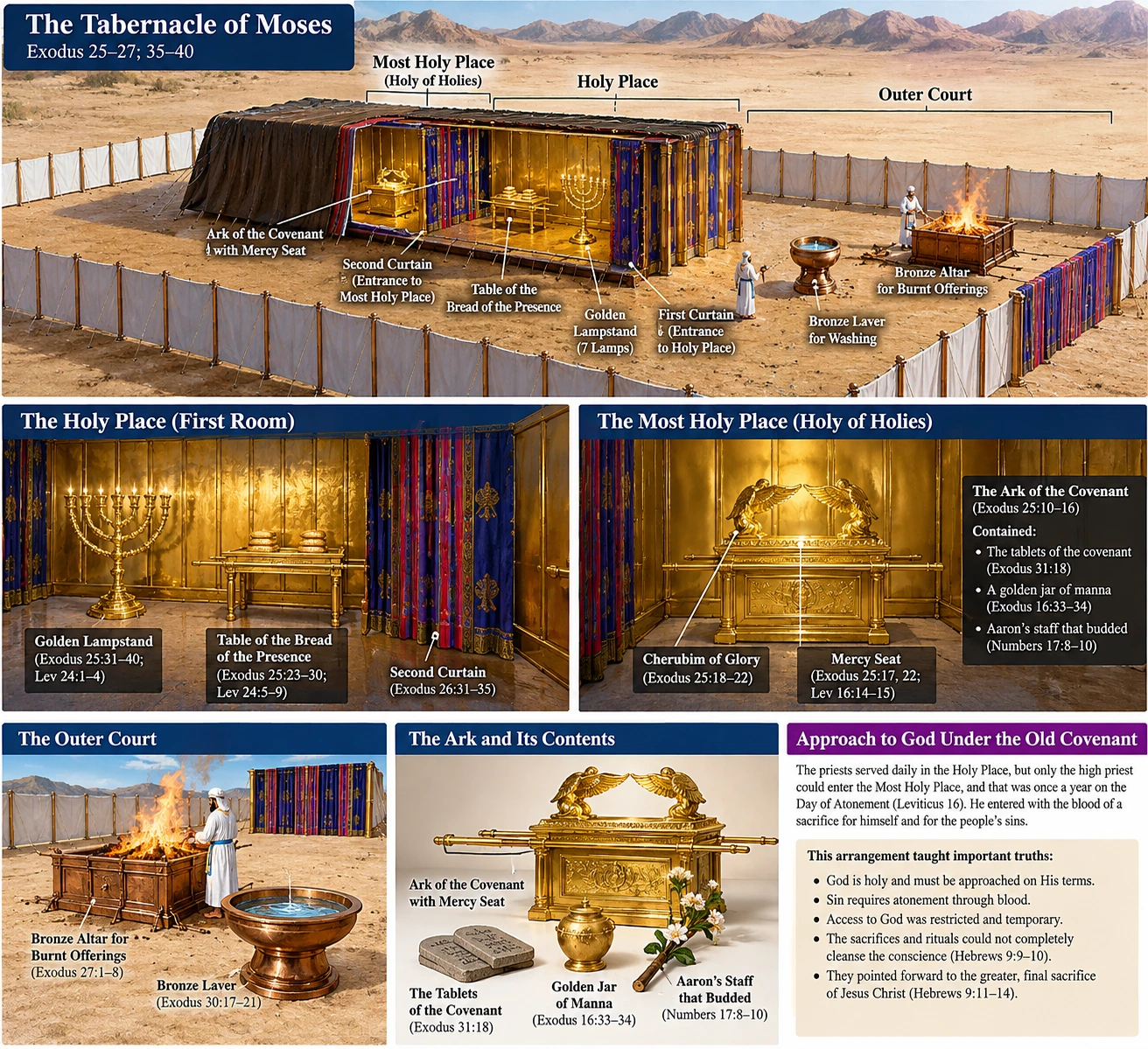
The word translated “earthly” does not mean that the sanctuary was sinful or invented by men. It identifies the sanctuary as belonging to this created world, in contrast to the heavenly reality discussed in Chapter 8. This distinction matters because we should never confuse the limitations of the Mosaic system with a defect in God’s character or wisdom. God established a genuine but temporary arrangement that taught His people through visible objects, appointed rituals, and restricted access.
Hebrews 9:3–5
The Most Holy Place, the Ark, and the Mercy Seat
Beyond the second curtain was the Most Holy Place, the innermost chamber associated with God’s presence among Israel. Hebrews describes the gold-covered ark of the covenant, the tablets of the covenant, the golden jar of manna, Aaron’s staff that budded, and the cherubim overshadowing the mercy seat. The tablets recalled God’s covenant commands; the manna recalled His provision in the wilderness (Exodus 16:32–34); and Aaron’s budding staff recalled God’s confirmation of the appointed priesthood (Numbers 17:8–10). Together these objects directed attention to God’s faithfulness, His authority, and Israel’s dependence upon Him.
The “mercy seat,” from the Greek hilastērion [G2435], was the covering associated with the ark and the place where atoning blood was presented on the Day of Atonement (Leviticus 16:14–15). The word also appears in Romans 3:25 in connection with Christ and atonement. The relationship is important, although we should not assume that every detail of the tabernacle furniture corresponds to a separate, hidden meaning. Hebrews itself identifies the central contrast: the earlier sanctuary and its rituals could not provide the final cleansing accomplished by Christ.
Supplementary Note: Was the Incense Altar Inside the Most Holy Place?
Hebrews 9:4 presents an interesting textual and historical question. Some translations refer to a “golden censer,” while others read “golden altar of incense.” The Greek word thymiatērion [G2369] has been understood in both ways. Exodus 30:6 locates the incense altar before the curtain, within the Holy Place, yet Hebrews associates the incense furnishing with the Most Holy Place. The writer may be describing its special relationship to the innermost sanctuary and the Day of Atonement rather than giving a precise floor plan. If a censer is intended, Leviticus 16:12–13 describes the high priest carrying incense within the curtain. Scholars disagree on the best explanation, and we should acknowledge that rather than pretend the wording presents no difficulty.
A related question concerns the manna and Aaron’s staff. Hebrews associates them with the ark, while 1 Kings 8:9 reports that, when the ark was placed in Solomon’s temple, only the stone tablets were inside it. Exodus 16:33–34 and Numbers 17:10 describe these objects as placed before the testimony. The texts may reflect different periods or ways of associating objects with the ark, but they do not supply enough detail to reconstruct every arrangement with certainty. Fortunately, the writer explicitly says that he cannot discuss these things in detail at present (Hebrews 9:5). His purpose is to explain the significance of priestly access and sacrifice, not to write a complete inventory of the sanctuary.
Hebrews 9:6–7
Regular Priestly Service and the Annual Day of Atonement
The priests entered the first room regularly to perform their appointed duties, but the high priest alone entered the second room, and then only in connection with the annual Day of Atonement. He did not enter without blood. Leviticus 16 explains the offerings made on account of his own sins and those of the people. This arrangement reminds us that the earthly high priest was himself a sinner who needed atonement. He could represent the people only within the limitations God had prescribed.
The expression concerning the people’s sins committed in ignorance should not be taken to mean that the Mosaic Law treated every deliberate act of rebellion as easily resolved by the annual ceremony. Numbers 15:27–31 distinguishes unintentional wrongdoing from defiant sin. The Day of Atonement addressed Israel’s uncleanness and transgressions within the covenant system, but its annual repetition demonstrated that the problem of sin had not been finally removed. Christ, by contrast, had no sins of His own to confess and no need to repeat His sacrifice (Hebrews 7:26–27).
When Hebrews says the high priest entered the Most Holy Place once a year, it identifies the one annual occasion on which this ministry was permitted, not necessarily one single entrance on that day. Leviticus 16 describes successive actions involving incense and sacrificial blood, including blood offered for the priest himself and for the people. This distinction helps us understand the comparison: the earthly ministry was restricted to an appointed day and had to be repeated year after year, whereas Christ entered the heavenly sanctuary on the basis of His completed, sufficient sacrifice.
The Seriousness of Entering the Most Holy Place
The seriousness of entering the Most Holy Place cannot be overstated. The high priest could not simply enter God’s presence whenever he wished, nor could he approach God according to his own preferences. Every aspect of his preparation, clothing, sacrifices, incense, and entrance was governed by God’s instructions (Leviticus 16:2–4, 11–17). This was no ordinary place of worship. It represented the dwelling place of the perfectly holy God, and disregarding His instructions could have deadly consequences. Leviticus 16:2 explicitly warns Aaron not to enter the Most Holy Place whenever he wished, “so that he will not die.” The deaths of Nadab and Abihu, who offered unauthorized fire before the Lord (Leviticus 10:1–2), provide a sobering reminder that God’s holiness was not something to be treated casually.
There is also a longstanding tradition that a rope was tied to the high priest so that, should he die while inside the Most Holy Place, his body could be retrieved without anyone else entering. Although this account is sometimes repeated as historical fact, Scripture does not mention such a practice, and its historical reliability is uncertain. Nevertheless, the biblical warnings themselves leave no doubt about the seriousness of approaching God contrary to His commands. This makes the contrast in Hebrews all the more remarkable: through Jesus Christ, our perfect and eternal High Priest, believers are invited to draw near to the very God whose holiness once required such carefully restricted access (Hebrews 4:14–16; 10:19–22). Our confidence does not arise because God has become less holy, but because Christ has accomplished the perfect sacrifice through which we may approach the Father.
Hebrews 9:8–10
What the Restricted Entrance Was Teaching
The Holy Spirit was communicating something through the arrangement of the tabernacle. As long as the first sanctuary and its ministry stood as the governing arrangement, the way into the greater presence of God had not yet been openly manifested in the manner that Christ would accomplish. The ordinary worshipper could not simply pass through the curtain, and even the high priest entered under carefully prescribed conditions. These restrictions were not meaningless obstacles. They taught the seriousness of sin and the inadequacy of the earthly system to provide permanent access.
The writer says that the gifts and sacrifices could not perfect the worshipper with respect to conscience. Here “conscience” concerns the inward awareness of sin and accountability before God. The sacrifices could provide the ritual cleansing prescribed under the Law, but they could not accomplish the complete inward purification and final redemption secured by Christ. Regulations concerning food, drink, and ceremonial washings were imposed until the time of reformation, when God would bring the promised greater arrangement into effect.
We should remember the discussion of the torn curtain in Chapter 6. Its tearing did not announce that people could now approach the Father independently of Jesus Christ. Rather, the old restrictions were overtaken by the sufficient sacrifice and permanent priesthood of the One through whom we draw near to God. Our access is greater because our Mediator is greater, not because mediation has become unnecessary.
Hebrews 9:11–12
Christ Entered Once and Secured Eternal Redemption
The writer now turns from the earthly sanctuary to Christ Himself. Jesus appeared as High Priest of the good things associated with His saving work and entered the greater and more perfect tabernacle, not made with human hands. He did not enter by means of the blood of goats and calves, but through His own blood, securing eternal redemption. The contrast concerns both the quality of the sacrifice and the permanence of its result. The blood of animals was repeatedly offered; Christ’s self-offering was sufficient once for all.
We should be careful with the imagery. Hebrews is not describing Jesus as repeatedly bleeding in heaven or as needing to perform a second sacrifice after the cross. The language of entering “through His own blood” connects His heavenly ministry with the death He had already accomplished. The Greek word lytrōsis [G3085], translated “redemption,” conveys release or deliverance by the payment of a ransom or redeeming price. The writer calls it eternal because the redemption secured by Christ is not limited to the temporary and repeated ceremonies of the former covenant.
Some translations of verse 11 speak of “good things that have come,” while others speak of “good things to come,” reflecting a textual variation. Both readings fit the chapter’s larger movement from promise to fulfillment, but the difference reminds us that the blessings of Christ’s work have a present reality and a future completion. The chapter ends by looking forward to His appearing again for the salvation of those who await Him (Hebrews 9:28).
This distinction would have been especially meaningful to believers who continued to suffer because of their faith. Hebrews later recalls those who endured public reproach, imprisonment, and the loss of possessions (Hebrews 10:32–34). Eternal redemption does not promise immediate freedom from earthly hardship; it establishes a lasting relationship with God and a future inheritance that suffering cannot cancel. As we observed when studying God’s rest in Chapter 4, believers can possess genuine blessings in Christ now while still awaiting the fullness of what God has promised.
Hebrews 9:13–14
From Ceremonial Cleansing to a Cleansed Conscience
Under the Mosaic system, the blood of sacrificial animals and the ashes of a heifer could provide the ceremonial purification prescribed by the Law (Numbers 19). The writer does not deny that these rites had a legitimate function. He argues from the lesser to the greater: if such ceremonies provided outward cleansing, how much more will the blood of Christ cleanse the conscience of those who approach God through Him? Jesus offered Himself without blemish to God through the eternal Spirit. Unlike an unwilling animal victim, Christ’s sacrifice involved His own obedient self-giving.
The purpose of this cleansing is not merely to relieve an unpleasant feeling of guilt. It enables believers to serve the living God. The expression “dead works” has been understood in different ways, including sinful deeds and works unable to impart life. Within this passage, the contrast is between what cannot finally cleanse the conscience and the living service made possible through Christ. The writer’s point is not that obedience has become unnecessary, but that acceptable service rests upon God’s redeeming work rather than upon repeated sacrifices incapable of perfecting the worshipper.
The phrase “through the eternal Spirit” has also prompted discussion. Many understand it as referring to the Holy Spirit, in keeping with the Spirit’s work in the life and ministry of Christ (Luke 4:18; Romans 8:11). Others understand it in relation to Christ’s divine nature or His willing obedience. Whatever distinction is made, the writer is not describing an ordinary human sacrifice or a merely external ceremony: the sinless Son willingly offered Himself to God. His death was the actual, sufficient sacrifice, and His resurrection and continuing heavenly ministry do not require that sacrifice to be performed again.
Notice also how the writer connects the cleansing of conscience to a new purpose for life. Hebrews began by calling for repentance from dead works (Hebrews 6:1), and it will later describe praise, doing good, and sharing with others as sacrifices pleasing to God (Hebrews 13:15–16). We are not redeemed merely from the guilt and consequences of sin; we are redeemed to belong to God and to serve Him. Such service does not purchase salvation. It is the proper response of those who have received His grace through Jesus Christ.
Hebrews 9:15
Mediator of the New Covenant and the Promised Inheritance
Because Christ’s sacrifice accomplishes what the earlier offerings could not, He is the mediator of the New Covenant. His death provides redemption from transgressions committed under the first covenant, so that those who are called may receive the promised eternal inheritance. This statement connects the two covenants without presenting them as two independent paths to salvation. The former covenant exposed and regulated sin but did not provide the final redemption that Christ accomplished.
The reference to an eternal inheritance recalls the promises of God and the future hope of His people. Inheritance language also connects with our earlier discussions of adoption and glorification. Believers already participate in the blessings of Christ, yet the fullness of the promised inheritance awaits the completion of God’s saving purpose. The writer’s emphasis remains upon the mediator: the inheritance is received because of what Jesus Christ has done, not because an earthly priesthood could secure it.
The inheritance also recalls Abraham, who obeyed God’s call while looking beyond the land before him to the city whose builder and maker is God (Hebrews 11:8–10, 13–16). The original readers likewise had promises that could not yet be seen in their fullness. Their hope did not depend upon possessing an earthly sanctuary or retaining earthly property; it depended upon the faithfulness of God and the mediation of His Son. Christ’s death secures the covenant through which that promised inheritance will be received.
Hebrews 9:16–17
Covenant or Testament? Why the Language of Death Matters
These verses are among the more difficult passages in Hebrews because the Greek word diathēkē [G1242] can refer to a covenant and, in certain contexts, to a will or testament. Many English translations understand verses 16–17 as an illustration from a legal will: the death of the person making the will is necessary before the inheritance is distributed. That reading fits the mention of an inheritance in verse 15 and explains why the writer suddenly emphasizes the death of the one who established the arrangement.
Other interpreters understand the word as “covenant” throughout the passage. They point to the writer’s sustained comparison of the Old and New Covenants and to verses 18–22, where the first covenant is inaugurated with sacrificial blood. On this reading, the emphasis is upon death in covenant ratification, not upon a legal will. The difficulty is that the covenant-making parties did not themselves ordinarily die when a covenant was established; sacrificial victims represented the seriousness of the covenant. Both interpretations have longstanding defenders, and the Greek wording does not permit us to dismiss the question as though it were settled beyond dispute.
For our purposes, we need not force the passage into an artificial certainty. Whether the writer briefly draws upon the illustration of a testament or continues the language of covenant ratification, the surrounding argument makes the essential point unmistakable: the death of Christ is indispensable to the establishment and benefits of the New Covenant. Unlike the sacrifices of the former covenant, His death is sufficient and need not be repeated.
Hebrews 9:18–22
Why the First Covenant Was Inaugurated With Blood
The writer returns to Exodus 24, where Moses proclaimed the covenant commands and sprinkled blood in connection with the people and the covenant. Hebrews also refers to water, scarlet wool, hyssop, and the cleansing of the sanctuary and its vessels. These details draw upon the wider ceremonial world of the Law, including purification rites described elsewhere in the Pentateuch. The main point is that bloodshed was woven into the establishment and maintenance of the Old Covenant’s sacrificial worship.
A reader comparing the passages carefully will notice that Exodus 24:3–8 does not mention all the details listed in Hebrews. The scarlet material, hyssop, and water recall purification ceremonies such as those in Leviticus 14 and Numbers 19, while the tabernacle itself was constructed after the covenant ceremony at Sinai (Exodus 35–40). Hebrews appears to bring these related elements of covenant dedication and ceremonial purification together to make its larger point. This is a useful reminder that the writer is explaining the meaning of the sacrificial system, rather than simply reproducing one Old Testament narrative word for word.
Verse 22 declares that under the Law almost everything was purified with blood and that without the shedding of blood there is no forgiveness. The word “almost” matters, because the Mosaic Law also prescribed other forms of purification, and Leviticus 5:11–13 permitted a grain offering for certain sins when a person could not afford an animal. We should therefore avoid turning the writer’s summary of the sacrificial system into a claim that Scripture knows absolutely no exceptions to the use of blood in every ritual. His central argument concerns the seriousness of sin and the sacrificial death through which the New Covenant’s forgiveness has been secured.
The death of an innocent animal under the Law never meant that the animal itself possessed the moral worth to remove humanity’s guilt permanently. Those offerings served the purpose God appointed for them and pointed toward the perfect sacrifice of Christ. His death is not simply another instance of the same ceremony. It is the fulfillment toward which the earlier system directed attention.
Hebrews 9:23–24
The Heavenly Reality and Christ’s Appearance Before God
Hebrews explains that the earthly copies were purified through the appointed sacrifices, while the heavenly realities required better sacrifices. The plural expression “better sacrifices” should not lead us to imagine multiple sacrifices by Jesus. The writer immediately identifies the decisive offering as Christ’s own sacrifice, and verses 25–26 explicitly reject its repetition. The plural language can reflect the comparison with the sacrificial system as a whole, while the reality fulfilled in Christ is one sufficient offering.
The statement about heavenly purification raises an interpretive question: why would heaven require cleansing? Hebrews does not suggest that God Himself is sinful or that His heavenly dwelling was morally corrupted. Interpreters have proposed that the language concerns the inauguration of heavenly access for redeemed humanity, the removal of sin’s barrier to communion with God, or the fulfillment of what earthly sanctuary purification represented. The precise relationship between the imagery and heavenly reality is debated. What the writer clearly says is that Christ entered heaven itself, appearing before God on our behalf, rather than entering a sanctuary made with human hands.
This returns us to a truth that must not be lost in the discussion of the curtain: Jesus appears before God for us. His completed sacrifice and continuing representation are inseparable aspects of His eternal priesthood. We approach the Father through Him, not apart from Him (Hebrews 7:25; Ephesians 2:18).
The heavenly purification language should therefore be considered alongside the chapter’s emphasis upon access and representation. Under the former covenant, the earthly sanctuary required ceremonial purification even though the furniture itself had committed no sin (Leviticus 16:16–19). That background helps explain why Hebrews can speak of the heavenly realities in sacrificial terms without suggesting that God is morally unclean. The text does not answer every question about how this imagery corresponds to heaven itself, but it leaves no doubt about the result for believers: Christ now appears in God’s presence on their behalf.
Hebrews 9:25–26
One Sacrifice, Not an Endless Repetition
The high priest entered the earthly Most Holy Place annually with blood that was not his own. Christ did not enter heaven to offer Himself repeatedly. If His sacrifice had to be repeated, the writer reasons, He would have needed to suffer repeatedly throughout history. Instead, He appeared once, at the culmination of the ages, to put away sin by the sacrifice of Himself. The contrast is deliberate: repeated earthly offerings could not complete the work, while Christ’s sacrifice possesses the sufficiency that repetition could never supply.
The expression “the end of the ages” should not be reduced to a prediction that the physical world had to end immediately after the first century. It identifies the decisive arrival of God’s promised redemptive work in Christ. The writer sees His death as the turning point toward which the earlier priesthood, sanctuary, and sacrifices pointed. We should also distinguish the completed nature of the sacrifice from the continuing application of its benefits. Christ does not need to die again whenever someone believes or sins; the one sacrifice remains sufficient, and He continues to intercede for those who draw near through Him.
Hebrews 9:27–28
Judgment, Christ’s Return, and the Completion of Salvation
The writer concludes with an analogy: human beings ordinarily die once and then face judgment; likewise, Christ was offered once to bear the sins of many and will appear a second time, not to repeat the offering for sin, but to bring salvation to those who eagerly await Him. The comparison is about the decisive, nonrepeating character of death and sacrifice. It should not be pressed into a complete account of every exceptional biblical event involving death or resurrection. The writer’s point is that Christ’s saving death is not a cycle that must occur again and again.
The statement that Christ bore “the sins of many” recalls Isaiah 53:12. It does not, by itself, settle debates concerning the intended extent of the atonement. Here the writer is emphasizing the effectiveness of Christ’s offering and the hope of those who await His return. His second appearing will not be another attempt to accomplish what the cross failed to accomplish. It will bring the promised salvation to its consummation.
This provides a fitting connection with our studies concerning the glorification of the saints. Salvation has a decisive foundation in the completed work of Christ, real blessings in the present life, and a promised future fulfillment. Believers still experience weakness, suffering, temptation, and death, but Christ’s return directs their hope toward the completed redemption God has promised. The chapter ends not with another animal sacrifice or an earthly priest standing behind a curtain, but with the expectation of the eternal High Priest who will bring His people into the fullness of salvation.
Christ Has Appeared, Appears Now, and Will Appear Again
The closing verses bring together three dimensions of Christ’s saving ministry. He appeared once in history to put away sin by the sacrifice of Himself (Hebrews 9:26). He now appears in the presence of God on our behalf (Hebrews 9:24). And He will appear again to bring salvation to its promised completion for those who await Him (Hebrews 9:28). These are not three sacrifices or three attempts to accomplish redemption. They are the completed sacrifice, the continuing heavenly ministry, and the future fulfillment of the one saving purpose of God in Jesus Christ.
Supplementary Study — The Day of Atonement and the Torn Curtain
The Day of Atonement provides one of the clearest historical backgrounds for understanding Hebrews 9. According to Leviticus 16, the high priest entered the Most Holy Place under carefully prescribed conditions and presented sacrificial blood. The people did not accompany him. The ceremony was repeated annually because the former system did not permanently remove sin. Its restrictions and repetition demonstrated both the seriousness of approaching a holy God and the limits of the earthly priesthood.
When the temple curtain was torn at Jesus’ death (Matthew 27:50–51), the event signaled a decisive change in the relationship between the earthly sanctuary and the greater work of Christ. It did not mean that the Father could now be approached without a mediator, nor did it end Christ’s priestly intercession. Rather, the perfect High Priest had accomplished the sacrifice that the former system could only anticipate. Hebrews 10:19–22 will invite believers to draw near with confidence, but that confidence rests expressly upon Jesus and His blood. The curtain was not torn because we no longer need a High Priest. It was torn because the eternal High Priest had accomplished what the earthly priesthood could never complete.
This background also helps us understand the warning passages of Hebrews 6 and 10. If some Jewish-background believers were tempted to abandon Christ and return to the former sacrificial system, the writer’s argument would have been especially urgent. Those sacrifices could not serve as an alternative to the One to whom they pointed. Nevertheless, we should not restrict the warnings solely to a return to animal sacrifices; the larger danger is knowingly turning away from Christ and the only sufficient sacrifice for sin.
Supplementary Study — What Does It Mean to Cleanse the Conscience?
The contrast between outward purification and the cleansing of conscience in Hebrews 9:9 and 9:14 deserves further reflection. A person could participate in the rituals required by the Mosaic Law and still know inwardly that sin remained a serious problem. The sacrifices testified to the need for atonement, but their repetition could not bring the worshipper to final perfection. Christ’s sacrifice provides a different foundation for approaching God: forgiveness grounded in His completed work rather than continual dependence upon ceremonies that could not remove sin permanently.
This does not mean that believers instantly become incapable of sin, that their moral judgment can never be mistaken, or that they no longer need confession, correction, and spiritual growth. Hebrews continues to warn, teach, and encourage those who belong to the Christian community. The cleansing of conscience therefore should not be confused with the completion of glorification in our present lives. It means that the worshipper can approach and serve the living God on the basis of the sufficient redemption Christ has accomplished, while continuing to grow toward the fullness of the salvation God has promised.
Chapter Summary
The Sacrifice That Accomplished What the Shadows Could Not
Hebrews Chapter 9 explains why the earthly sanctuary, priesthood, and sacrifices could never be the final means of humanity’s redemption. They were established by God and served a genuine purpose, but they were limited in their access, repeated in their offerings, and unable to perfect the conscience. The writer uses the tabernacle and the Day of Atonement to show that the former arrangement anticipated something greater rather than providing a permanent alternative to Christ.
Jesus Christ entered the heavenly reality through His own sacrificial death, secured eternal redemption, and established the New Covenant. His blood cleanses the conscience so that believers may serve the living God. His sacrifice was offered once, not repeatedly, and His heavenly appearance before God is on our behalf. The writer therefore joins two truths that we must hold together: the sacrifice is finished, and the priestly ministry of Christ continues.
The chapter also looks forward. The same Christ who offered Himself once will appear again to bring salvation to its promised completion. This prepares us for Chapter 10, where the writer will contrast the repeated sacrifices of the Law with the single offering of Christ and explain why believers may draw near to God with confidence through Him. The central message is unmistakable: there is no other sacrifice that can accomplish what Jesus Christ has accomplished, and there is no access to the Father apart from our eternal High Priest.