
-
Anchoring in Christ
-
- But I Am a Good Person—Why Would God Condemn Me?
- But Christians are Hypocrites
- But Faith in God is Irrational?
- But Isn't the God of the Old Testament a Monster?
- But If God Exists, Why Does God Allow Evil?
- But is the Bible Full of Mysteries, Paradoxes, and Unknowable Things?
- But How Can You Know The Bible Is True?
- But Why Christianity And Not Some Other World Religion?
- But There Are So Many Churches and Denominations - Which One Is Right?
-
Topical Studies
-
-
- Sin: The Elephant In The Room
- But I Am a Good Person—Why Would God Condemn Me?
- What is Sin?
- Is God The Author Of Sin?
- The introduction of Sin into the World
- What Changed Because of the Fall?
- What Did Humanity Inherit from Adam?
- Personal Sin and Personal Guilt
- The Deceitfulness and Progressiveness of Sin
- The Consequences and Judgment of Sin
- Analogies of Sin
- Analogies of Repentance
- Generational Sin and the Increasing Corruption of a People
- Evangelism and the Topic of Sin
-
- Ignorance of God - No Excuse
- God’s Remedy for Sin
- Adoption as Sons: From Bondage to Glory
- Called to Glory: Understanding the Purpose of God's Call
- Those IN Christ: Elected & Predestined to Glory
- The Role of Faith in Salvation
-
- Glorification of the Saints - An Introduction
- Glorification of the Saints - First Creation
- Glorification of the Saints - Fall of Angels
- Glorification of the Saints - Fall of Man
- Glorification of the Saints - Redemption
- Glorification of the Saints - The New Creation
- Glorification of the Saints - God's Eternal Purpose
- The Glorified Body: From Adam to Christ
-
- Foreknowledge, Predestination, and Election: An Examination in Their Biblical Context
- Predestined to Glory: Why Predestination Must Be Understood Before Election
- Biblical Predestination: From Sin to Glory
-
- Articles coming soon
-
-
Book Studies
- Book Study Intro Note
- Study References, Resources, and Acknowledgments
- Hebrew Bible and Jewish Writings
- The Septuagint (LXX) - Scripture in Greek Translation
-
-
-
- Articles coming soon
-
- Articles coming soon
-
- Articles coming soon
-
-
- Articles coming soon
-
- Articles coming soon
-
- Articles coming soon
-
- Articles coming soon
-
- Articles coming soon
-
- Articles coming soon
-
- Articles coming soon
-
- Articles coming soon
-
- Articles coming soon
-
- Articles coming soon
-
- Articles coming soon
-
- Articles coming soon
-
-
-
- Articles coming soon
-
- Articles coming soon
-
- Articles coming soon
-
- Articles coming soon
-
-
-
- Articles coming soon
-
- Articles coming soon
-
- Articles coming soon
-
- Articles coming soon
-
-
- Articles coming soon
-
- Articles coming soon
-
- Articles coming soon
-
- Articles coming soon
-
- Articles coming soon
-
- Articles coming soon
-
- Articles coming soon
-
- Articles coming soon
-
- Articles coming soon
-
- Articles coming soon
-
- Articles coming soon
-
- Articles coming soon
-
-
-
-
-
- Articles coming soon
-
- Articles coming soon
-
- Articles coming soon
-
- Articles coming soon
-
-
- Articles coming soon
-
- Articles coming soon
-
- Articles coming soon
-
- Articles coming soon
-
-
-
- Articles coming soon
-
- Articles coming soon
-
- Articles coming soon
-
- Articles coming soon
-
- Articles coming soon
-
- Articles coming soon
-
-
-
- Articles coming soon
-
- Articles coming soon
-
- Articles coming soon
-
- Articles coming soon
-
- Articles coming soon
-
-
- Articles coming soon
-
Musings
-
Reference Tools
Hebrew Bible and Jewish Writings
0 out of 5 stars
| 5 Stars | 0% | |
| 4 Stars | 0% | |
| 3 Stars | 0% | |
| 2 Stars | 0% | |
| 1 Stars | 0% |
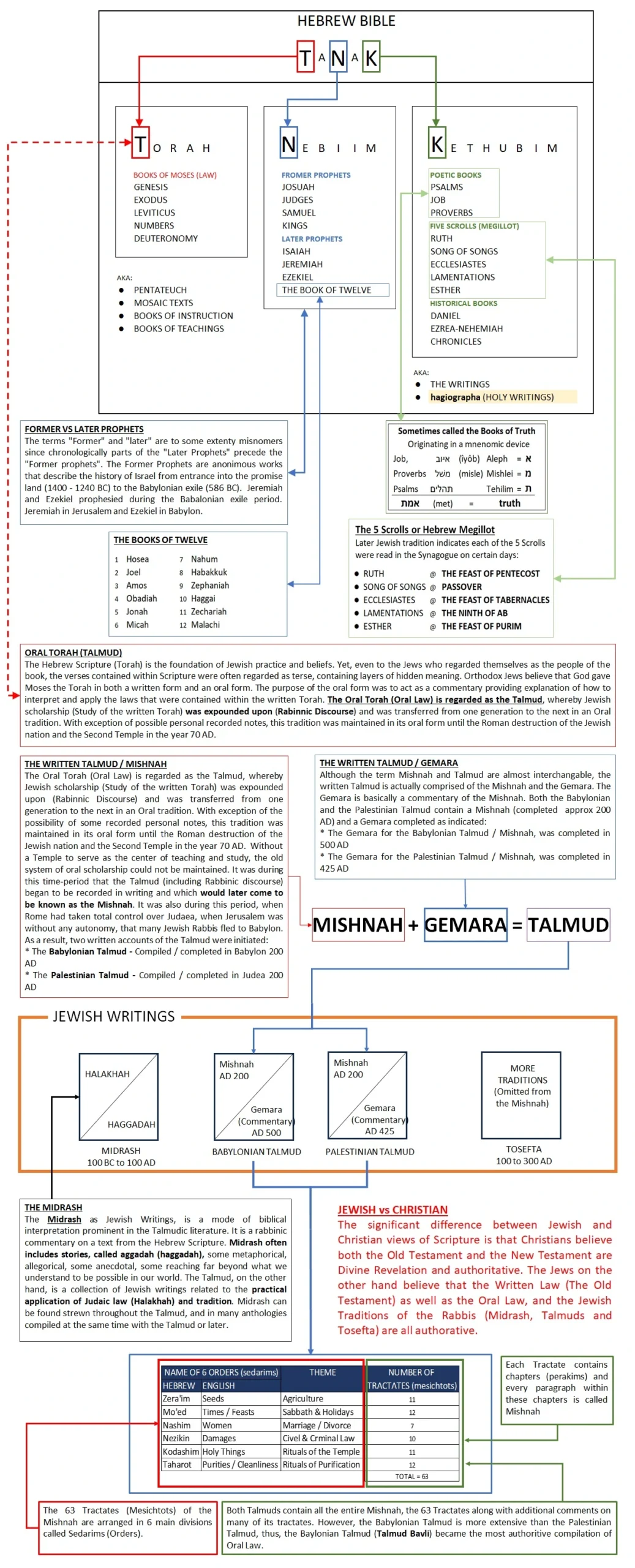
The Hebrew Bible and Jewish Religious Writings
This illustration provides an overview of the Hebrew Bible (Tanakh), its three principal divisions, and the development of Jewish religious writings and traditions. It explains the distinctions and relationships between the Written Torah, Oral Torah, Mishnah, Gemara, Talmud, Midrash, and other rabbinic literature, including their historical development and organization. By distinguishing the Hebrew Scriptures from the later writings and interpretations of Jewish religious scholars, it provides valuable historical and religious context for understanding Judaism, the Old Testament, and the Jewish world in which Jesus and His apostles lived.
What Did the Pharisees Study and Teach?
Understanding the distinction between the Written Torah and the Oral Torah is particularly important when reading the New Testament, especially the encounters between Jesus and the Pharisees. The Pharisees were a Jewish religious movement that studied and upheld the Written Law of Moses, but they also placed considerable importance on the interpretations, explanations, and traditions handed down by earlier religious teachers. These traditions, sometimes described in the New Testament as the tradition of the elders (Matthew 15:2; Mark 7:3–5), sought to explain how the commandments of the Written Law should be understood and applied in everyday life.
In some respects, these oral traditions functioned much like a commentary on Scripture, but they went considerably further. They included religious regulations, interpretations of biblical commandments, and practical instructions governing matters such as ceremonial washing, Sabbath observance, purity, and other aspects of Jewish life. The Pharisees regarded these traditions as important to the proper observance of God’s Law, although the extent and application of particular traditions were subjects of debate among Jewish teachers.
This distinction helps explain some of the confrontations between Jesus and the Pharisees. Jesus did not condemn the careful study of Scripture or obedience to God’s commandments. Rather, He challenged religious traditions whenever they contradicted, obscured, or displaced what God had actually commanded. In Mark 7:8–9, Jesus declared, “For laying aside the commandment of God, ye hold the tradition of men” and “Full well ye reject the commandment of God, that ye may keep your own tradition” (KJV).
It is also important to recognize that the Mishnah and Talmuds illustrated below were compiled after the earthly ministry of Jesus. Although they preserve and discuss traditions with earlier roots, we should not assume that every teaching found in these later collections was already practiced or accepted by the Pharisees of Jesus’ day.
0 out of 5 stars
| 5 Stars | 0% | |
| 4 Stars | 0% | |
| 3 Stars | 0% | |
| 2 Stars | 0% | |
| 1 Stars | 0% |