
Reading Scripture Through the Proper Lens
Reading Scripture Through the Proper Lens
Understanding Biblical Perspective, Context, and Interpretation
The Bible is unlike any other book we will ever read. It contains history, poetry, prophecy, instruction, promises, warnings, and accounts of God’s dealings with humanity. It was written over many centuries, through numerous human authors, to different audiences, under very different circumstances. Yet, throughout its pages, we encounter the revelation of one God whose character, purposes, and truth remain consistent.
Unfortunately, it is possible to read the words of Scripture without correctly understanding what those words communicate. Two people can read the same passage and arrive at very different conclusions. Sometimes this happens because one person understands something about the historical circumstances that the other does not. Sometimes it happens because figurative language is mistaken for literal language, or because a passage is separated from its surrounding context. At other times, the problem is that we approach Scripture with conclusions we have already accepted and then attempt to make what we read conform to those conclusions.
The question, therefore, is not simply whether we are reading Scripture, but whether we are reading it through the proper lens.
God’s Word is written from His perspective for our perspective.
This is a principle worth remembering every time we open our Bibles. God has revealed His Word so that we might know Him, understand what He has done, recognize what He requires, and respond appropriately to what He has made known. However, to understand that revelation properly, we must consider the perspectives from which Scripture was written, the context in which it was given, and the language through which it communicates.
1. Understanding the Proper Perspective
Before asking what a passage means to us, we should first seek to understand what it communicated to those who originally received it. We must also consider what the passage reveals from God’s perspective and, finally, how its truth applies to our own lives. These three perspectives are not competing approaches to Scripture. They complement one another.
The Perspective of the Intended Audience
Every book of the Bible was written within a particular historical, cultural, and religious setting. The original audience often understood circumstances, expressions, traditions, and controversies that are unfamiliar to modern readers. For example, when Jesus spoke with the Samaritan woman at the well in John 4, His conversation involved far more than a request for drinking water. Understanding the historical hostility between Jews and Samaritans helps us appreciate the significance of Jesus speaking with her. Understanding the importance of Jacob’s well and the competing places of worship helps us recognize why their conversation developed as it did.
Without that background, we can still understand much of what Jesus taught. However, with it, we begin to appreciate the depth of His words and the significance of His actions. The same principle applies throughout Scripture. Understanding the circumstances surrounding Israel’s departure from Egypt, the significance of the Levitical priesthood, or the challenges facing the early churches can greatly improve our understanding of the passages that address them. This does not mean that someone must become a historian or biblical scholar before reading the Bible. It simply means recognizing that the more we understand about the original audience and its circumstances, the better equipped we become to understand what was communicated.
The Perspective of God: His Being, Character, and Realm
Although Scripture was written through human authors and addressed to human audiences, its ultimate source is God. 2 Timothy 3:16 tells us that all Scripture is God-breathed. Consequently, we must consider not only the circumstances of the human audience but also the character and purposes of the God who has revealed Himself through His Word. God does not view existence from the same limited perspective that we do. We experience life moment by moment, with an incomplete understanding of the past and an uncertain knowledge of the future. God, however, is eternal. He is not limited by our experience of time, our inability to see what lies ahead, or our incomplete understanding of His creation.
Consider Isaiah 55:8–9, where God declares that His thoughts and ways are higher than ours. This does not mean that Scripture is beyond our ability to understand or that we should abandon the effort. Rather, it reminds us that we must allow God’s revelation to inform and correct our limited human perspective. We must also remember that God is consistent with His own character. He is holy, righteous, just, merciful, loving, faithful, and truthful. An interpretation that requires God to act contrary to what He has revealed about Himself should cause us to examine that interpretation carefully. The more we learn about God through the whole of Scripture, the better equipped we become to recognize what individual passages reveal about Him.
The Perspective of Our Own Lives: Understanding and Application
Having considered the intended audience and God’s perspective, we can then ask how the passage applies to our own lives. This distinction is important because a passage can have a particular historical setting while communicating truths that remain relevant to people living centuries later. For example, God’s command to Noah to build an ark was given to Noah under particular circumstances. We are not commanded to build an ark simply because Noah was. Nevertheless, the account teaches us about God’s judgment, His mercy, the importance of faith, and the obedient response that genuine faith produces.
Likewise, the warnings and encouragements given to the early churches were written to particular congregations facing particular circumstances. Yet the truths they communicate about faithfulness, obedience, love, and perseverance remain applicable to believers today. Proper application begins with proper understanding. Rather than immediately asking, “What does this verse mean to me?” we should first ask, “What does this passage communicate?” Only then can we properly consider how we should respond.
2. Allowing Scripture to Speak for Scripture
One of the greatest dangers in Bible study is reading our own beliefs into Scripture rather than allowing Scripture to shape our beliefs. There is an important difference between discovering what a passage teaches and searching for passages that appear to support something we have already decided must be true. We all approach Scripture with existing knowledge, experiences, assumptions, and beliefs. None of us begins with a completely empty mind. However, we must remain willing to examine those beliefs against what God has actually revealed. Our responsibility is not to make Scripture agree with us. It is to bring our understanding into agreement with Scripture.
Allow Scripture to Interpret Scripture
The Bible is not a collection of unrelated statements. Its books were written at different times and under different circumstances, but together they communicate God’s unfolding revelation. A passage should therefore be understood within its immediate context, within the book in which it appears, and within the broader testimony of Scripture. Consider the relationship between Genesis and Hebrews. Genesis tells us that God rested on the seventh day after completing His work of creation. Hebrews 3–4 draws upon that account, together with Israel’s failure to enter the promised rest, to teach about the rest that remains for God’s people.
Reading Genesis alone provides important information. Reading Hebrews alongside Genesis reveals further significance in what God had previously communicated. The later revelation does not make the earlier revelation untrue. Rather, it helps us understand more fully what God has revealed. This is one reason the New Testament’s use of the Old Testament is so valuable. The apostles frequently explain how earlier events, promises, institutions, and prophecies relate to Jesus Christ and God’s purposes in salvation.
Interpret Scripture Contextually and Progressively
Context matters. A sentence removed from a conversation can communicate something entirely different from what the speaker intended. The same is true of Scripture. We should consider what comes before and after a passage, who is speaking, who is being addressed, and what subject is under discussion. We must also recognize that God’s revelation unfolded progressively throughout biblical history. For example, the Old Testament sacrificial system cannot be fully appreciated without understanding its relationship to the sacrifice of Jesus Christ explained in Hebrews. The earlier revelation established the historical and theological foundation upon which the later explanation builds. Progressive revelation does not mean that God changed His mind or that His character developed over time. It means that He revealed His purposes through history, providing additional understanding as His plan unfolded.
When an Interpretation Appears to Contradict Scripture
This brings us to an especially important principle: If an interpretation of one passage contradicts what Scripture clearly teaches elsewhere, that interpretation is either incomplete or incorrect. We should distinguish between a contradiction in Scripture itself and a contradiction created by our understanding of Scripture. For example, if one passage teaches that God is truthful, while our interpretation of another passage requires Him to deceive, we should reconsider whether we have understood the second passage correctly.
Likewise, if our interpretation of a passage requires us to deny something Scripture clearly reveals about the person or work of Jesus Christ, the problem lies with our interpretation, not with God’s revelation. This does not mean that every difficult passage can be resolved immediately. There are matters that require careful study, and some questions may remain unanswered. Nevertheless, difficulty is not a reason to disregard what Scripture has already made clear. The objective is to arrive at an understanding that remains consistent with the whole counsel of God.
3. Recognizing Literal and Figurative Language
The Bible communicates through different forms of language. Some passages describe historical events. Others use comparisons, poetry, imagery, exaggeration, or other figures of speech to communicate truth. Recognizing the difference is essential. However, we should be careful not to assume that figurative language communicates something less truthful than literal language. A metaphor can communicate a very real truth without requiring us to interpret every word as a physical description.
Beginning with the Ordinary Meaning
When reading Scripture, we should begin by considering the ordinary meaning of the words within their grammatical and historical context. If a passage describes a journey, a person, a location, or an event, we should not automatically assume that it represents something else. At the same time, reading Scripture literally does not mean refusing to recognize figures of speech. Proper interpretation considers the kind of language being used and what that language was intended to communicate. When Jesus said, “I am the door” in John 10:9, He was not claiming to be a wooden structure with hinges. The context makes it clear that He was using figurative language to communicate that He is the means through which His sheep enter and find salvation. The statement is figurative, but the truth it communicates is not imaginary.
Recognizing Figurative Language
Figurative language appears throughout Scripture and is particularly prominent in biblical poetry. The books of Job, Psalms, Proverbs, Ecclesiastes, and the Song of Solomon contain numerous examples of poetic expression, imagery, comparison, and other literary devices. Consider Psalm 18:2, where David describes the Lord as his rock, fortress, and deliverer. David is not claiming that God is literally made of stone. He is describing God’s strength, faithfulness, protection, and reliability through images his audience could readily understand.
Figurative language can communicate profound truths in memorable and powerful ways. However, those truths must be understood according to the intended meaning of the expression rather than by forcing every image into a literal description. The challenge is to recognize when Scripture is using figurative language and when it is describing something that should be understood as an actual event or circumstance. We should not spiritualize a passage merely because its ordinary meaning is uncomfortable or conflicts with a belief we already hold. Neither should we insist upon a woodenly literal interpretation when the language and context clearly indicate a figure of speech.
4. Understanding Prophetic Language
Prophecy presents additional challenges because it can involve historical circumstances, future events, warnings, promises, symbolic imagery, and declarations of God’s purposes. One common misunderstanding is the assumption that prophecy is concerned exclusively with predicting future events. In Scripture, prophets frequently proclaimed God’s truth to people living in their own time. They confronted disobedience, exposed injustice, warned of judgment, called people to repentance, and reminded them of God’s promises.
Forth-Telling and Foretelling
These two aspects of prophecy are often described as forth-telling and foretelling.
- Forth-telling involves proclaiming God’s message, making His will known, and addressing the spiritual or moral circumstances of the audience.
- Foretelling involves revealing what God has declared concerning events that have not yet occurred.
A prophet might engage in both within the same message. For example, the prophets repeatedly warned Israel and Judah about the consequences of their disobedience. These warnings addressed existing conditions while also declaring judgments that would follow if the people continued in rebellion. Likewise, the Old Testament prophets spoke about the coming Messiah, the restoration of God’s people, and the fulfillment of God’s promises. Understanding the distinction helps us avoid treating every prophetic statement as though it were exclusively a prediction about events far removed from the original audience.
The Importance of Historical and Biblical Context
Prophetic passages can be difficult because their language sometimes moves between immediate circumstances and events that reach beyond the prophet’s own lifetime. To understand them properly, we should consider the prophet’s audience, the historical circumstances, the purpose of the message, and any later biblical passages that explain or fulfill the prophecy. For example, Matthew 1:22–23 identifies the birth of Jesus Christ as the fulfillment of Isaiah’s prophecy concerning Immanuel. The New Testament provides information that helps us understand the significance of the earlier revelation. This is another example of why Scripture must be allowed to interpret Scripture.
5. Recognizing Symbolic Language
Symbolism is closely related to figurative language, but it deserves particular attention because biblical symbols can communicate meanings that are not immediately obvious to modern readers. A symbol may involve an object, a person, an action, an event, or an image that represents something beyond its immediate appearance. Sometimes the meaning is explained directly within Scripture. At other times, understanding the symbol requires familiarity with the language, historical setting, or related biblical passages.
Symbols Explained by Scripture
In John 1:29, John the Baptist identifies Jesus as “the Lamb of God, who takes away the sin of the world”. The title becomes much more meaningful when considered alongside the Old Testament sacrificial system, the Passover, and the New Testament’s explanation of Christ’s sacrifice. Jesus is not literally an animal. Nevertheless, the symbolism communicates a profound truth about His identity and His saving work. The book of Revelation also contains numerous symbols. Importantly, Revelation sometimes explains those symbols directly. For example, Revelation 1:20 identifies the seven stars and seven lampstands introduced earlier in the chapter. Rather than guessing what these images represent, we are given an explanation within the passage itself. This demonstrates an important interpretive principle: Before assigning a meaning to a biblical symbol, look for the explanation Scripture itself provides.
Recognizing Patterns and Parallels
Scripture also contains recurring patterns and relationships that help us understand God’s unfolding purposes. The New Testament, for example, draws comparisons between Adam and Jesus Christ. In Romans 5:12–21, Paul explains the relationship between Adam’s disobedience and Christ’s obedience, showing how the actions of these two men have profound consequences for humanity. In 1 Corinthians 15:45–49, Paul develops the comparison further, identifying Adam as the first man and Christ as the last Adam. These connections are not simply imaginative similarities discovered by later readers. They are relationships explicitly established by Scripture. Recognizing such patterns can deepen our appreciation of the unity of God’s revelation. However, we must also exercise care. Not every resemblance between two biblical events establishes an intended symbolic relationship. We should distinguish between symbolism that Scripture identifies and symbolism that we merely suspect might exist. The objective is to discover what God has revealed, not to invent meanings that the text does not support.
6. Bringing the Different Lenses Together
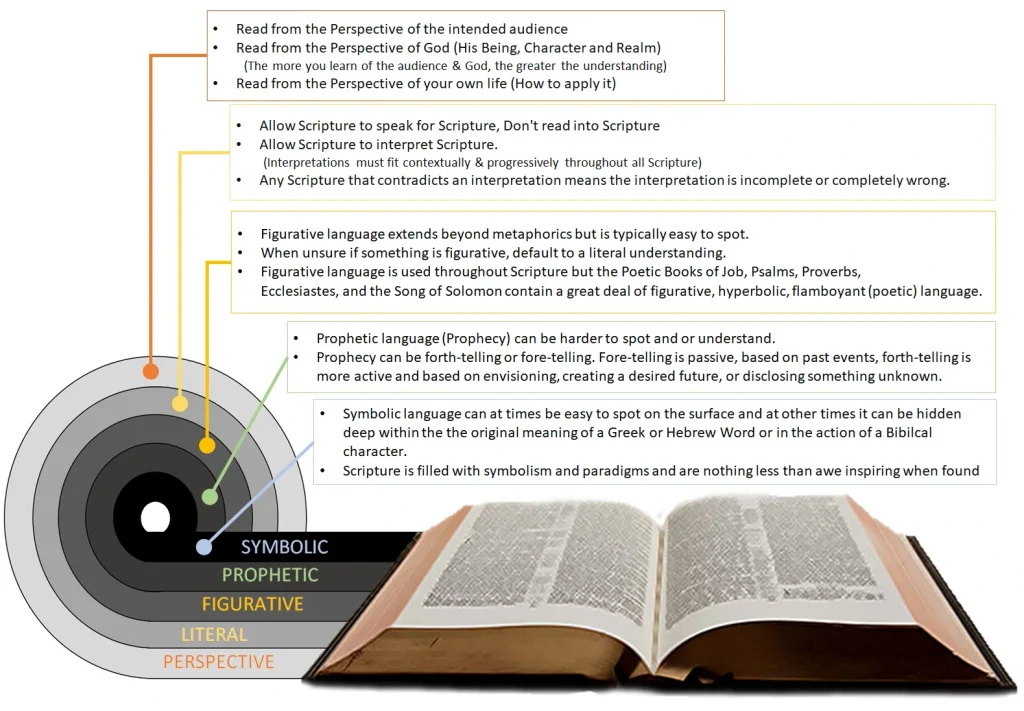
The accompanying illustration presents five important considerations: perspective, literal language, figurative language, prophetic language, and symbolic language. Although these are displayed as different layers, they should not be understood as five entirely separate methods of interpretation. They work together.
- Perspective provides the foundation. We seek to understand the original audience, God’s character and purposes, and the proper application of His Word.
- Literal understanding directs us to consider what the words ordinarily communicate within their context.
- Figurative language reminds us that comparisons, poetry, and other forms of expression can communicate genuine truths without describing everything literally.
- Prophetic language requires us to recognize the nature of God’s message, whether it addresses present circumstances, reveals future events, or includes both.
- Symbolic language calls us to examine how objects, images, actions, and patterns communicate meaning, especially when Scripture itself explains their significance.
These considerations frequently overlap. A prophetic passage may contain figurative language and symbolism. A historical account may establish a pattern that is explained in a later biblical book. A poetic expression may communicate a truth about God’s character that applies to every generation. Consequently, the purpose of the illustration is not to suggest that every passage must be assigned to one exclusive category. Rather, it reminds us to recognize the different ways Scripture communicates and to interpret each passage accordingly.
7. A Practical Approach to Studying Any Passage
Whenever we encounter a passage that is difficult to understand, there are several questions worth asking:
- Who was the original audience? What circumstances, traditions, or historical events might help explain what was communicated?
- What does the passage reveal about God? How does it relate to His character, attributes, purposes, and the broader revelation of Scripture?
- What is the immediate context? What comes before and after the passage, and what subject is being addressed?
- What kind of language is being used? Is the passage historical narrative, instruction, poetry, prophecy, figurative expression, or symbolism?
- Does Scripture explain the passage elsewhere? Are there related passages, especially later revelations, that provide additional understanding?
- Does my interpretation agree with the whole counsel of Scripture? Or does it require me to disregard something God has clearly revealed elsewhere?
- How should I respond? Having sought to understand what God has communicated, what does that truth require of me?
These questions are not intended to turn Bible study into a complicated academic exercise. Rather, they encourage us to slow down, examine what we are reading, and avoid drawing conclusions before we have properly considered what God has revealed. Sometimes the answer will be immediately apparent. At other times, we may need to compare passages, investigate historical circumstances, examine the meaning of a Hebrew or Greek word, or simply acknowledge that we have more studying to do. There is nothing wrong with admitting that we do not yet understand something. The danger comes when we become so committed to an interpretation that we are no longer willing to examine whether Scripture actually supports it.
Conclusion: Let God’s Word Shape Our Understanding
The purpose of studying Scripture is not merely to accumulate biblical information or develop arguments in support of our theological positions. It is to know God more fully, understand His revelation more accurately, and respond appropriately to what He has made known. The Bible was not given so that we could impose our own meanings upon it. Nor was it given so that we could isolate individual verses from their context and use them to defend conclusions that cannot be sustained by the whole of Scripture. God has revealed Himself through His Word, and our responsibility is to listen carefully to what He has communicated.
That requires humility. It requires a willingness to learn, to reconsider assumptions, and, when necessary, to correct beliefs we may have held for many years. It also requires recognizing that our understanding is not the standard against which Scripture must be measured. Scripture is the standard against which our understanding must be measured. As we grow in our knowledge of the original audiences, the historical settings, the different forms of biblical language, and, most importantly, the character and purposes of God, we become better equipped to understand His Word. And having understood what God has revealed, we are then responsible for considering how we should respond.
God’s Word is written from His perspective for our perspective. The more faithfully we seek to understand His perspective, the more accurately we can understand our own place within His revealed purposes. That is what it means to read Scripture through the proper lens.