
The Romans Road of Salvation
Estimated time to read:
Read this article to me
Suggested prerequisite reading:
Supporting Articles:
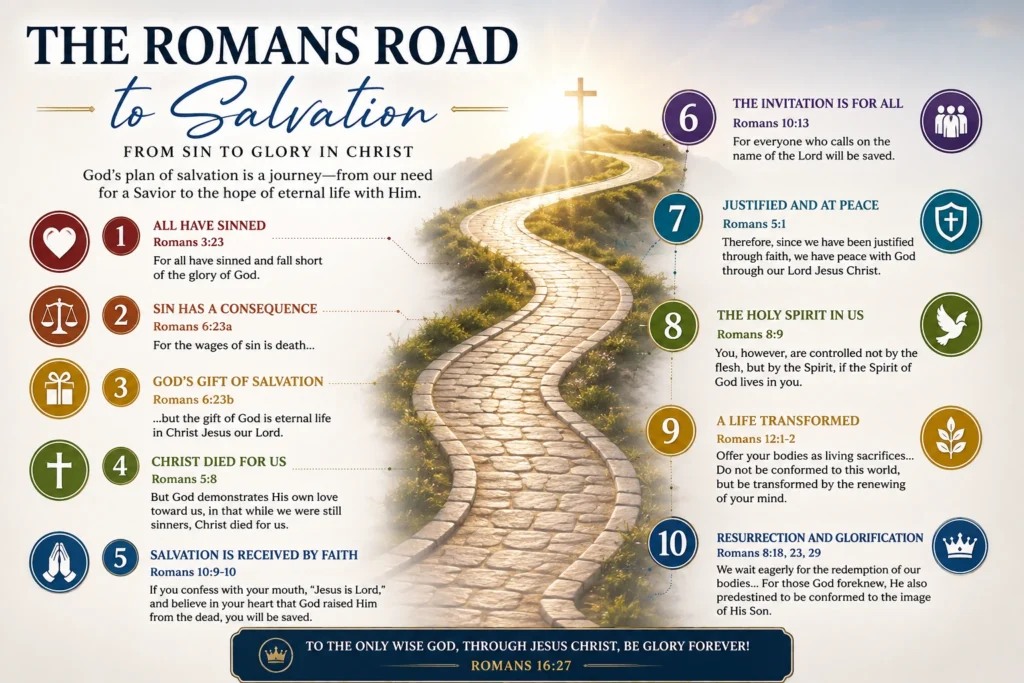
This Romans Road of Salvation study follows Paul’s message through Romans from humanity’s sin and condemnation to salvation through faith in Jesus Christ, new life in the Spirit, and the believer’s hope of glory. Rather than treating salvation as a handful of isolated verses, it traces the broader gospel message of Romans and shows how these passages fit together in their biblical context.
The Romans Road of Salvation: From Sin and Condemnation to Glory in Christ
From Sin and Condemnation to Life, Transformation, and Glory in Christ
The expression “Romans Road of Salvation” refers to a simple method of explaining the gospel by using a series of passages from Paul’s letter to the Romans. For generations, Christians have used these verses to show that all people are sinners, that sin results in death, that Jesus Christ died for sinners, and that salvation is received through faith in Him.
It is a useful and powerful way of presenting the gospel. But there is something important we should understand from the beginning: Paul never actually called this collection of verses the “Romans Road.” The familiar Romans Road is a teaching method developed by Christians from selected passages in Romans. There is nothing wrong with doing that, provided we do not mistake the abbreviated outline for the whole of Paul’s message.
The traditional Romans Road takes us to the doorway of salvation. Romans itself takes us much farther. Paul explains not only why we need salvation and how we receive salvation, but also what God does with those who are saved. He takes us from sin and condemnation to justification, from justification to life in Christ, from life in Christ to the indwelling Holy Spirit, from the Spirit to transformed living, and finally from suffering and mortality to resurrection and glorification.
The fuller Romans Road can therefore be expressed this way:
Sin → Judgment → God’s Love → Christ’s Death and Resurrection → Faith → Justification → Life in Christ → The Holy Spirit → Obedience Flowing From Faith → Resurrection and Glorification
That is the road we will follow.
The First Stop: All Have Sinned
Romans 3:23: “For all have sinned and fall short of the glory of God”.
The gospel begins with a problem that belongs to every one of us. We have sinned. Paul spends much of the opening chapters of Romans establishing this fact. Gentiles cannot excuse themselves because they did not possess the Law of Moses, and Jews cannot excuse themselves merely because they did possess it. Religious privilege does not erase sin, and ignorance does not turn unrighteousness into righteousness. Paul eventually brings the entire human race under the same conclusion: “There is none righteous, not even one” (Romans 3:10). This does not mean that every human being is equally wicked in every possible respect or that people are incapable of performing acts that are relatively good toward one another. Paul’s argument concerns our standing before a perfectly righteous God.
Measured against one another, some people certainly appear better than others.
Measured against God’s righteousness, all fall short.
That is why Christianity does not begin by dividing humanity into good people who deserve heaven and bad people who deserve judgment. It begins with sinners who need a Savior.
The Second Stop: Sin Has a Consequence
Romans 6:23: “For the wages of sin is death, but the gift of God is eternal life in Christ Jesus our Lord”.
Sin is not merely an unfortunate personality flaw. It has consequences. Paul calls death the wages of sin. Wages are what something earns. Sin produces death. Earlier Paul explained:
“Therefore, just as sin entered the world through one man, and death through sin, so also death was passed on to all men, because all sinned.”
—Romans 5:12
Humanity lives in a world in which sin and death reign. We are mortal creatures living within the consequences of Adam’s transgression, and each of us adds our own sin to that fallen history. But Romans 6:23 contains one of the most important contrasts in the entire gospel. Paul does not say:
The wages of sin is death, but the wages of righteousness is eternal life. That would make salvation another wage.
Instead:
Sin pays wages. God gives a gift. “The gift of God is eternal life in Christ Jesus our Lord”. Salvation is not something God owes us because we finally became good enough. It is something He gives us in Christ.
The Third Stop: God Loved Us While We Were Still Sinners
The Romans Road does not move from human sin to human self-improvement. It moves from human sin to God’s action.
Romans 5:8 “But God proves His love for us in this: While we were still sinners, Christ died for us”.
Notice the order. Christ did not wait until humanity became worthy of saving. He died while we were sinners. The cross therefore demonstrates something about the character of God. God’s love is not merely a response to lovable people. His saving action reaches toward people who have already sinned against Him.
This is grace. Grace does not mean that sin does not matter. The cross actually demonstrates how seriously sin matters. If sin were insignificant, there would be no need for Christ to die.
At the cross, therefore, we see both the seriousness of sin and the greatness of God’s love. God does not simply pretend sin never happened. He deals with it through Christ.
The Fourth Stop: Christ Died and Rose Again
Sometimes the Romans Road is presented almost entirely around the death of Christ. Paul certainly places enormous importance upon Christ’s death, but his gospel never ends with a dead Messiah. The gospel is about the crucified and risen Lord. Paul writes:
Romans 4:25 “He was delivered over for our trespasses and was raised for our justification”.
And later:
Romans 10:9 “If you confess with your mouth, ‘Jesus is Lord,’ and believe in your heart that God raised Him from the dead, you will be saved”.
The resurrection is not an optional appendix to the gospel. Jesus Christ died for sins, but He also rose from the dead. The resurrection vindicates Christ, defeats death, and becomes the foundation of the believer’s own future resurrection. Christian faith is therefore not merely believing that Jesus once died. It is trusting in the living Christ.
The Fifth Stop: Salvation Is Received Through Faith
Paul has already spent Romans establishing that sinners cannot justify themselves before God through works.
Romans 3:28: “For we maintain that a man is justified by faith apart from works of the Law”.
And:
Romans 5:1: “Therefore, since we have been justified through faith, we have peace with God through our Lord Jesus Christ”.
This is essential. Salvation is not: Christ does most of the work and we earn the remainder. Nor is faith itself a meritorious work by which we purchase salvation from God. Faith receives what God provides. The object of saving faith is Jesus Christ. That is why Paul can write: Romans 10:9–10 “If you confess with your mouth, ‘Jesus is Lord,’ and believe in your heart that God raised Him from the dead, you will be saved. For with your heart you believe and are justified, and with your mouth you confess and are saved”. This is more than repeating a formula. Paul speaks of believing in the heart. The sinner hears the gospel, believes God concerning His Son, and confesses Jesus as Lord.
The Sixth Stop: The Invitation Is for Everyone Who Calls Upon the Lord
Paul then gives one of the clearest invitations in Romans: Romans 10:13 “For everyone who calls on the name of the Lord will be saved”.
“Everyone” matters. Paul has spent Romans explaining the relationship between Jews and Gentiles. Salvation is not restricted to one ethnicity, social class, nationality, or religious heritage. Immediately before this Paul writes: “For there is no difference between Jew and Greek. The same Lord is Lord of all, and gives richly to all who call on Him” (Romans 10:12)
The gospel goes out into the world because people must hear what God has done in Christ. Paul continues: “How then can they call on the One in whom they have not believed? And how can they believe in the One of whom they have not heard?” (Romans 10:14). And then: “Consequently, faith comes by hearing, and hearing by the word of Christ” (Romans 10:17). The gospel is proclaimed so that people may hear, believe, call upon Christ, and be saved.
The Traditional Romans Road Often Stops Too Soon
At this point many presentations of the Romans Road effectively end.
- You sinned.
- Christ died.
- Believe in Jesus.
- You are saved.
Every one of those statements contains important truth. But Romans does not stop there. Paul does not envision salvation merely as receiving a ticket allowing a person to go to heaven after death. God saves people into Christ. And that changes everything.
The Seventh Stop: Justified and at Peace With God
Romans 5:1: “Therefore, since we have been justified through faith, we have peace with God through our Lord Jesus Christ”.
To be justified is to be declared righteous before God. The sinner who could not establish righteousness through personal works receives a righteous standing through faith in Christ. This means the believer’s relationship with God has fundamentally changed. The gospel does not merely promise that someday God might become favorable toward us if we maintain a sufficient level of performance. Paul says: We have peace with God through our Lord Jesus Christ. The basis of that peace is Christ.
The Eighth Stop: United With Christ
Romans then takes us deeper. Salvation is not merely something Christ does for us. The believer is also brought into relationship with Christ.
Romans 6:4: “We were therefore buried with Him through baptism into death, in order that, just as Christ was raised from the dead through the glory of the Father, we too may walk in newness of life”.
Paul describes believers as united with Christ in His death and resurrection. The old life under sin is no longer supposed to define them. This is why grace cannot legitimately be turned into permission to continue deliberately living under sin. Paul anticipates exactly that misunderstanding: “What then shall we say? Shall we continue in sin so that grace may increase? Certainly not!”, (Romans 6:1–2). Grace does not merely forgive the old life. Grace introduces us into new life in Christ.
The Ninth Stop: No Condemnation in Christ
After wrestling with sin, Law, death, and the inability of the flesh, Paul reaches one of the great declarations of Romans:
Romans 8:1
“Therefore, there is now no condemnation for those who are in Christ Jesus.”
Notice again the location of salvation.
It is in Christ Jesus.
The Christian’s confidence is not:
I have finally become good enough that God cannot condemn me.
Our confidence is Christ.
This does not make holiness irrelevant. Romans 8 immediately moves into the work of the Holy Spirit and the transformed life of those who belong to Christ.
But condemnation is not removed because Christians achieve sinless perfection.
It is removed in Christ.
The Tenth Stop: The Holy Spirit Dwells in the Believer
The fuller Romans Road must include the Holy Spirit.
Romans 8:9
“You, however, are controlled not by the flesh, but by the Spirit, if the Spirit of God lives in you. And if anyone does not have the Spirit of Christ, he does not belong to Christ.”
Christianity is not merely accepting a set of theological propositions.
Those who belong to Christ have the Spirit of God.
The Spirit gives life, leads God’s children, assists believers in weakness, intercedes according to God’s will, and points toward the resurrection life still to come.
Paul writes:
Romans 8:11
“And if the Spirit of Him who raised Jesus from the dead is living in you, He who raised Christ Jesus from the dead will also give life to your mortal bodies through His Spirit, who dwells within you.”
This brings the Romans Road all the way from Christ’s resurrection to our resurrection.
The Spirit who presently indwells the believer is connected with the future transformation of the believer’s mortal body.
The Eleventh Stop: Salvation Produces a Changed Life
Paul does not teach salvation by good works.
But neither does he teach salvation without consequence.
After eleven chapters explaining God’s saving work, Paul writes:
Romans 12:1
“Therefore I urge you, brothers, on account of God’s mercy, to offer your bodies as living sacrifices, holy and pleasing to God, which is your spiritual service of worship.”
The word “therefore” matters.
Christian obedience follows God’s mercy.
It does not purchase it.
Paul continues:
Romans 12:2
“Do not be conformed to this world, but be transformed by the renewing of your mind.”
The Christian life is therefore a life of transformation.
Romans 12–15 describes what this looks like in practice: humility, service, genuine love, patience, generosity, forgiveness, submission where appropriate, moral purity, concern for weaker believers, unity, and the willingness to surrender personal liberty for the spiritual good of another.
These works do not replace faith.
They are what a life of faith increasingly produces.
The Obedience of Faith
This relationship is so important that Paul frames Romans with essentially the same expression at its beginning and end.
Near the beginning he speaks of his apostleship:
“To call all the Gentiles to the obedience that comes from faith.”
—Romans 1:5
And at the end:
“To bring about the obedience of faith among all the Gentiles.”
—Romans 16:26
Paul does not place faith against obedience as though one must destroy the other.
He places faith against works as the basis of justification.
Saving faith receives Christ.
And the person who receives Christ is called to live under the lordship of the Christ he has received.
Therefore:
We are not saved because we obey.
But neither should we imagine that salvation leaves us permanently unchanged.
Obedience is not the price of salvation.
It is part of the fruit of salvation.
The Final Stop: Resurrection and Glorification
This is perhaps the part most often missing from the traditional Romans Road.
Where is the road ultimately going?
Not merely to death followed by an invisible existence in heaven.
Paul’s hope is resurrection and glorification.
Romans 8:18
“I consider that our present sufferings are not comparable to the glory that will be revealed in us.”
Creation itself waits for this.
Romans 8:23
“We ourselves, who have the firstfruits of the Spirit, groan inwardly as we wait eagerly for our adoption as sons, the redemption of our bodies.”
The salvation of the believer therefore includes the redemption of the body.
The God who raised Jesus Christ from the dead will complete His saving work in those who belong to Christ.
Paul describes God’s purpose this way:
Romans 8:29
“For those God foreknew, He also predestined to be conformed to the image of His Son.”
The destination is conformity to Christ.
This does not mean that redeemed human beings become God or acquire God’s divine nature.
Christ remains uniquely divine.
Rather, those who are in Christ participate in the perfected human destiny revealed in the risen Christ. Our corruptible and mortal condition will not have the final word. God intends His children for resurrection, incorruption, and glory.
That is where the Romans Road ultimately leads.
From “All Have Sinned” to “No Condemnation”
We can now see why the fuller Romans Road is so much richer than a handful of isolated verses.
Paul begins by bringing humanity face to face with sin.
All have sinned.
Sin brings death.
But God demonstrates His love through Christ.
Christ dies for sinners and rises from the dead.
The gospel is proclaimed.
People hear.
They believe.
They call upon the Lord.
They are justified through faith.
They have peace with God.
They are united with Christ.
There is no condemnation for those who are in Him.
The Holy Spirit dwells within them.
They begin walking in newness of life.
Faith produces obedience.
The Spirit sustains hope.
And the God who raised Jesus from the dead will ultimately give life to their mortal bodies.
The road therefore looks like this:
Sin
↓
Judgment and Death
↓
God’s Love and Grace
↓
Christ Crucified
↓
Christ Risen
↓
The Gospel Proclaimed
↓
Hearing
↓
Faith in Christ
↓
Calling Upon the Lord
↓
Justification
↓
Peace With God
↓
Union With Christ
↓
No Condemnation
↓
The Indwelling Holy Spirit
↓
Transformation and the Obedience of Faith
↓
Perseverance and Hope
↓
Resurrection
↓
Glorification in Christ
↓
The Glory of God
The Romans Road Ends Where Romans Ends
There is one final point worth noticing.
Romans does not ultimately end with us.
It ends with God.
Romans 16:27
“To the only wise God, through Jesus Christ, be glory forever! Amen.”
That is the proper destination of the Romans Road.
Salvation certainly rescues sinners. It forgives, justifies, reconciles, transforms, preserves, resurrects, and glorifies those who are in Christ.
But salvation ultimately displays the wisdom, mercy, righteousness, love, and glory of God.
The fuller message of Romans is therefore not merely:
You are a sinner, so believe in Jesus so that you can go to heaven.
It is something far greater:
You are a sinner who cannot establish your own righteousness before God. Yet God loved sinners and sent His Son. Jesus Christ died for our sins and rose from the dead. The gospel now calls everyone to turn to Him in faith. Those who believe are justified, reconciled to God, united with Christ, indwelt by the Holy Spirit, called into a transformed life of obedient faith, sustained in hope, and destined for resurrection and glorification in Christ.
And all of it ends where it began:
with the grace and glory of God.