Understanding the Apocrypha – Ancient Jewish Writings and Their Place in Biblical History
Understanding the Apocrypha — Ancient Jewish Writings and Their Place in Biblical History
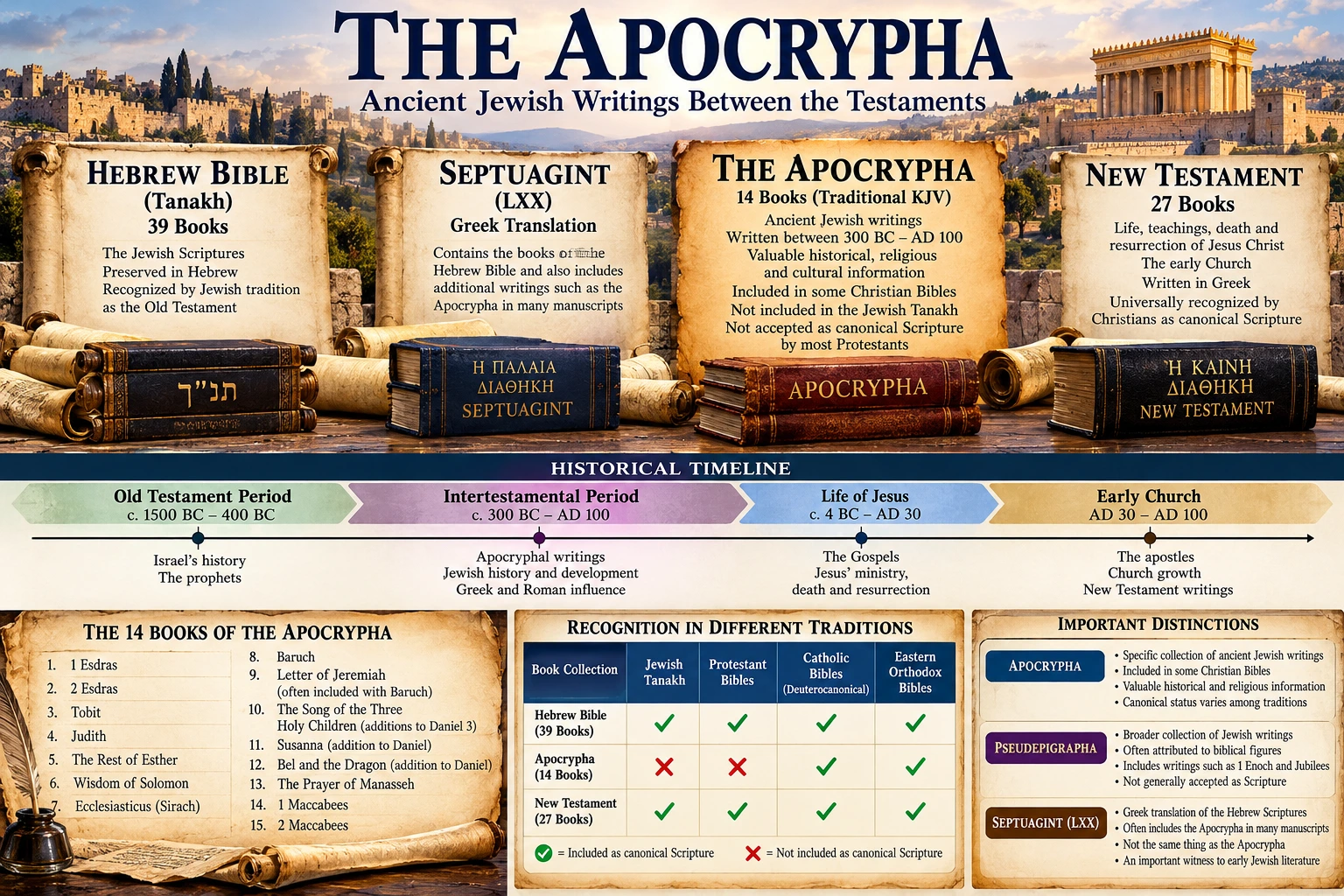
When studying the Bible, particularly the centuries between the Old and New Testaments, we encounter a collection of ancient Jewish writings commonly known as the Apocrypha. Some of these writings preserve valuable historical information, while others contain religious instruction, wisdom literature, prayers, and accounts of Jewish life and belief. They provide an opportunity to better understand the historical, cultural, and religious environment that developed between the ministries of the Old Testament prophets and the coming of Jesus Christ. However, an important question arises: If these writings are historically and religiously valuable, why are they included in some Bibles but excluded from others? The answer requires us to distinguish between the historical usefulness of a religious writing and its recognition as divinely inspired Scripture. Understanding that distinction is essential before considering the individual books of the Apocrypha.
What Does the Word Apocrypha Mean?
The word Apocrypha comes from the Greek apokryphos [G614], meaning hidden or concealed. Over time, the term came to be applied to various religious writings whose status differed from that of the universally recognized biblical books. In Protestant biblical studies, the term generally identifies a collection of ancient Jewish writings found in the Apocrypha section of some older English Bibles, including the original 1611 King James Version. These books are not included in the Jewish Tanakh, nor are they generally accepted as canonical Scripture by Protestant churches. Roman Catholic Christians refer to several of these writings as the Deuterocanonical Books and recognize them as Scripture. Eastern Orthodox churches also accept various books beyond the Jewish Hebrew canon, although the precise collections differ among Orthodox traditions. Consequently, the word Apocrypha does not always identify exactly the same collection of books. Its meaning depends partly upon the religious and historical context in which it is used.
When Were the Apocryphal Books Written?
Most of the writings traditionally associated with the Old Testament Apocrypha originated during the last few centuries before Christ and, in certain cases, into the early Christian era. Their dates, original languages, and authorship vary considerably. Some were composed in Hebrew or Aramaic and subsequently translated into Greek, while others were originally written in Greek. This period is often called the intertestamental period, referring to the centuries between the later Old Testament writings and the events recorded in the New Testament. However, the term should not be understood to mean that nothing of historical or religious significance occurred during those centuries. Quite the opposite. Jewish communities experienced Persian, Greek, and Roman political influence, significant cultural changes, disputes concerning religious identity, and periods of intense persecution. These developments help explain many aspects of the Jewish world encountered in the Gospels. The Apocrypha is especially valuable because some of its writings provide firsthand or relatively early literary witnesses to portions of this history.
What Books Are Included in the Apocrypha?
The traditional Apocrypha section of the 1611 King James Bible contained fourteen principal entries, including several additions to books already found in the Old Testament.
| Book or Writing | Principal Subject |
|---|---|
| 1 Esdras | Retelling of events concerning Israel’s history and restoration |
| 2 Esdras | Visions concerning suffering, judgment, and restoration |
| Tobit | Family, faithfulness, prayer, and divine providence |
| Judith | A Jewish heroine who delivers her people |
| The Rest of Esther | Additional prayers and religious material associated with Esther |
| Wisdom of Solomon | Wisdom, righteousness, judgment, and immortality |
| Ecclesiasticus (Sirach) | Practical wisdom, moral instruction, and reverence for God |
| Baruch | Repentance, wisdom, and hope for Israel |
| The Song of the Three Holy Children | Prayer and praise associated with Daniel 3 |
| Susanna | Daniel’s exposure of false accusations |
| Bel and the Dragon | Accounts challenging idolatry |
| The Prayer of Manasseh | A penitential prayer attributed to King Manasseh |
| 1 Maccabees | The Jewish revolt against Seleucid domination |
| 2 Maccabees | Persecution, martyrdom, and events surrounding the Maccabean struggle |
The Letter of Jeremiah is another important writing, commonly included as part of Baruch in traditional Apocrypha collections. This accounts for some differences in the number of books reported. It is important to recognize that these writings do not all belong to the same literary category. Some present historical narratives, others offer wisdom and instruction, while still others contain visions, prayers, or stories intended to communicate religious and moral lessons. Their historical reliability and literary character must therefore be evaluated individually rather than treating the entire collection as though it were one continuous historical account.
The Maccabees — Understanding the World Before Christ
Among the most historically valuable writings in the Apocrypha are 1 and 2 Maccabees. These books describe events surrounding the persecution of the Jewish people under the Seleucid ruler Antiochus IV Epiphanes and the resistance that followed during the second century BC. Antiochus attempted to impose policies that seriously threatened Jewish religious identity and worship. The Jerusalem Temple was desecrated, Jewish religious practices were suppressed, and those who remained faithful to their ancestral laws faced severe persecution. The resulting revolt, associated with the priestly family of Mattathias and particularly his son Judas Maccabeus, eventually led to the recovery and rededication of the Temple in Jerusalem. This history helps explain the origin of the Jewish Feast of Dedication, commonly known today as Hanukkah. Interestingly, this feast is mentioned in the New Testament. John 10:22 records: “And it was at Jerusalem the feast of the dedication, and it was winter”. The Gospel does not explain the feast’s historical origin, but the Maccabean writings help us understand the circumstances behind its observance. This provides an excellent example of how an ancient writing can contribute valuable historical knowledge without first requiring us to settle the question of its canonical authority.
The Apocrypha and the Septuagint (LXX)
The relationship between the Apocrypha and the Septuagint is particularly important when studying the history of the biblical text. The Septuagint (LXX) refers to the ancient Greek translation tradition of the Hebrew Scriptures, beginning with the Torah in approximately the third century BC. Other biblical books were translated into Greek over time, and additional Jewish religious writings also circulated in Greek. Some important ancient Greek biblical manuscripts contain books that are now classified as Apocryphal or Deuterocanonical alongside books of the Hebrew Bible. This demonstrates that such writings were preserved and read within certain Jewish and Christian literary traditions. However, the Septuagint and the Apocrypha are not the same thing. The Septuagint refers primarily to a Greek biblical textual tradition, whereas the Apocrypha identifies a collection of writings whose canonical status differs among religious communities. Nor should we assume that the inclusion of a book within a later Greek biblical manuscript proves that every Jewish community, or every early Christian, regarded that book as divinely inspired Scripture. Ancient manuscript collections provide important evidence of which writings were preserved and transmitted, but the history of the biblical canon involves additional questions.
The Apocrypha and the Masoretic Text (MT)
The Masoretic Text represents the traditional Hebrew textual form of the Old Testament preserved and transmitted by Jewish scribes and scholars. Its consonantal textual tradition predates the medieval Masoretes, whose work included adding vowel points, accents, and explanatory notes. The Jewish Tanakh, as represented by the Masoretic tradition, does not include the books traditionally classified as the Old Testament Apocrypha. This difference is important because it helps explain why the contents of the Old Testament differ among Jewish, Protestant, Catholic, and Orthodox biblical traditions. Nevertheless, the Masoretic Text and the Apocrypha should not be regarded as two competing versions of the same writings. The Masoretic Text is a Hebrew textual tradition of the canonical Jewish Scriptures, whereas the Apocrypha consists of additional religious writings whose acceptance as Scripture has varied.
Why Was the Apocrypha Included in the Original King James Bible?
Many readers are surprised to discover that the original 1611 King James Bible included an Apocrypha section. These writings were printed between the Old and New Testaments, following a practice already established in several earlier English Protestant Bibles. Their inclusion reflected the longstanding use of these books for historical reading, religious instruction, and familiarity with ancient Jewish literature. However, their inclusion in the 1611 King James Bible did not mean that the Church of England regarded them as having the same authority as the canonical Scriptures. Article VI of the Church of England’s Thirty-Nine Articles distinguished between canonical books used to establish doctrine and other books that could be read for examples of life and instruction in manners, but not used to establish doctrine.
Over time, many Protestant Bible editions omitted the Apocrypha altogether. This was influenced by theological distinctions concerning the canon, publishing practices, and the activities of Bible societies. Therefore, the absence of these writings from most modern Protestant Bibles should not be mistaken for evidence that they were unknown to earlier Protestant Christians.
Why Do Christians Disagree About Their Authority?
The disagreement concerning the Apocrypha is not simply a disagreement about whether these books contain useful information. Rather, it concerns the more fundamental question of which writings belong to the divinely inspired canon of Scripture. Jewish tradition recognizes the books of the Tanakh but does not include the Apocryphal writings within its biblical canon. Most Protestant churches likewise distinguish these books from the canonical Old Testament, although they may recognize their historical and literary value. The Roman Catholic Church accepts several of these writings as Deuterocanonical Scripture. The Council of Trent, in 1546, formally reaffirmed the Catholic canon, including these books and additions. Eastern Orthodox traditions also recognize broader Old Testament collections, although their precise boundaries and classifications are not entirely uniform.
These differences have a long and complicated history involving ancient Jewish scriptural collections, Greek biblical manuscripts, early Christian usage, and later church decisions. It would therefore be an oversimplification to suggest that every Christian community originally agreed upon an identical Old Testament collection and that all differences arose from one later decision. For our purposes, it is important to recognize the distinction between the authority attributed to a writing and the historical information that writing may preserve.
Did Jesus and the Apostles Quote the Apocrypha?
This question deserves careful consideration because the New Testament contains numerous quotations and allusions to the Old Testament. The New Testament also contains themes, expressions, and ideas that resemble material found in certain Apocryphal writings. Scholars have identified possible literary relationships involving books such as Wisdom of Solomon, Sirach, and 2 Maccabees. However, identifying a possible allusion is not the same as demonstrating a direct quotation, and a literary resemblance does not necessarily establish that the New Testament author regarded the earlier writing as divinely inspired Scripture.
There is no generally accepted example of Jesus explicitly introducing a book of the traditional Old Testament Apocrypha as Scripture in the same unmistakable manner that He cites books of the Hebrew Bible. At the same time, the New Testament does sometimes refer to material outside the Jewish biblical canon. Jude 14–15, for example, closely corresponds to material found in 1 Enoch, a writing usually classified among the Pseudepigrapha rather than the traditional Protestant Apocrypha. This demonstrates why careful distinctions are necessary. A biblical writer’s use of material from another source does not, by itself, establish that every part of that source possesses the same authority as Scripture.
What Is the Difference Between the Apocrypha and the Pseudepigrapha?
The terms Apocrypha and Pseudepigrapha are sometimes used interchangeably, but in biblical studies they commonly identify different collections of ancient religious literature. The traditional Protestant Apocrypha consists primarily of the writings historically printed between the Old and New Testaments in certain Christian Bibles. The term Pseudepigrapha, meaning writings attributed to someone other than their actual author, is commonly used for a broader and less precisely defined collection of ancient Jewish religious writings. Examples include 1 Enoch, Jubilees, and various works attributed to biblical patriarchs or other prominent figures. The distinction is not absolute. Different religious traditions classify certain writings differently, and some works traditionally called Pseudepigrapha are accepted as Scripture by particular Christian communities. For example, 1 Enoch and Jubilees are included in the biblical canon of the Ethiopian Orthodox Tewahedo Church. For this reason, these terms should be understood as useful categories of religious literature rather than universal declarations about the authority of every writing they contain.
Should Christians Study the Apocrypha?
There is an important difference between studying an ancient religious writing to understand its historical and cultural significance and accepting that writing as divinely inspired Scripture. A Christian can study Jewish history, ancient religious traditions, and the development of biblical interpretation without automatically accepting every belief or teaching encountered in those sources. In fact, understanding the religious world in which Jesus and His apostles lived can help us recognize the historical background of passages that might otherwise be difficult to appreciate. The Maccabean writings help explain the Feast of Dedication. Other writings reveal discussions concerning wisdom, resurrection, judgment, faithfulness under persecution, and the relationship between Jewish identity and the surrounding Greek-speaking world. Such knowledge can be valuable when approached with care, discernment, and a proper understanding of the nature of the sources being studied. For readers who accept the Protestant canon, the Apocrypha may be studied as historical and religious literature without being treated as an independent authority for establishing biblical doctrine. Readers from Catholic and Orthodox traditions will approach the canonical status of certain books differently, and those differences should be recognized accurately.
Supplementary Note: Theological — Knowledge, Scripture, and Discernment
God has not called us to abandon understanding, nor should we imagine that careful study somehow diminishes faith. The Scriptures themselves repeatedly encourage knowledge, wisdom, discernment, and a willingness to examine what we are taught. In Acts 17:11, the Bereans were commended because they received Paul’s message with readiness while searching the Scriptures daily to determine whether what they were hearing was true. Their example reminds us that genuine faith and careful examination are not enemies. At the same time, not every ancient religious writing carries the same authority, and not every historical claim should be accepted without examination. We must distinguish between what a text explicitly says, what historical evidence supports, and what later traditions or interpretations have added.
This is particularly important when studying the Apocrypha. Our purpose is not simply to accumulate information, but to understand the historical setting of God’s revelation more accurately while carefully considering the authority and reliability of the sources before us. Knowledge does not replace wisdom or discernment. Rather, when properly understood and applied, knowledge provides information upon which wisdom and discernment can operate.
Conclusion — Understanding the Apocrypha in Its Proper Context
The Apocrypha occupies an important place in the history of Jewish religious literature and the development of Christian biblical traditions. Its writings help illuminate the centuries surrounding the close of the Old Testament period and the coming of Jesus Christ, providing historical accounts, religious instruction, prayers, and evidence of the beliefs and concerns of ancient Jewish communities. However, the historical value of these writings and their recognition as canonical Scripture are two separate questions. Different religious traditions have answered the question of their authority differently, and understanding those differences is part of understanding the history of the Bible itself.
By studying the Apocrypha alongside the Hebrew Bible, the Septuagint, the Masoretic Text, and the New Testament, we gain a broader appreciation of the world in which the biblical events unfolded. The objective is not to replace Scripture with other writings, but to use reliable historical knowledge to better understand the setting, language, and circumstances in which Scripture was written.