
Appreciating and Sharing Our God-Given Gifts
Estimated time to read:
Read this article to me
Suggested prerequisite reading:
Supporting Articles:
The Person I Meet at Every Bible Study
I have attended a number of Bible studies over the years, and I have noticed something rather interesting. No matter where I go, no matter who is leading the study, and no matter who else is attending, there always seems to be one particular person who shows up.
Now, this is rather remarkable because this person never seems to have the same name or even the same appearance. Sometimes he is young, sometimes old. Sometimes he has been attending church for decades, while other times he has only recently become involved. Yet somehow, despite these differences, I can almost always recognize him.
You see, I recognize him not by his name or his appearance, but by his arrogance, ignorance, and pride.
Sometimes he is the fellow who seems to have an opinion about absolutely everything, even when he has little understanding of the subject being discussed. But other times, he is almost the exact opposite. He may sit quietly through much of the Bible study, contributing very little to the discussion, until someone else shares something they have learned through studying Scripture.
And that is when I recognize him.
Rather than examining what has been shared, asking questions, or contributing something that might further everyone’s understanding, he simply dismisses the value of knowledge itself. 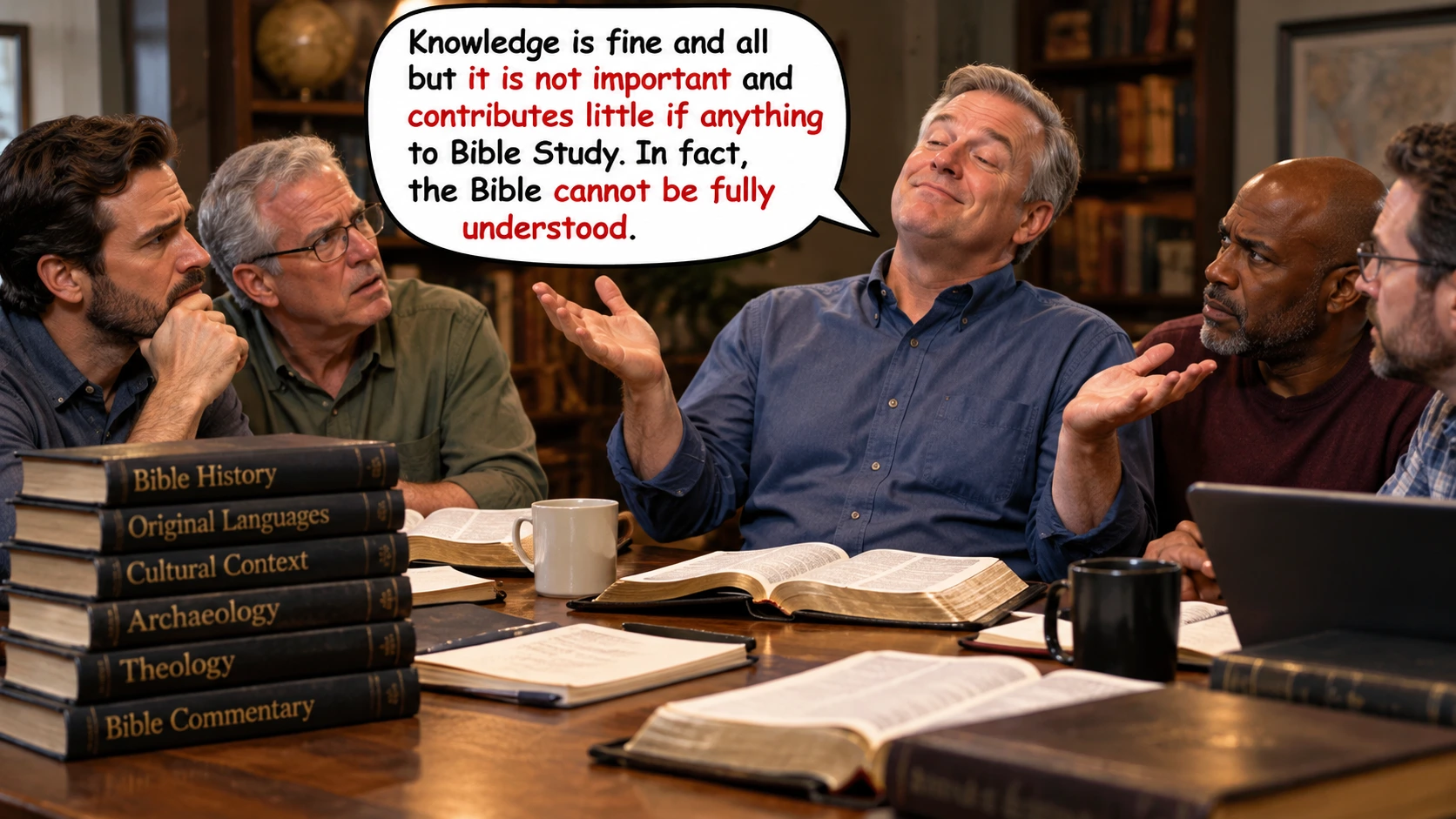 He speaks as though nobody really knows anything, or as though gaining knowledge of God’s Word is somehow unimportant. It matters little whether the information being shared is accurate, helpful, or the result of years of careful study. His response is to diminish its importance rather than consider its value.
But what I find particularly remarkable is the contradiction in his own behavior. While dismissing the knowledge of others, he speaks with considerable confidence about what he himself supposedly knows. And sometimes, what he confidently presents as knowledge is not knowledge at all, but something demonstrably false.
Think about that for a moment. He dismisses the possibility that someone else might genuinely know something, yet expects everyone to accept that he does. He questions the value of knowledge while relying upon his own supposed knowledge to justify dismissing it. And perhaps the saddest part is that his attitude does more than reveal his own unwillingness to learn. It can discourage others from sharing what they have learned, prevent worthwhile discussions from developing, and deprive those attending the Bible study of opportunities to grow in their understanding of God’s Word.
Ignorance is not something to be ashamed of. We are all ignorant of many things, and that is precisely why we need to learn. But ignorance accompanied by pride becomes something far more troubling, particularly when it seeks to discourage knowledge in others.
Of course, there is truth in recognizing that human knowledge is limited. None of us possesses a complete or exhaustive understanding of God or His Word. But there is an enormous difference between acknowledging that we cannot know everything and suggesting that what we can know is of little importance. If that were true, why would God have given us His Word in the first place? Why would He repeatedly instruct us to seek wisdom, gain understanding, grow in knowledge, and examine what we are taught?
Scripture also reminds us that God has given different gifts and abilities to different members of the body of Christ. Some are particularly gifted in teaching, others in encouragement, service, discernment, or communicating the Gospel. Some have spent years studying biblical languages, history, and theology, while others bring practical wisdom and valuable life experience. We should welcome these contributions rather than treating them as competitors for our own importance.
And that brings me back to the fellow I seem to meet at every Bible study.
Perhaps the greatest obstacle to his learning is not what he does not know, but his unwillingness to acknowledge that there is something he does not know. His ignorance is not the real problem, because ignorance can be corrected through learning. The greater problem is pride, because pride can convince a person that he has nothing left to learn.
Proverbs 18:13 warns against answering a matter before hearing it, while Proverbs 12:15 reminds us that a wise person listens to counsel. These are not merely instructions for the person who knows the least. They apply equally to the person who has spent a lifetime studying Scripture. And before anyone begins looking around the room to identify the person I am describing, perhaps we should all consider one final possibility.
What if, on some occasion, that person has been me?
After all, the moment I become convinced that arrogance, ignorance, and pride are problems found only in other people, I may have demonstrated that I have more in common with this fellow than I care to admit. A good Bible study should be a place where we can bring what we know, acknowledge what we do not know, respectfully examine what others contribute, and allow God’s Word to correct us all. We do not have to agree on every interpretation, but we should be willing to listen, learn, and test our conclusions against Scripture. The objective is not to establish who knows the most, who speaks the loudest, or who wins the argument. The objective is to grow together in our understanding of God’s Word and, more importantly, to allow what we learn to shape how we live.
No One Gift Makes Another Less Important
Now, having said all of this, I want to make something very clear. If you have ever attended a Bible study and felt discouraged from contributing because someone dismissed what you had to share, please do not allow that person’s attitude to silence you. Forgive them, and if it continues then take them to the side and talk to them as a brother in Christ.
God has not given every believer the same gifts, abilities, experiences, or opportunities to learn. Nor has He suggested that one person’s gift somehow makes another person’s gift unnecessary or unimportant. Quite the opposite! In 1 Corinthians 12, Paul explains that the body of Christ consists of many members, each having a different function, yet all belonging to the same body. The eye cannot tell the hand that it has no need of it, nor can the head say the same to the feet (1 Corinthians 12:21).
Think about what that means. The person who has spent years studying Scripture does not make the person who is just beginning to learn any less important. Neither does the person gifted in teaching diminish the value of the person gifted in encouragement, service, discernment, or any of the other gifts God has provided. No one gift monopolizes the importance of another, and no member of the body of Christ has been given the authority to declare another member’s contribution worthless.
And this applies just as much to those attending a Bible study. Some people bring considerable knowledge of Scripture. Others bring an understanding of biblical history, geography, languages, or the cultural circumstances in which Scripture was written. Some bring wisdom gained through years of applying God’s Word to the difficulties of life. Others bring personal experiences, observations, encouragement, or a perspective that the rest of us may never have considered.
And then there is the person who brings a question.
Please do not underestimate the value of the person who asks questions. After all, questions come before answers.
How many times have we attended a Bible study where someone asked a question that nobody else had thought to ask? Perhaps several people were wondering about the very same thing but were reluctant to speak up. Perhaps the question exposed something we had misunderstood or simply taken for granted. Or perhaps it led us to examine a passage more carefully than we otherwise would have.
The person who asked that question may not have known the answer, but that does not mean they contributed nothing. On the contrary, their question may have provided everyone in the room with an opportunity to learn something valuable. And what about the person who provides the answer? Should we diminish that person’s contribution simply because they happen to know something we do not? Of course not! We should be thankful that someone took the time to study, learn, and share what they have discovered. Their knowledge may answer the question, but the question itself may be what made that knowledge useful to everyone attending.
The question and the answer are not competing contributions. They complement one another.
This is precisely why I find it so troubling when someone attempts to discourage another person from sharing what they know. A Bible study should never become a competition to determine who knows the most, nor should it become a place where knowledge is treated as something undesirable. We gather to learn from God’s Word, and one of the ways we accomplish that is by learning from one another.
Of course, everything we share must remain open to examination and correction by Scripture. Having knowledge does not make someone infallible, and possessing a particular gift does not place anyone above correction. But neither should the possibility of being mistaken prevent us from contributing. If that were the standard, none of us would ever have anything to say. Paul instructs believers in 1 Thessalonians 5:11 to encourage and build one another up. He also explains in Ephesians 4:11–16 that Christ has provided gifts to His people for the building up of His body, so that believers might grow together toward maturity.
Notice the purpose. These gifts are not given so that one person might elevate himself above another. They are given for the benefit and growth of the entire body. So whether you come to Bible study with years of knowledge, a particular gift, a personal experience, an observation, or simply a question you have been wanting to ask, do not allow another person’s arrogance or dismissive attitude to convince you that you have nothing worthwhile to contribute.
And for those of us who may have acquired considerable knowledge over the years, let us remember that our knowledge is not an excuse for pride. It is an opportunity to serve. We should be just as willing to listen to a question as we are to provide an answer, and just as willing to learn from someone else as we are to share what we have learned. After all, the objective of a Bible study is not to demonstrate how much any one of us knows. It is to help all of us grow in our knowledge and understanding of God’s Word, encourage one another in our faith, and become better equipped to live according to what God has revealed.
We do not all bring the same thing to the table, but that is precisely why we need one another.