
-
Anchoring in Christ
-
- But I Am a Good Person—Why Would God Condemn Me?
- But Christians are Hypocrites
- But Faith in God is Irrational?
- But Isn't the God of the Old Testament a Monster?
- But If God Exists, Why Does God Allow Evil?
- But is the Bible Full of Mysteries, Paradoxes, and Unknowable Things?
- But How Can You Know The Bible Is True?
- But Why Christianity And Not Some Other World Religion?
- But There Are So Many Churches and Denominations - Which One Is Right?
-
Topical Studies
-
-
- Sin: The Elephant In The Room
- But I Am a Good Person—Why Would God Condemn Me?
- What is Sin?
- Is God The Author Of Sin?
- The introduction of Sin into the World
- What Changed Because of the Fall?
- What Did Humanity Inherit from Adam?
- Personal Sin and Personal Guilt
- The Deceitfulness and Progressiveness of Sin
- The Consequences and Judgment of Sin
- Analogies of Sin
- Analogies of Repentance
- Generational Sin and the Increasing Corruption of a People
- Evangelism and the Topic of Sin
-
- Ignorance of God - No Excuse
- God’s Remedy for Sin
- Adoption as Sons: From Bondage to Glory
- Called to Glory: Understanding the Purpose of God's Call
- Those IN Christ: Elected & Predestined to Glory
- The Role of Faith in Salvation
-
- Glorification of the Saints - An Introduction
- Glorification of the Saints - First Creation
- Glorification of the Saints - Fall of Angels
- Glorification of the Saints - Fall of Man
- Glorification of the Saints - Redemption
- Glorification of the Saints - The New Creation
- Glorification of the Saints - God's Eternal Purpose
- The Glorified Body: From Adam to Christ
-
- Foreknowledge, Predestination, and Election: An Examination in Their Biblical Context
- Predestined to Glory: Why Predestination Must Be Understood Before Election
- Biblical Predestination: From Sin to Glory
-
- Articles coming soon
-
-
Book Studies
- Book Study Intro Note
- Study References, Resources, and Acknowledgments
- Hebrew Bible and Jewish Writings
- The Septuagint (LXX) - Scripture in Greek Translation
- Masoretic Text, and Why Is It Important
-
-
-
- Articles coming soon
-
- Articles coming soon
-
- Articles coming soon
-
-
- Articles coming soon
-
- Articles coming soon
-
- Articles coming soon
-
- Articles coming soon
-
- Articles coming soon
-
- Articles coming soon
-
- Articles coming soon
-
- Articles coming soon
-
- Articles coming soon
-
- Articles coming soon
-
- Articles coming soon
-
- Articles coming soon
-
-
-
- Articles coming soon
-
- Articles coming soon
-
- Articles coming soon
-
- Articles coming soon
-
-
-
- Articles coming soon
-
- Articles coming soon
-
- Articles coming soon
-
- Articles coming soon
-
-
- Articles coming soon
-
- Articles coming soon
-
- Articles coming soon
-
- Articles coming soon
-
- Articles coming soon
-
- Articles coming soon
-
- Articles coming soon
-
- Articles coming soon
-
- Articles coming soon
-
- Articles coming soon
-
- Articles coming soon
-
- Articles coming soon
-
-
-
-
-
- Articles coming soon
-
- Articles coming soon
-
- Articles coming soon
-
- Articles coming soon
-
-
- Articles coming soon
-
- Articles coming soon
-
- Articles coming soon
-
- Articles coming soon
-
-
-
- Articles coming soon
-
- Articles coming soon
-
- Articles coming soon
-
- Articles coming soon
-
- Articles coming soon
-
- Articles coming soon
-
-
-
- Articles coming soon
-
- Articles coming soon
-
- Articles coming soon
-
- Articles coming soon
-
- Articles coming soon
-
-
- Articles coming soon
-
Musings
-
Reference Tools
The Septuagint (LXX) – Scripture in Greek Translation
0 out of 5 stars
| 5 Stars | 0% | |
| 4 Stars | 0% | |
| 3 Stars | 0% | |
| 2 Stars | 0% | |
| 1 Stars | 0% |
Why Is the Septuagint (LXX) Important?
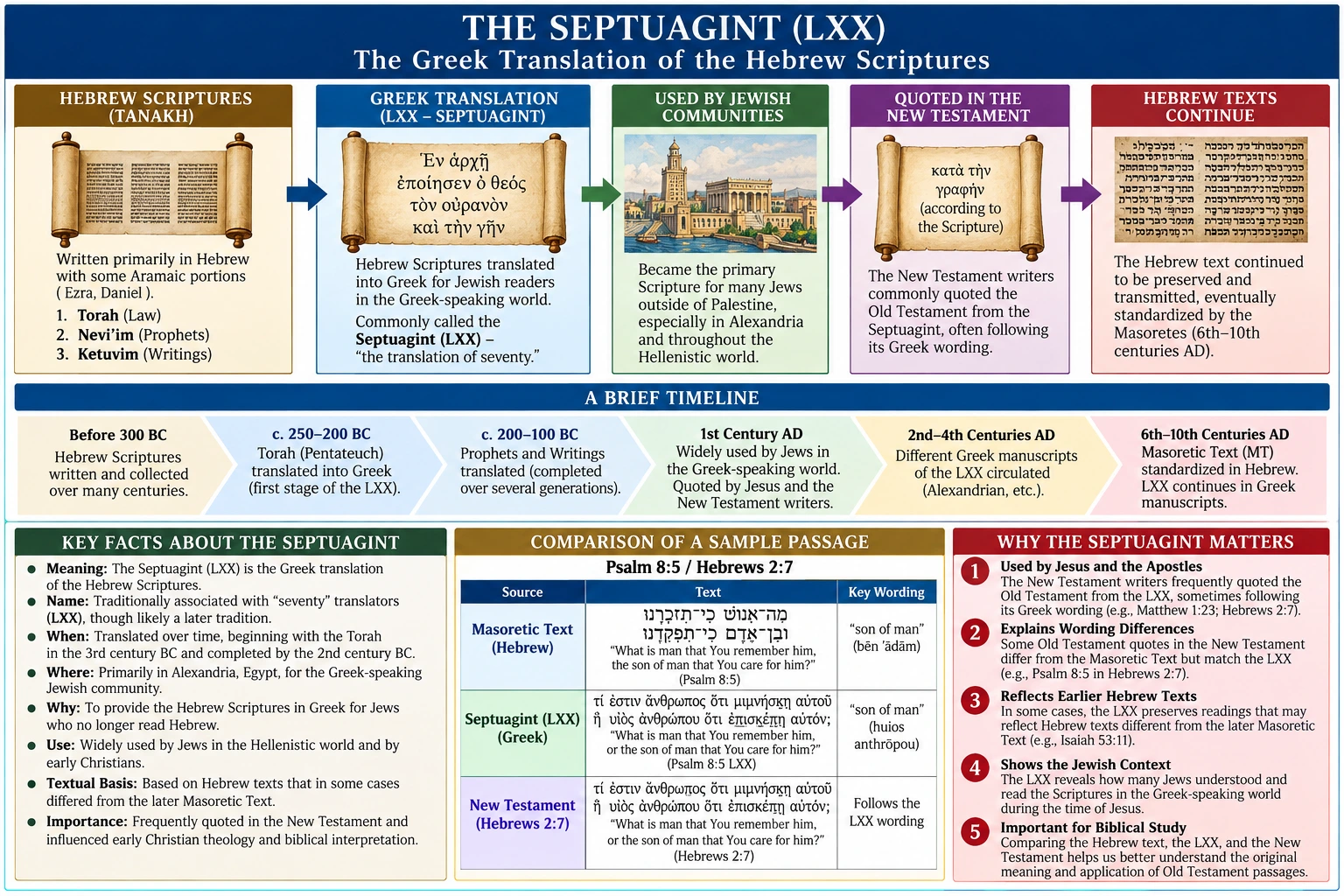
The Septuagint (LXX) is the ancient Greek translation of the Hebrew Scriptures, and its importance becomes particularly evident when studying the New Testament. Hundreds of Old Testament quotations and allusions appear throughout the New Testament, and many of its direct quotations follow the wording of the Septuagint, either closely or exactly, while others reflect the Hebrew text or different textual forms. Because the New Testament was written in Greek, the Septuagint allows us to compare Greek words with Greek words—an apples-to-apples comparison—helping us better understand how the Scriptures were being read, expressed, and interpreted in the Greek-speaking Jewish world of Jesus and His apostles.
This does not mean that the Septuagint should replace the Hebrew Scriptures or that every New Testament quotation comes directly from it. Rather, where the New Testament writers quote or closely follow the Septuagint, we should recognize the significance of that wording. Comparing the Hebrew text, the Septuagint, and the New Testament can reveal important differences in translation, meaning, and emphasis, sometimes providing valuable insight into the biblical author’s intended message. Hebrews 2:7, for example, follows the Septuagint’s reference to angels in Psalm 8:5, where the Hebrew uses elohim [H430], a word that can refer to God or divine beings. Such comparisons help us appreciate both the Hebrew Scriptures and the Greek translation that played an important role in the Jewish world and the writing of the New Testament.
0 out of 5 stars
| 5 Stars | 0% | |
| 4 Stars | 0% | |
| 3 Stars | 0% | |
| 2 Stars | 0% | |
| 1 Stars | 0% |