
Glorification of the Saints – First Creation
Estimated time to read:
Read this article to me
Suggested prerequisite reading:
Supporting Articles:
The Perfect Nature of God
Things God Cannot Do
How to Understand the Trinity
Throughout the following section I distinguish carefully between (1) explicit biblical teaching, (2) theological inference drawn from multiple biblical passages, and (3) philosophical reflection arising from those doctrines. My conclusions are intended to remain subordinate to Scripture itself.
THE LANGUAGE OF TE FIRST CREATION
Before examining the creation of mankind, it is important to understand that the opening chapters of Genesis employ several different Hebrew words to describe God’s creative activity. Although our English Bibles often translate these words as create, make, form, or build, they are not necessarily synonymous. Each carries its own nuance and contributes to our understanding of the creation account.
Whether these distinctions indicate differences in chronology, method, purpose, function, or emphasis must ultimately be determined by allowing Scripture to interpret Scripture. Therefore, before drawing theological conclusions from Genesis, one should first understand how these words are used throughout the creation narrative.
Created (bara — בָּרָא | Strong’s H1254)
The Hebrew word bara [H1254] is translated create and is used exclusively of God throughout the Old Testament. It describes God’s unique creative activity and frequently carries the idea of bringing into existence something new and unique.
Some understand bara to refer exclusively to creation ex nihilo (creation out of nothing), while others recognize that Scripture also uses the word to describe God bringing forth something entirely new from material He had previously created. Regardless of one’s position, the emphasis remains the same: bara highlights the uniqueness of what God creates rather than the process by which He creates it.
This distinction becomes important because Moses does not use bara to describe every creative act recorded in Genesis. Instead, he reserves it for only certain acts of creation, suggesting that he intentionally distinguishes bara from the other Hebrew words he employs.
Made (asah — עָשָׂה | Strong’s H6213)
The Hebrew word asah [H6213] is most commonly translated made, although its range of meaning is considerably broader. Depending upon the context, it may mean:
- to make
- to do
- to accomplish
- to prepare
- to appoint
- to ordain
- to establish
- to produce
Unlike bara, which emphasizes God’s unique creative activity, asah frequently emphasizes the ordering, appointing, preparing, or accomplishing of God’s purposes.
Throughout Genesis, asah occurs far more frequently than bara, making it one of the principal words used to describe God’s work during the six days of creation.
Formed (yatsar — יָצַר | Strong’s H3335)
The Hebrew word yatsar [H3335] means to form, to fashion, or to shape. It is the word commonly used of a potter shaping clay into a vessel.
Rather than emphasizing origination, yatsar emphasizes careful workmanship, design, and purpose. It conveys the picture of an artisan skillfully shaping something according to a predetermined plan.
This word first appears in relation to mankind when Genesis records: “Then the LORD God formed the man of dust from the ground…” (Genesis 2:7, ESV).
The imagery is striking. Adam is not simply said to be created; he is formed from the dust of the ground, emphasizing God’s personal workmanship in preparing the physical body of man.
Built (banah — בָּנָה | Strong’s H1129)
The Hebrew word banah [H1129] means to build, to construct, or to establish. Throughout the Old Testament it is commonly used of building:
- houses,
- cities,
- altars,
- kingdoms,
- and families.
Its first appearance in relation to mankind occurs in Genesis 2:22: “And the rib that the LORD God had taken from the man he made into a woman…” (ESV).
The English word made unfortunately obscures the Hebrew. Moses does not use bara, asah, or yatsar. He deliberately uses banah. Literally rendered, the verse reads: “And the rib that the LORD God had taken from the man He built into a woman.”
This distinction is noteworthy because Eve is neither said to have been created (bara) nor formed (yatsar), but rather built (banah) from that which God had previously taken from Adam.
The Importance of These Distinctions
At first glance, these four Hebrew words may appear to be little more than stylistic variations. Many commentators simply treat them as interchangeable descriptions of God’s creative activity. However, the opening chapters of Genesis suggest otherwise.
Moses consistently employs these words in deliberate contexts. Certain things are created (bara), others are made (asah), Adam is formed (yatsar), and Eve is built (banah). Such consistent distinctions naturally invite the reader to ask whether the Holy Spirit intentionally chose these words to communicate different aspects of God’s creative work.
This observation does not, by itself, establish a doctrine. Nor should we force meanings upon the text that Scripture itself does not support. At the same time, neither should we dismiss these distinctions as insignificant before allowing Genesis to speak for itself.
Allowing Genesis to Interpret Genesis
Rather than beginning with theological conclusions, we should first allow the creation account itself to unfold. As the creation account unfolds, the repeated use of these four Hebrew words begins to form recognizable patterns. Those patterns, in turn, provide an important foundation for understanding not only the creation account itself, but ultimately the unique creation of mankind in the image of God.
THE PATTERN OF CREATION
Having established the distinction between the Hebrew words bara (create), asah (make), yatsar (form), and banah (build), we can now examine how Moses actually employs these words throughout the creation account. One of the fundamental principles of sound biblical interpretation is that Scripture must be allowed to interpret Scripture. Therefore, before asking why Moses chose these particular words, we should first observe where and how he uses them.
As we carefully work through the six days of creation, an unmistakable pattern begins to emerge.
The Beginning
Taking Genesis at face value of its sequential order, Genesis opens with one of the most familiar verses in all of Scripture: “In the beginning, God created the heavens and the earth.“ (Genesis 1:1, ESV). Here Moses uses the Hebrew word bara. This opening declaration records God’s initial act of creation, God created:
- the heavens and
- the earth
This establishes God as the Creator of everything that follows. Nothing exists apart from Him. He alone is the source of all creation. The earth is then described as: “…without form and void, and darkness was over the face of the deep. And the Spirit of God was hovering over the face of the waters.“ (Genesis 1:2, ESV). Already we see that although God has created the heavens and the earth, the earth has not yet been ordered or prepared for life. Much of what follows during the six days involves God bringing order, purpose, and function to that which He has already created.
Day One — Light
God’s first recorded command is: “Let there be light.“. Notice that Moses does not say that God created light. Nor does he say that God made light. Instead, God simply speaks, and light appears.
God then separates the light from the darkness and names them Day and Night.
This immediately raises an interesting observation. If Moses intended bara to describe every new thing that came into existence, one might naturally expect light to be described as being created. Yet the text deliberately refrains from using bara. Therefore, this verse may be understood in one of two ways:
First, God may have been commanding the manifestation of the electromagnetic radiation (light) that had already been created when He created “the heavens and the earth” ex nihilo in Genesis 1:1. If this understanding is correct, then the stars, planets, sun, and moon may likewise have already existed, although their light had not yet become visible from the surface of the earth—perhaps because the earth’s dense atmosphere initially prevented that light from penetrating to the surface. In this view, God’s command, “Let there be light,” is not the creation of light itself but its appearance or manifestation upon the earth.
Second, the statement may also refer to the manifestation of the uncreated presence of God Himself. Genesis records that, before God spoke, “…darkness was over the face of the deep. And the Spirit of God was hovering over the face of the waters” (Genesis 1:2). God’s command, “Let there be light,” may therefore signify the manifestation of His own glorious presence, the radiance of His glory illuminating the darkness that covered the earth. Throughout Scripture, God’s presence is repeatedly associated with light (Psalm 104:2; John 1:4–9; 1 John 1:5; Revelation 21:23).
Personally, I do not believe these two interpretations are necessarily mutually exclusive. They may both be true, giving the command “Let there be light” both a physical and a theological significance. God may have simultaneously caused physical light to become manifest upon the earth while also revealing the radiance of His own glorious presence.
This understanding also harmonizes with a broader pattern that begins to emerge throughout Genesis 1 and 2. Repeatedly, God says “Let…”—“Let there be light,” “Let there be an expanse,” “Let the waters… be gathered together,” “Let the earth sprout vegetation,” “Let the waters swarm,” and “Let the earth bring forth.”
In many of these instances, the emphasis appears not to be upon the initial creation of something ex nihilo, but upon God sovereignly ordaining, appointing, or causing that which already exists to become manifest, functional, or productive according to His divine purpose.
However, rather than drawing conclusions prematurely, I am – at this stage – simply noting the distinction and suggest allowing the creation narrative to unfold.
Day Two — The Expanse
God next declares: “Let there be an expanse in the midst of the waters…“. Genesis then records: “And God made the expanse…“.
Here Moses uses asah, not bara. God separates the waters above from the waters below and calls the expanse Heaven. Again, something is made, not created.
Some Christian apologists have proposed that, prior to the separation of the waters described in Genesis, the earth’s atmosphere may have contained a substantial canopy of water vapor. According to this interpretation, the canopy originated from the waters already present upon the earth and may have been dense enough to obscure the sun, moon, and stars from view, despite their having already been created in Genesis 1:1. Some advocates of this view also suggest that such an atmospheric condition may have influenced the earth’s climate and gravitational dynamics, potentially affecting tidal cycles and contributing to ocean levels so high that dry land had not yet appeared.
Day Three — Dry Land and Vegetation
God’s subsequent separation of the waters—placing some within the atmosphere as clouds—may have, by His sovereign design, allowed the winds to disperse them. According to this understanding, the gradual clearing of the atmosphere could have permitted the sun and moon to exert their gravitational influence more fully upon the earth’s waters, potentially contributing to the retreat of the seas and the exposure of the dry land described in Genesis 1:9–10.
Notice once again God’s deliberate use of the command: “Let the waters under the heavens be gathered together into one place, and let the dry land appear.“
The text does not say that God created the dry land at this point. Rather, He commands it to appear. This suggests that the land already existed beneath the waters but had not yet been made visible. Only after the waters were gathered together did the dry land become manifest.
By this point in the creation account, a recognizable pattern begins to emerge. Just as God had previously commanded, “Let there be light,” He now commands, “Let the dry land appear.” In neither instance does the text explicitly describe the creation of the object itself at that moment. Instead, God’s command appears to bring into view—or make manifest—that which had previously been brought into existence but had not yet been observable from the earth’s surface.
As the creation narrative continues, this pattern is repeated several times. Whenever God issues a command beginning with “Let…“—whether, “Let there be…“, “Let…appear,“ or “Let…bring forth“—the emphasis frequently appears to be not upon creating something ex nihilo, but upon God sovereignly ordaining, appointing, or causing something that already exists to become manifest, functional, or productive according to His divine purpose. This recurring pattern becomes increasingly significant as we continue through Genesis 1 and 2.
God then commands: “Let the earth sprout vegetation, plants yielding seed, and fruit trees bearing fruit…” Again, Moses does not use bara. The earth itself is commanded to bring forth vegetation according to God’s command. It is also noteworthy that vegetation is not described as being created in this passage. If the pattern observed thus far is intentional, it may suggest that, like the dry land which already existed beneath the waters before being commanded to appear, the vegetation likewise already existed within the earth as part of God’s original creation recorded in Genesis 1:1. God’s command, therefore, was not necessarily to create vegetation at that moment, but to cause the earth to bring it forth and make it manifest according to His sovereign purpose.
Notice the progression that is beginning to emerge. Light is commanded to appear, not created. Dry land is commanded to appear, not created. Vegetation is commanded to spring forth from the earth, not created. In each case, God’s command beginning with “Let…” appears to make manifest that which had already been created or prepared, rather than describing a new act of creation ex nihilo. The emphasis continues to be upon God’s sovereign word bringing order and productivity to His creation. Whether this pattern is intentional must ultimately be determined by allowing Scripture to interpret Scripture, but by this point it is becoming increasingly difficult to dismiss it as mere coincidence.
Day Four — The Heavenly Lights
God declares: “Let there be lights in the expanse of the heavens…“
These lights are given specific purposes:
-
- to separate day from night,
- to serve as signs,
- for seasons,
- for days,
- and for years.
Genesis then records: “And God made the two great lights…“. Again, Moses chooses asah. The sun and moon are made, not created. He likewise records that God made the stars. Their purpose is emphasized more than their origin. They are appointed to govern the day and the night and to give light upon the earth.
Day Five — Fish and Birds
It is not until the fifth day that Moses again uses the Hebrew word bara. Genesis records: “So God created the great sea creatures and every living creature that moves, with which the waters swarm… and every winged bird according to its kind.” (Genesis 1:21, ESV)
This is highly significant. For the first time since Genesis 1:1, living creatures are specifically said to be created (bara). Moreover, they are described as living creatures (nephesh chayyah). This marks an important transition within the creation account. Plants possess biological life, yet they are never described as nephesh. Fish and birds are the first creatures specifically identified in this way.
Any introductory biology text will attest that fish and birds, like all living organisms, are composed of the same basic elements found within the earth—primarily carbon, hydrogen, oxygen, nitrogen, phosphorus, sulfur, calcium, and other naturally occurring elements. From a biblical perspective, these elements were all part of the material universe God created ex nihilo in Genesis 1:1. One might therefore expect Moses simply to write, “God made the fish and birds,” just as he later writes, “God made the beasts of the earth.” Instead, Genesis deliberately states, “God created the great sea creatures… and every winged bird…” Although their material composition was not new, the fish and birds themselves are presented as a new and unique act of God’s creative work.
If the pattern we have observed thus far is intentional, the significance appears to lie not in their physical composition but in the introduction of something fundamentally new into creation. Fish and birds are the first beings presented as living creatures (nephesh chayyah)—the first creatures possessing both a physical body and a living soul.
This observation also helps explain the language Moses employs on the sixth day. When God later brings forth the land animals, Moses no longer says that He created them but that He made them (Genesis 1:25), even though they too are described as living creatures (nephesh chayyah). If this pattern is indeed intentional, it may indicate that the truly new element introduced on the fifth day was not the material from which these creatures were composed, but the introduction of animal life itself. The land animals would then be understood as being made according to that already established pattern, just as the vegetation had been brought forth from the earth according to God’s prior creative work.
This observation should not be overlooked, for it becomes increasingly significant as the creation narrative unfolds.
Day Six — The Land Animals
On the sixth day God declares: “Let the earth bring forth living creatures according to their kinds…“. Genesis then records: “And God made the beasts of the earth according to their kinds and the livestock according to their kinds, and everything that creeps on the ground according to its kind.“ (Genesis 1:25, ESV)
Here we encounter another noteworthy distinction. Although the land animals are likewise described as living creatures (nephesh), Moses does not say that God created them. Instead, he says that God made them. This difference deserves careful consideration.
- The fish and birds are created.
- The beasts, livestock, and creeping things are made.
Why?
At this point, I will simply acknowledge the distinction without forcing a conclusion. However, it is reasonable to ask whether Moses intends the reader to recognize that the fish and birds introduce something fundamentally new into creation—the first appearance of living creatures possessing both body and soul—while the land animals are subsequently made according to that already established pattern.
Whether this understanding is correct must ultimately be determined by the testimony of Scripture as a whole.
The Climax Approaches
As remarkable as the previous five days have been, the creation account has been steadily building toward one final act. Everything that has come before now prepares the reader for the creation of mankind.
Here the language changes once again. God does not simply command the earth to bring forth man. Nor does He merely create or make him as He had the other living creatures. Instead, God first announces His intention: “Let us make man in our image, after our likeness.“. With these words, the creation narrative reaches its climax.
The careful distinctions Moses has been making throughout the six days now become increasingly important, for the creation of mankind is described unlike anything that has preceded it.
THE CREATION OF MAN
Having carefully followed the pattern established throughout the six days of creation, we now arrive at the climax of God’s creative work. Everything that has preceded this point appears to prepare the reader for the creation of mankind. Unlike every previous creative act, God does not simply issue a command for the earth or the waters to bring forth life. Instead, He pauses and declares His intention. “Then God said, ‘Let us make man in our image, after our likeness. And let them have dominion over the fish of the sea and over the birds of the heavens and over the livestock and over all the earth and over every creeping thing that creeps on the earth.’“ (Genesis 1:26, ESV)
Several observations immediately distinguish this passage from everything that has preceded it.
First, God does not simply command the earth to produce mankind as He had done with the beasts of the field. Rather, He personally announces His intention: “Let us make man…“
Second, mankind alone is said to be made “in our image, after our likeness.” Every other living creature is described as being created or made according to its own kind. Mankind alone is said to bear the image and likeness of God.
Third, before mankind is even created, God assigns him dominion over every other living creature. This immediately establishes mankind as unique within the created order.
Genesis then records the fulfillment of God’s declaration: “So God created man in his own image, in the image of God he created him; male and female he created them.” (Genesis 1:27, ESV)
Here another important observation emerges.
- In verse 26 God says, “Let us make man…” using the Hebrew word asah.
- Yet in the very next verse Moses writes, “So God created man…” using the Hebrew word bara.
Both words are intentionally employed in describing the creation of mankind.
- The fish and birds were created.
- The beasts of the earth were made.
- Now mankind is both made and created.
It is important that we do not simply dismiss these distinctions as though they possess no significance. Moses has demonstrated throughout Genesis 1 that he carefully distinguishes between these words. It is therefore reasonable to believe he does so intentionally here as well.
Dominion
Immediately following man’s creation, Scripture records: “And God blessed them. And God said to them, ‘Be fruitful and multiply and fill the earth and subdue it, and have dominion…’” (Genesis 1:28, ESV)
- Dominion is not presented as something mankind earned.
- It is part of God’s original design.
- Mankind was created to represent God’s rule upon the earth.
- This authority was not given to the angels.
- Nor was it given to the animals.
- It was entrusted uniquely to mankind.
This further distinguishes man from every other earthly creature.
Genesis Returns to the Sixth Day
The first chapter of Genesis provides a broad, sequential and cosmic overview of creation over six days. The second chapter of Genesis provides additional details concerning mankind’s creation. This is not a second creation account. Rather, it is an expansion of the sixth day.
Genesis 1 presents the panoramic view.
Genesis 2 presents the close-up view.
The focus is no longer upon the creation week as a whole but upon God’s unique creation of mankind.
The Formation of Adam
Genesis 2 records: “Then the LORD God formed the man of dust from the ground and breathed into his nostrils the breath of life, and the man became a living creature.” (Genesis 2:7, ESV)
Here Moses introduces yet another Hebrew word.
- Adam is not said to be created.
- Nor is he said merely to be made.
- He is formed (yatsar) from the dust of the ground.
The imagery is that of a master craftsman carefully fashioning His workmanship. This also reminds us that although mankind possesses a material body like the animals, Scripture carefully distinguishes the manner in which God prepared that body. No such description is given concerning any other earthly creature.
The Breath of Life
Genesis next records that God: “…breathed into his nostrils the breath of life…” (Genesis 2:7, ESV). This statement is equally remarkable. Only of mankind does Scripture describe God personally breathing the breath of life into His creature. Whether one understands this to describe the impartation of biological life, spiritual life, or both, it clearly distinguishes the creation of Adam from every other creature recorded in Genesis.
The result is immediate: “…and the man became a living creature.“
The Hebrew expression is nephesh chayyah. Adam became a living creature. Interestingly, this is the very same expression previously used of the fish, birds, and land animals. This observation should not be overlooked. It demonstrates that mankind shares something in common with the animal kingdom. Like the animals, man is a living creature. Yet Genesis simultaneously distinguishes mankind in numerous other ways.
Man alone is:
- made in God’s image,
- created in God’s image,
- formed from the dust,
- personally given the breath of life by God,
- and entrusted with dominion over creation.
Thus, while mankind shares certain characteristics with the animal kingdom, he is also uniquely distinguished from it.
This naturally raises an important question. If Adam became a living creature (nephesh chayyah) just as the animals did, then in what specific sense was he uniquely created? Put another way, where within the Genesis account do we find the distinctive creative act that sets mankind apart from every other living creature?
While Scripture does not explicitly answer that question, the text itself may suggest a reasonable explanation. God did not first breathe one kind of life into Adam and then another. Rather, He performed one deliberate act: “…breathed into his nostrils the breath of life…“. Although Scripture does not explicitly explain the mechanics of God’s breath of life, it is interesting to observe that man breathes through two nostrils, causing a single breath to divide while remaining one breath. This provides a fitting illustration of how God’s one act of breathing into Adam could have simultaneously imparted both natural life and spiritual life. In that single divine act, Adam became a living creature (nephesh chayyah), sharing with the animals a body and a living soul, while also being uniquely created in the image of God through the possession of a human spirit through which he could enjoy fellowship with the God who is Spirit.
If this understanding is correct, then Genesis 2:7 beautifully harmonizes the entire creation account. Through one divine act, God both made Adam a living creature like the animals and created him uniquely unlike the animals. He possessed a body formed from the dust, a living soul, and a human spirit, making him the only creature revealed in Scripture to possess all three.
The Creation of Eve
The uniqueness of mankind becomes even more apparent in the creation of the woman. Genesis records: “So the LORD God caused a deep sleep to fall upon the man… And the rib that the LORD God had taken from the man he made into a woman…” (Genesis 2:21–22, ESV)
Sometimes, things get lost in our English translations of the Bible and unless we endeavor to research the original words and their meanings, we can often miss a profound significance behind those words.. Here the English word “made” in reference to “he made into a woman” is translated from the Hebrew word banah. Literally, the passage says: “…the rib… He built into a woman.” This is the fourth distinct Hebrew word Moses employs in describing mankind.
- Adam is made.
- Adam is created.
- Adam is formed.
- Eve is built.
No other aspect of creation is described using this combination of terms.
A Growing Pattern
At this point, several observations have accumulated.
- The heavens and the earth are created.
- The expanse is made.
- The heavenly lights are made.
- The fish and birds are created as living creatures.
- The beasts are made as living creatures.
- Mankind is made in God’s image.
- Mankind is created in God’s image.
- Adam is formed from the dust.
- Eve is built from Adam’s side.
Standing alone, any one of these observations might appear insignificant. Taken together, however, they form a consistent and undeniable pattern. As the biblical revelation unfolds, these distinctions become increasingly significant and provide the foundation for understanding both the nature of mankind and the remarkable truth that mankind alone was created in the image of God.
UNDERSTANDING THE PATTERN
Having carefully examined the creation account, we are now in a position to consider the significance of what Moses has recorded. Throughout the previous chapters we have intentionally resisted drawing theological conclusions, choosing instead to allow Genesis to establish its own pattern. We have observed that Moses consistently distinguishes between what God creates, what He makes, what He forms, and what He builds. We have also seen that these distinctions become increasingly concentrated in the creation of mankind.
The question naturally follows: Why?
Are these distinctions merely stylistic variations, or did Moses intentionally employ different words to communicate different aspects of God’s creative work?
While we should always exercise caution when interpreting Scripture, we should be equally careful not to dismiss repeated patterns that the Holy Spirit intentionally records. Sound biblical interpretation requires that we neither force meaning upon the text nor ignore meaningful distinctions within the text.
Throughout this study we have adopted a simple hermeneutical principle:
Scripture must be allowed to interpret Scripture.
Rather than appealing first to theological systems or philosophical speculation, we should ask whether the Bible itself sheds further light upon these observations.
Isaiah Confirms the Pattern
One of the first passages that draws our attention back to the language of Genesis is Isaiah 43:7. God declares: “…everyone who is called by my name, whom I created for my glory, whom I formed and made.” (Isaiah 43:7, ESV).
This verse is remarkable. Isaiah does not simply say that God created His people. Neither does he say that God merely made them. Instead, he deliberately employs three of the very same Hebrew words introduced in Genesis. God says He:
- created them,
- formed them,
- and made them.
This demonstrates that the distinctions observed in Genesis were not confined to the creation account alone. Hundreds of years later, Isaiah continues to distinguish between these same creative acts. This alone does not prove precisely what each word signifies. However, it does strongly suggest that the distinctions were intentional rather than accidental.
The Progressive Nature of Revelation
This pattern is entirely consistent with the way God reveals truth throughout Scripture. God rarely reveals an entire doctrine in a single passage. Instead, He progressively unfolds His truth throughout redemptive history.
- The doctrine of the Messiah is progressively revealed.
- The New Covenant is progressively revealed.
- The inclusion of the Gentiles is progressively revealed.
- Even the doctrine of the Trinity is progressively revealed.
The opening chapters of Genesis introduce God as Creator. Later revelation identifies the Son as the divine Word through whom all things were made (John 1:1–3). Still later, Scripture reveals the Holy Spirit’s active role in creation and redemption. The doctrine itself does not change. Rather, our understanding becomes progressively clearer as God continues to reveal Himself.
I believe the same principle applies to biblical anthropology.
- Genesis introduces mankind.
- Genesis records how God created him.
- Genesis distinguishes between creating, making, forming, and building.
- Genesis tells us mankind was created in God’s image.
Yet Genesis does not fully explain what all of those statements mean. Instead, Scripture gradually unfolds that understanding throughout the remainder of the biblical record.
Building Upon the Foundation
This is why we must intentionally delayed drawing conclusions. If we begun with Paul’s statement concerning man’s “spirit, soul, and body” (1 Thessalonians 5:23), then we risk being tempted to read that distinction back into Genesis without first asking whether Genesis itself contains the foundation for such an understanding. Instead, by working in the opposite direction, we can allow Moses to establish the pattern. Only now are we prepared to ask whether later revelation builds upon that foundation. If Scripture progressively reveals the nature of God, it should come as no surprise that Scripture likewise progressively reveals the nature of the very creature made in God’s image.
With the observations made thus far therefore becoming the foundation— not yet the conclusion— the next step is to examine if and how later biblical revelation itself presents man as possessing a threefold nature consisting of body, soul, and spirit.
THE PROGRESSIVE REVELATION OF MAN
Nowhere in the Bible will you find the word Trinity, nor will you find a single verse that simply states, “God is three Persons in one.” Nevertheless, Scripture progressively reveals the Father, the Son, and the Holy Spirit while consistently affirming that there is only one God. The doctrine of the Trinity is therefore not built upon one isolated verse but upon the cumulative testimony of Scripture.
The same principle applies to the doctrine of mankind.
It therefore stands to reason that the discovery of man’s tripartite nature would likewise be progressive. Furthermore, if there is indeed some correspondence between the trichotomy of man’s nature—body, soul, and spirit—and the Persons of our triune God, then it is only to be expected that the same air of enigma that surrounds the one would also surround the other. As God progressively revealed His own nature, so too we should expect Him to progressively reveal the nature of the creature made in His image.
This also helps explain why the human spirit receives so little direct attention in the Old Testament. Before the Holy Spirit was given to believers, the human spirit is mentioned only indirectly. Just as the distinct personhood of the Holy Spirit is largely implied rather than fully developed in the Old Testament, so too the distinction between the psyche (soul) and the pneuma (spirit) remains largely undeveloped. Had the Old Testament explicitly revealed the tripartite nature of man while only hinting at the plurality of Persons within the Godhead, the progressive harmony of God’s revelation would have been disrupted. It is therefore entirely consistent that the doctrines concerning the nature of God and the nature of man should unfold together throughout the course of Scripture.
Even so, the Old Testament does contain early indications of man’s tripartite nature, beginning in the opening chapters of Genesis. As we have already observed, God formed man from the dust of the ground, made him a living creature, and created mankind, male and female, in His own image. If the pattern we have observed is intentional, these distinctions may correspond to the formation of the body, the impartation of the living soul, and the unique creation of mankind as spiritual beings created in the image of God.
Genesis therefore lays the foundation without fully explaining it. It introduces mankind as uniquely created in the image and likeness of God, distinguishes between God’s acts of creating, making, forming, and building, and records that Adam was formed from the dust, that God breathed into him the breath of life, and that he became a living creature. The fuller significance of these truths is not abandoned by later revelation but progressively unfolded throughout the remainder of Scripture, culminating in the New Testament’s explicit distinction between body, soul, and spirit.
Isaiah Continues the Pattern
One of the clearest examples appears in Isaiah 43:7. God declares: “…everyone who is called by my name, whom I created for my glory, whom I formed and made.” (ESV). This verse is remarkable because Isaiah intentionally repeats the very language established in Genesis.
God says He:
- created,
- formed,
- and made
those who are called by His name. Isaiah does not define these terms, but neither does he collapse them into one another. He preserves the distinctions already established by Moses, suggesting that they remain significant beyond the creation account itself.
The New Testament Provides Greater Clarity
As revelation continues, the New Testament begins to describe mankind with increasing precision. Paul writes: “Now may the God of peace himself sanctify you completely, and may your whole spirit and soul and body be kept blameless at the coming of our Lord Jesus Christ.” (1 Thessalonians 5:23, ESV).
Notice that Paul does not simply refer to the body and soul. Neither does he merely speak of the inward and outward man. Rather, he deliberately distinguishes between:
- spirit,
- soul,
- and body.
Likewise, the writer of Hebrews declares: “For the word of God is living and active… piercing to the division of soul and of spirit, of joints and of marrow…” (Hebrews 4:12, ESV).
Again, soul and spirit are distinguished rather than treated as synonymous. These passages do not invent a new doctrine. Rather, they provide greater clarity concerning what Genesis had already begun to reveal.
Genesis Revisited
Looking back at Genesis through the light of progressive revelation, several observations become increasingly significant.
- Adam’s body was formed from the dust of the ground.
- God breathed into him the breath of life.
- Man became a living creature (nephesh).
- Mankind was created in the image of God.
These are not isolated statements.
Together they form a coherent picture that becomes increasingly clear as later revelation unfolds. Just as the doctrine of the Trinity emerges progressively from the cumulative testimony of Scripture, so too does the doctrine of the tripartite nature of man. Neither doctrine is built upon a single verse. Both arise from allowing the whole counsel of God to interpret itself.
A Unique Creation
- Animals possess physical bodies.
- Animals are likewise described as living creatures (nephesh).
- Angels are spirit beings.
Yet mankind alone is described as being:
- made in God’s image,
- created in God’s image,
- formed from the dust,
- personally receiving the breath of life from God,
- and ultimately revealed as possessing body, soul, and spirit.
This does not mean mankind shares God’s divine essence. The Creator and the creature remain infinitely distinct. Rather, mankind uniquely reflects God’s image according to God’s design.
Just as the doctrine of the Trinity answers the question,
“What is God three of?“
the doctrine of the tripartite nature of man answers the question,
“What is man?“
The one concerns the nature of the Creator. The other concerns the nature of His image-bearer. Having seen that Scripture progressively reveals mankind as consisting of body, soul, and spirit, we may now examine each individually to better understand both God’s original design and the effects that sin would have upon that design.
THE NATURE OF MAN
Having established that Scripture progressively reveals mankind as consisting of body, soul, and spirit, we are now prepared to examine each individually. Although these three aspects of man’s nature are distinguishable, they should never be understood as three separate beings. Rather, together they constitute one complete human person.
Just as Scripture reveals one God while distinguishing between the Father, the Son, and the Holy Spirit, so Scripture reveals one man while distinguishing between the body, the soul, and the spirit.
The comparison, however, should not be pressed beyond what Scripture reveals. Man does not possess God’s divine nature, nor is he a trinity in the same sense that God is triune. Rather, man reflects God’s image as a finite creature created according to God’s design.
Understanding these distinctions helps explain not only how God created mankind but also why redemption affects every aspect of man’s being.
The Body
Genesis records: “Then the LORD God formed the man of dust from the ground…” (Genesis 2:7). The body is mankind’s physical nature. It is that part of man formed from the dust of the earth and through which he interacts with the physical world. Through the body we see, hear, speak, touch, work, eat, and carry out every physical action. Scripture never presents the body as evil in itself.
- God formed it.
- God declared it good.
The body became subject to corruption because of sin, not because physical existence is inherently sinful. Indeed, one of the great promises of redemption is not escape from the body but its future resurrection and glorification.
Paul writes: “…who will transform our lowly body to be like his glorious body…” (Philippians 3:21). Thus the body remains an essential part of God’s eternal purpose for mankind.
The Soul
Genesis continues: “…and the man became a living creature.” (Genesis 2:7). The Hebrew expression is nephesh chayyah. The word nephesh is frequently translated soul throughout the Old Testament. Earlier in Genesis we observed that the fish and birds were the first creatures specifically said to be created as living creatures (nephesh). Later the beasts of the earth are likewise described as living creatures, although they are said to be made rather than created. This observation is significant. It demonstrates that mankind shares something in common with the animal kingdom.
- Both possess a body.
- Both are described as living souls (nephesh).
This should not surprise us.
- Animals possess intellect appropriate to their created nature.
- They possess desires.
- They display affection.
- They experience fear.
- They exhibit recognizable personality and instinctive behavior.
Scripture therefore distinguishes them from plants, which possess biological life but are never described as living creatures (nephesh).
Mankind likewise possesses a soul. However, Scripture immediately begins distinguishing man’s soul from that of the animals by describing mankind as uniquely created in God’s image and entrusted with dominion over creation. The human soul therefore encompasses those immaterial faculties through which man thinks, reasons, chooses, remembers, imagines, desires, loves, grieves, rejoices, and exercises moral responsibility.
The Spirit
If Genesis had ended with mankind becoming a living creature, little distinction would exist between man and the higher forms of animal life. Yet Scripture does not end there. Throughout the remainder of biblical revelation another aspect of mankind gradually comes into view.
Paul writes: “…your whole spirit and soul and body…” (1 Thessalonians 5:23)
Likewise, Hebrews speaks of: “…the division of soul and of spirit…” (Hebrews 4:12)
These passages reveal that the spirit is distinguishable from the soul. The human spirit is that aspect of man’s nature uniquely created for fellowship with God.
Because God is Spirit (John 4:24), it is through the human spirit that mankind is capable of knowing, worshipping, loving, and communing with his Creator.
This should never be confused with the Holy Spirit. The Holy Spirit is God.
The human spirit is entirely created.
Nevertheless, it is through man’s spirit that God intended spiritual fellowship to occur.
One Complete Person
Although Scripture distinguishes between body, soul, and spirit, it never divides mankind into three independent beings.
- Rather, man is one person.
- Each aspect of his nature contributes to the whole.
- The body enables man to function within the physical creation.
- The soul provides personality, self-consciousness, intellect, emotion, desire, and will.
- The spirit enables communion with the God who is Spirit.
- Together they form one complete human being.
This understanding also explains why Scripture can sometimes speak of man simply as body and soul, body and spirit, or even soul alone, depending upon the emphasis of the passage. Such expressions no more deny the tripartite nature of man than speaking of “heart” or “mind” denies the existence of the rest of the person. Scripture often emphasizes the aspect of man’s nature most relevant to its immediate purpose.
God’s Original Design
Recognizing these distinctions prepares us for one final question. How were the body, soul, and spirit intended to function together? Scripture not only distinguishes these aspects of man’s nature, it also reveals an order within God’s design. Understanding that order is essential to understanding both the Fall and the work of redemption. For that reason, we must now consider how God originally intended mankind to live before sin entered the world.
GOD’S ORIGINAL DESIGN
Having seen that Scripture distinguishes between the body, soul, and spirit, we are now prepared to consider how God originally intended these three aspects of man’s nature to function together. It is one thing to recognize that mankind consists of body, soul, and spirit. It is another to understand the relationship that exists between them.
Scripture never presents these three aspects of man’s nature as existing independently of one another. Nor does it present them as competing for control. Rather, before the Fall they functioned together in perfect harmony according to God’s original design. Understanding that design is essential because it provides the foundation for understanding the Fall, the Christian life, and ultimately God’s work of redemption.
God is Spirit
Jesus declared: “God is Spirit, and those who worship him must worship in spirit and truth.” (John 4:24, ESV). This statement is profoundly important.
God is not a physical being.
He is Spirit.
Consequently, God’s fellowship with mankind was never intended to occur through man’s physical body. Nor was it intended to occur merely through man’s intellect or emotions. Rather, fellowship with God necessarily occurs through that aspect of mankind created for communion with the God who is Spirit. This is why I believe the human spirit occupies such an important place within God’s original design.
The spirit is not the Holy Spirit.
Neither is it divine.
It is entirely created.
Yet it is that aspect of man’s nature uniquely suited for fellowship with his Creator.
God’s Intended Order
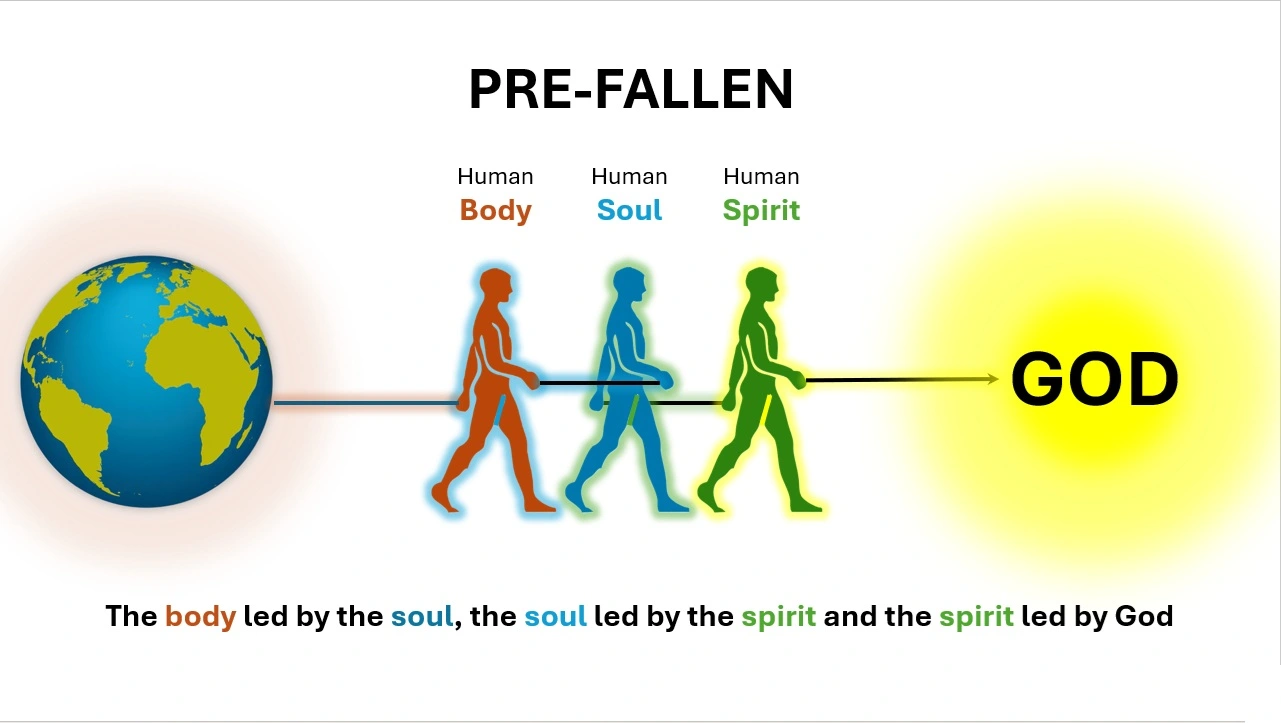
If this understanding is correct, then God’s life and fellowship were intended to flow through mankind in an orderly manner.
This order may be illustrated as follows:
- God communed with man’s spirit.
- The spirit directed the soul.
- The soul governed the body.
In this arrangement, every aspect of man’s life functioned according to God’s purpose.
- The spirit remained in continual fellowship with God.
- The soul willingly submitted to the influence of the spirit.
- The body faithfully carried out the desires of the soul.
Everything functioned in harmony.
The Soul as Mediator
The soul occupies a remarkable position within man’s constitution. It stands between the spirit and the body. On the one hand, it is capable of responding to the influence of the spirit.
On the other hand, it continually experiences the appetites, desires, and sensations communicated through the body.
This places the soul in the position of decision.
Through the intellect, the soul reasons.
Through the conscience, it discerns.
Through the emotions, it responds.
Through the will, it chooses.
In God’s original design, every one of these faculties functioned under the influence of a spirit that enjoyed perfect fellowship with God. Thus, man’s thoughts, desires, decisions, and actions reflected the character of his Creator.
The Body as Servant
The body was never intended to govern mankind. Rather, it served as a vessel for the Soul and the Spirit, an instrument through which the inner man expressed himself.
Through the body mankind exercised dominion over creation.
Through the body Adam cultivated the Garden.
Through the body mankind fulfilled God’s command to be fruitful, multiply, and fill the earth.
The body was therefore neither evil nor inferior.
It faithfully served God’s purpose so long as it remained under the proper authority of the soul, which itself remained under the influence of the spirit in fellowship with God.
The Harmony of Creation
Prior to the Fall, Scripture records no conflict within mankind. There is no struggle between flesh and spirit.
No internal warfare.
No guilty conscience.
No shame.
No fear.
No hiding from God.
Everything functioned according to God’s original design. Adam’s thoughts reflected truth.
His desires reflected holiness.
His will reflected righteousness.
His actions reflected obedience.
The body willingly served the soul.
The soul willingly followed the spirit. The spirit remained in perfect fellowship with God. The result was complete harmony.
Created in the Image of God
This understanding also sheds light upon what it means for mankind to have been created in the image of God. Mankind does not possess God’s divine essence.
Neither does mankind become a miniature trinity. Rather, mankind uniquely reflects God’s communicable attributes according to God’s design.
- Love.
- Holiness.
- Justice.
- Mercy.
- Creativity.
- Wisdom.
- Dominion.
- Stewardship.
- Truthfulness.
- Righteousness.
These qualities were intended to be expressed through a human life properly ordered under God’s authority. The image of God therefore involves much more than possessing certain abilities. It also involves functioning according to the order God established at creation. Only then does mankind properly reflect the character of the One in whose image he was created.
GIVEN COMMANDMENTS
Having created Adam and Eve in His image, God immediately blessed them and gave them specific commandments (Genesis 1:28). He commanded them:
- To be fruitful, multiply, and fill the earth.
- To subdue the earth.
- To exercise dominion over the fish of the sea, the birds of the heavens, and every living thing that moves upon the earth.
These were not mere suggestions. They were divine commandments, every bit as binding as God’s later command not to eat from the Tree of the Knowledge of Good and Evil.
It is also worth noting that the English word subdue translates the Hebrew word kabash (כָּבַשׁ, Strong’s H3533), meaning to bring into subjection, to conquer, to bring into bondage, to make subservient, to dominate, or to tread down. Adam’s dominion was therefore intended to be active and purposeful rather than passive or merely symbolic.
GIVEN RESPONSIBILITY & ACCOUNTABILITY
For some Christians, the expression free will can be problematic when applied to human beings. Human will, after all, always operates within external constraints. Our choices are limited by the options available to us, by our knowledge, by our abilities, and by countless other factors beyond our control.
Adam and Eve, for example, possessed no more ability to intentionally choose to grow physical wings than they possessed the ability to choose any other impossibility. Unless God first provided the means, the method, the opportunity, the awareness, and therefore the ability, such a choice simply did not exist. This is why I distinguish between freedom of will and freedom of action.
Properly understood, moral agency is not the unrestricted ability to choose absolutely anything imaginable. Rather, it is the response-ability to freely respond through action or inaction with respect to what is right and wrong, and to be held accountable for those responses.
This distinction is reflected in the history of the English language itself. The word responsible derives from the Latin responsus, conveying the idea of an obligation or commitment to respond. Responsibility, therefore, is the moral obligation of a moral agent to respond appropriately—to do what is right and to fulfill an entrusted duty.
Today, responsibility is often understood primarily as accepting personal ownership of one’s duties, where failure produces feelings of guilt or shame. While that idea is certainly related, it does not fully capture the biblical concept.
The word accountable, dating from the fourteenth century, combines the words account and able, conveying the idea of being liable to give an account. Liability is the legal or moral obligation by which a lawful authority may demand justice, call an individual or entity into account, and impose the appropriate consequence for damages or injuries resulting from dereliction of duty, willful misconduct, disobedience, or even gross neglect.
Responsibility and accountability are therefore inseparable. Responsibility establishes one’s obligation to act; accountability establishes the certainty that one’s actions—or failures to act—will be judged. Accountability must be real and enforceable, for if there are no corresponding consequences, it becomes little more than an empty word. As Hosea declared,
“They have spoken mere words; with false oaths they have made covenants, so judgment springs up like poisonous weeds in the furrows of the field.” (Hosea 10:4)
For moral agency to have genuine meaning, responsibility must be accompanied by accountability, and accountability must carry fitting consequences for both obedience and disobedience.
CREATED VERY GOOD
God cannot create another God, because:
- a created being would depend on God
- a created being would have a beginning
- a created being would have potentiality and thus, entropy
- a created being would not be identical with its own essence
A being with these characteristics cannot be perfect in the way God is perfect.
Thus, God cannot create an equal or greater being, not because of a limitation in God, but because of the logical impossibility of a “created uncreated being.”
The Only Way for God to Create Something Perfect Is to Create Something “of” Himself
If God creates something from nothing, it is necessarily finite and imperfect. But if God creates something from Himself, it shares His nature. This is why:
- The Son is eternally begotten of the Father (eternal generation).
- The Spirit eternally proceeds (procession).
These are not acts of creation. They are acts of eternal self‑communication within the divine essence. The Son and Spirit are:
- Uncreated
- infinite
- perfect
- immutable
- simple
- eternal
Because they are of God, not made by God. Thus:
God can only produce perfection by communicating His own essence, not by creating something outside Himself.
This is why the Trinity is the only “perfect plurality” in existence.
Adam and Eve were created in the image of God, reflecting aspects of His nature; they were not created to share in God’s divine essence. Consequently, they were not perfect in the absolute sense that God alone is perfect. Nevertheless, although formed from the dust of the earth and made living creatures, they were, as Scripture declares, made “very good.” Being created a little lower than the angels (Hebrews 2:7–9), Adam and Eve were without sin and without flaw, perfectly suited to fulfill the perfect purposes of God according to His perfect design. It was in this sense that God “created man in His own image; in the image of God He created him; male and female He created them” (Genesis 1:27).
Key Takeaways
- God alone possesses absolute perfection.
- Creation was declared very good, meaning it perfectly fulfilled God’s purpose for that stage of His plan.
- “Very good” should not automatically be equated with absolute perfection.
- Adam was created without sin yet remained a created being.
- The first creation establishes the foundation for understanding why God’s purpose extends beyond Eden.
Looking Ahead
If creation was very good, why did it fail?
Before answering that question for mankind, Scripture first presents another created being who fell.