Calvinism – History of:
Estimated time to read:
Read this article to me
Suggested prerequisite reading:
Supporting Articles:
Calvinism – History
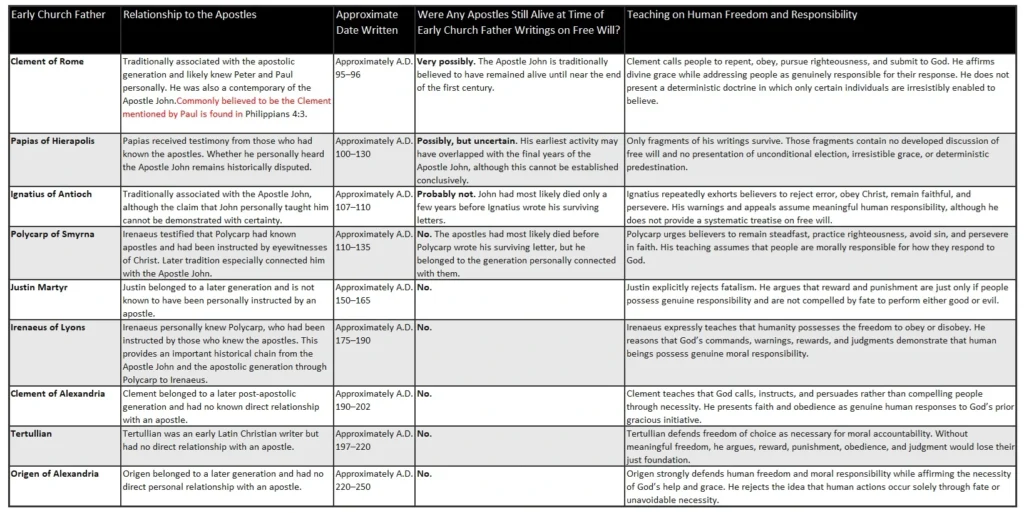
This historical question is both legitimate and important because it naturally invites us to ask: How did those who sat closest to the apostles understand these doctrines? While historical proximity to the apostles does not, in itself, determine theological truth—Scripture alone remains the final authority—it nevertheless provides valuable historical insight. Those who personally knew the apostles, or who were directly taught by them, were uniquely positioned to preserve and transmit the apostolic understanding of the Christian faith. Consequently, examining the writings of the Apostolic Fathers and the earliest generations of Christian leaders helps us determine how the doctrines of grace, election, predestination, and human responsibility were understood before the theological controversies of later centuries gave rise to more fully developed interpretive systems.
From this survey, two historical facts emerge. First, Clement of Rome wrote his epistle while the Apostle John was most likely still living, and Papias may likewise have begun writing during John’s lifetime. Second, the Fathers who personally knew the apostles—or who were directly taught by them—consistently affirmed God’s sovereignty, grace, election, and predestination while simultaneously affirming humanity’s genuine responsibility to respond to God. None of the extant writings from this earliest post-apostolic period present the mature deterministic framework that would later characterize Augustine’s anti-Pelagian theology.
It is important not to overstate the evidence. We cannot conclude that the apostles formally endorsed every statement written by these early Fathers simply because no recorded correction has survived. However, it is historically significant that the earliest surviving Christian writings, produced either during the lifetime of the Apostle John or by those directly instructed by him, contain no extant presentation of the later Augustinian doctrine of unconditional election, irresistible grace, or a deterministic understanding of predestination. This does not settle the theological question—Scripture alone remains the final authority—but it does provide an important historical context for understanding how the generations closest to the apostles expressed these doctrines.
Click to open or close: Dispelling the Claims the Early Church Held Calvinistic Views
Fact Checking Calvinist Early Church Claims
Calvinists claim that the concept of Free Will was never taught or supported by the Pre-Augustine Fathers of the early Church. It is important to understand that neither I, nor (I assume) Calvinists suggest that the writings of the Early Church Fathers should ever be thought of as infallible nor be given the same weight as the writings of the Apostles that make up our Gospel. However, just as we can make use of historical writings like that of Josephus and Philo (and other historical references), to gain understanding of the customs and beliefs of earlier cultures we can do the same thing here by investigating the beliefs and understandings of the Early Church Fathers. After all, and in consideration of the fact that some of the early Church Fathers actually walked with and were disciples of the Apostles we can assume that any general consensus between such Early (Pre-Augustine) Church Fathers as helpful to our own understanding and teachings today. Thus I believed it only fair to fact check the Calvinist claims in this regard. Now although there was a small group of Early (Post-Augustine) Church Fathers who would later support Augustine, I did not find any Early (Pre-Augustine) Church Father who did not teach Free Will. Thus I provide the following statements made by some of the most influential and renowned Early (Pre-Augustine) Church Fathers as evidence that the Calvinist claim is proven to be False:
Acknowledgment of Additional Research
The additional notes highlighted in pale yellow are included in recognition of a fellow Brother in Christ who, wishing to remain anonymous, took the time to examine my original research, conduct further research of his own, and generously share his additional findings, and supporting references. I am grateful for his contribution and pleased to acknowledge his work while respecting his desire to remain anonymous.
Justin Martyr (100-165)
- “God wishing men and angels to follow His Will, resolved to create them free to do righteousness. But if the Word of God foretells that some angels and men shall certainly be punished, it did so because it foreknew that they would be unchangeably (wicked) but not because God created them so. So, if they repent, all who wish for it can obtain mercy from God” (Dialogue with Trypho, Chapter 141)
- “In the beginning, he made the human race with the power of thought and of choosing the truth and doing right, so that all men are without excuse before God” (First Apology, Chapter 28; see also Chapter 43)
- “Let some suppose, from what has been said by us, that we say that whatever occurs happens by a fatal necessity, because it is foretold as known beforehand, this too we explained. We have learned from the prophets and we hold it to be true, that punishments, chastisements, and good rewards, are rendered according to the Merit of each man’s actions. Now if this is not so but all things happen by fate, then neither is anything at all in our own power. For if it is predetermined that this man will be good in this other man will be evil neither is the first one meritorious nor the later man to be blamed. And again unless the human race has the power of avoiding evil and choosing good by free choice they are not accountable for their actions”. (First Apology, Chapter 43).
- “Neither do we maintain that it is by Fate that men do what they do, or suffer what they suffer. Rather we maintain that each man acts rightly or sins by his free choice … Since God in the beginning made the race of angels and men with free will, they will justly suffer in Eternal fire the punishment of whatever sins they have committed”. (Second Apology, Chapter 7)
- “It was God’s desire for both angels and men, who were endowed with free will … that if they choose the things acceptable to him he would keep them free from death and from punishment. However, if they did Evil he would punish each as he sees fit”. (c 160 E) 1.243
- “He created both angels and Men free to do that which is righteous. And he appointed. Of time during which he knew it would be good for them to have the exercise of free will”. (c 160 E) 1.250
- “I have proved and what has been said that those who were foreknown to be unrighteous whether men or angels are not made Wicked by God’s fault rather each man is what he will appear to be through his own fault”. (c 160 E) 1.269
- Unless the human race has the power of avoiding evil and choosing good by free choice, they are not responsible for their actions. (The First Apology, chapter 43)
Irenaeus (130-200)
- “This expression ‘How often would I have gathered thy children together, and thou wouldst not’ set forth the ancient law of human liberty, because God made man a free [agent] from the beginning, possessing his own soul to obey the behest of God voluntarily, and not by compulsion of God. For there is no coercion with God, but good will [toward us] is present in Him continually. And therefore, does He give good council to all. And in man as well as angels, He has placed power of choice (for angels are rational beings), so that those who had yielded obedience might justly posses what is good, given indeed by God but preserved by themselves… If then were it not in our power to do or not to do these things, what reason had the Apostle and much more the Lord Himself, to give us council to do some things and to abstain from others” But because man is possessed of free will from the beginning, and God is possessed of free will in whose likeness man was created, advice is always given to him to keep fast the good, which thing is done by means of obedience to God”. (Against Heresies, Book IV, Chapter 37)
- But man, being endowed with reason, and in this similar respect similar to God, having been made free in his will, and with power over himself, is himself his own cause that sometimes becomes wheat, and sometimes chaff. (Against Heresies, Book IV, chapter 4, section 3.) (1,466)
- Because man is possessed of free will from the beginning, and God is possessed of free will (in whose likeness man was created), advice is always given to him to hold fast to the good, which is done through obedience to God. God has preserved the will of man free and under his own control. This is not merely in works, but also in faith. (Against Heresies, Book IV, chapter 37, section 4) (1,519)
- Nor, again, does God exercise compulsion upon anyone unwilling to accept the exercise of His skill…. They have been created free agents and possessed of power over themselves. (Against Heresies (4.37 or 1.523)
Athenagoras of Athens (Second Century)
- “Just as men have freedom of choice as to both virtue and vice (for you would not either honor the good or punish the bad; unless vice and virtue were in their own power and some are diligent in the matters entrusted to them, and others faithless), so is it among the angels”. (A Plea for the Christians, Chapter 24)
Theophilus of Antioch (Second Century)
- “God made man free, and with power over himself … now God vouchsafes to him as a gift through His own philanthropy and pity, when men obey Him. For as man, disobeying, drew death on himself; so obeying the will of God, he who desires is able to procure for himself life everlasting”. (To Autolycus, Book II, Chapter 27)
Tatian of Syria (Late Second Century)
- “Live to God, and by apprehending Him lay aside your old nature. We were not created to die, but we die by our own fault. Our free will has destroyed us; we who were free become slaves; we have been sold through sin. Nothing evil has been created by God; we ourselves have manifested wickedness; but we, who have manifested it, are able again to reject it”. (Address to the Greeks, Chapter 11)
- Each of these two orders of creatures [men and angels] was made free to act as it pleased. They did not have the nature of good, which again is with God alone. However, it is brought to perfection in men through their freedom of choice. In this manner, the bad man can be justly punished, having become depraved through his own fault. Likewise, the just man can be deservedly praised for his virtuous deeds, since in the exercise of his free choice, he refrained from transgressing the will of God. (Address to the Greeks, Chapter 7, “Concerning the Fall of Man.”)
Bardaisan of Syria (c 154-222)
- “How is that God did not so make us that we should not sin and incur condemnation? If man had been made so, he would not have belonged to himself but would have been the instrument of him that moved him … And how, in that case, would man differ from a harp, on which another plays; or from a ship, which another guides; where the praise and the blame reside in the hand of the performer or the steersman … they being only instruments made for the use of him in whom is the skill? But God in His benignity, chose not so to make man; but by freedom He exalted him above many of His creatures”. (The Book of the Laws of Divers Countries, §1.18)
Clement of Alexandria (c 150-215)
- “We who have heard by the Scriptures that self-determining choice and refusal have been given by the Lord to men, rest in the infallible criterion of faith, manifesting a willful Spirit, since we have chosen life and believe God through His voice?” (Stromata 2.4)
- “Nothing is without the will of the Lord of the universe. It remains to say that such things happen without prevention of God; for this alone saves both the providence and the goodness of God. We must therefore think that He activity produces afflictions (far be it that we should think this!); but we must be persuaded that He does not prevent those that cause them but overrules for good the crimes of His enemies”. (Stromata 4.12)
- Each one of us who sins with his own free will, chooses punishment. So the blame lies with him who chooses. God is without blame. (The Instructor (Paedagogus), Book I, chapter 8.) (2.226)
- Neither praises nor censures, neither rewards nor punishments, are right if the soul does not have the power of inclination and disinclination and if evil is involuntary…. In no respect is God the author of evil. But since free choice and inclination originate sins,…punishments are justly inflicted. (Stromata 1.17.) (Stromata (The Miscellanies), Book I, Chapter XVII, titled “On the Saying of the Saviour, ‘All that Came Before Me Were Thieves and Robbers.’”)
- For believing and obeying are in our own power. (Stromata 7.3.)
- For neither is God involuntarily good, as the fire is warming; but in Him the imparting of good things is voluntary, even if He receive the request previously. Nor shall he who is saved be saved against his will, for he is not inanimate; but he will above all voluntarily and of free choice speed to salvation. Wherefore also man received the commandments in order that he might be self-impelled, to whatever he wished of things to be chosen and to be avoided. Wherefore God does not do good by necessity, but from His free choice benefits those who spontaneously turn. (Stromata 7.7.42.4-6)
- And divinely the expression if you will showed the self-determination of the soul holding converse with Him. For choice depended on the man as being free; but the gift on God as the Lord. And He gives to those who are willing and are exceedingly earnest, and ask, that so their salvation may become their own. For God compels not (for compulsion is repugnant to God), but supplies to those who seek, and bestows on those who ask, and opens to those who knock. (Who Is the Rich Man That Shall Be Saved?, Chapter 10 (ANF 2:593).
Tertullian (155 – 225)
I must note that Tertullian is one of my favorites.
- “I find then that man was by God constituted free, master of his own will and power, indicating the presence of God’s image and likeness in him by nothing so well as by this constitution of his nature. …You will find that when He sets before man good and evil, life and death, that the entire course of discipline is arranged in percepts by God’s calling men from sin, and threatening and exhorting them; and this on no other ground that man is free, with a will either for obedience or resistance … Both goodness and purpose of God are discovered in the gift to man of freedom in his will”. (Against Marcion, Book II, Chapter 5)
- Therefore it was proper that (he who is) the image and likeness of God should be formed with a free will and a mastery of himself; so that this very thing – namely, freedom of will and self-command – might be reckoned as the image and likeness of God in him. (Against Marcion, Book II, Chapter 6)
- Entire freedom of will, therefore, was conferred upon him in both tendencies; so that, as master of himself, he might constantly encounter good by spontaneous observance of it, and evil by its spontaneous avoidance; because, were man even otherwise circumstanced, it was yet his bounden duty, in the judgment of God, to do justice according to the motions of his will regarded, of course, as free. But the reward neither of good nor of evil could be paid to the man who should be found to have been either good or evil through necessity and not choice. (Against Marcion, Book II, Chapter 6)
- To conclude: the goodness of God, then fully considered from the beginning of His works, will be enough to convince us that nothing evil could possibly have come forth from God; and the liberty of man will, after a second thought, show us that it alone is chargeable with the fault which itself committed. (Against Marcion, Book II, Chapter 6)
- The necessary consequence, therefore, was, that God must separate from the liberty which He had once for all bestowed upon man (in other words, keep within Himself), both His foreknowledge and power, through which He might have prevented man’s falling into danger when attempting wrongly to enjoy his liberty. Now, if He had interposed, He would have rescinded the liberty of man’s will, which He had permitted with set purpose, and in goodness. But, suppose God had interposed; suppose Him to have abrogated man’s liberty, by warning him from the tree, and keeping off the subtle serpent from his interview with the woman; would not Marcion then exclaim, What a frivolous, unstable, and faithless Lord, cancelling the gifts He had bestowed! Why did He allow any liberty of will, if He afterwards withdrew it? Why withdraw it after allowing it? (Against Marcion, Book II, Chapter 7).
- No doubt it was an angel who was the seducer; but then the victim of that seduction was free, and master of himself; and as being the image and likeness of God (Against Marcion, Book II, Chapter 8).
- For He afforded room for a conflict, wherein man might crush his enemy with the same freedom of his will as had made him succumb to him (proving that the fault was all his own, not God’s) (Against Marcion — Book II, Chapter 10).
Hippolytus of Rome (c. 170–235)
- Now man, that was brought into existence, was a creature endued with a capacity of self-determination, yet not possessing a sovereign intellect, nor holding sway over all things by reflection, and authority, and power, but a slave to his passions, and comprising all sorts of contrarieties in himself. But man, from the fact of his possessing a capacity of self-determination, brings forth what is evil, that is, accidentally; which evil is not consummated except you actually commit some piece of wickedness. For it is in regard of our desiring anything that is wicked, or our meditating upon it, that what is evil is so denominated. Evil had no existence from the beginning, but came into being subsequently. Since man has free will, a law has been defined for his guidance by the Deity, not without answering a good purpose. For if man did not possess the power to will and not to will, why should a law be established? For a law will not be laid down for an animal devoid of reason, but a bridle and a whip; whereas to man has been given a precept and penalty to perform, or for not carrying into execution what has been enjoined. (The Refutation of All Heresies, Book X, Chapter 29 (ANF 5:151)).
- And that by Himself in person He might prove that God made nothing evil, and that man possesses the capacity of self-determination, inasmuch as he is able to will and not to will, and is endued with power to do both. . (The Refutation of All Heresies, Book X, Chapter 29 (ANF 5:151)).
- But the Word, by declaring them, promulgated the divine commandments, thereby turning man from disobedience, not bringing him into servitude by force of necessity, but summoning him to liberty through a choice involving spontaneity. . (The Refutation of All Heresies, Book X, Chapter 29 (ANF 5:151)).
Novation of Rome (c 200-258)
- “He also placed man at the head of the world man too made in the image of God, to whom He imparted mind, and reason, and foresight that he might imitate God; and although the first elements of his body were earthly yet the substance was inspired by Heavenly and divine breathing, and when He had given him all the things for His service, He willed that he alone would be free and lest again an unbounded Freedom should fall into Peril. He laid down a command in which man was taught that there was no evil in the fruit of the tree; but he was forewarned that evil would arise if perchance he should exercise his Free Will in the contempt of the law that was given” (On the Trinity Chapter 1)
Origen (c 185-254)
- “This also is clearly defined in the teaching of the Church, that every rational soul is possessed of free-will and volition; that it has a struggle to maintain with the devil and his angels, and opposing influences, because they strive to burden it with sins; but if we live rightly and wisely, we should endeavour to shake ourselves free of a burden of that kind.” (On First Principles [De Principiis], Preface, §5; ANF 4:240)
- “There are indeed innumerable passages in the Scriptures which establish with exceeding clearness the existence of freedom of will”. (On First Principles [De Principiis], Book III, Chapter 1)
- The Saviour also saying, I say unto you, Resist not evil; and, Whoever shall be angry with his brother, shall be in danger of the judgment; and, Whosoever shall look upon a woman to lust after her, has already committed adultery with her in his heart; and in issuing certain other commands — conveys no other meaning than this, that it is in our own power to observe what is commanded. (De Principiis, Book III, Chapter 1, § Section 6 (ANF 4:306)
- Let us observe also, that the Apostle Paul addresses us as having power over our own will, and as possessing in ourselves the causes either of our salvation or of our ruin: (De Principiis, Book III, Chapter 1, § Section 6 (ANF 4:306)
- You will find also innumerable other passages in holy Scripture, which manifestly show that we possess freedom of will. (De Principiis, Book III, Chapter 1, § Section 6 (ANF 4:306)
- But since those rational creatures themselves, as we have frequently shown, and will yet show in the proper place, were endowed with the power of free-will, this freedom of will incited each one either to progress by imitation of God, or reduced him to failure through negligence. And this, as we have already stated, is the cause of the diversity among rational creatures, deriving its origin not from the will or judgment of the Creator, but from the freedom of the individual will. (On First Principles, Book II, ch. 9, §6, in Ante-Nicene Fathers, vol. 4 (ANF 4:292).
Cyprian of Carthage (c. 210–258)
- That the liberty of believing or of not believing is placed in free choice. In Deuteronomy: “Lo, I have set before thy face life and death, good and evil. Choose for thyself life, that thou mayest live. (Three Books of Testimonies Against the Jews, Book III, ch. 52 (ANF 5:547).
Methodius (c 260-311)
- “Those who decide that man is not possessed of free will and affirm that he is governed by the unavoidable necessities of fate … are guilty of impiety toward God Himself, making Him out to be the cause and author of human evils”. (The Banquet of the Ten Virgins XVI)
- “I say that man was made with free will, not as if there were already existing some evil, which he had the power of choosing if he wished … but that the power of obeying and disobeying God is the only cause”. (Concerning Free Will)
Archhellaus (c 277)
- “All creatures that God made, He made very good, and He gave to every individual the sense of free will in accordance with which standard He also instituted the law of judgment. To sin is ours, and that we sin not is God’s gift, as our will is constituted to choose either to sin or not to sin”. (The Disputation with Manes)
Arnobius of Sicca (c 253-327)
- “Does He not free all alike who He invites all alike? Or does He thrust back or repel any one from the kindness of the Supreme who gives to all alike the power of coming to Him? To all, He says the fountain of life is opem, and no one is hindered or kept back from drinking …”. (Against the Heathen, Book II, Chapter 64)
- “Nay, my opponent says, If God is powerful, merciful, willing to save us, let Him change our dispositions, and compel us to trust in His promises. This then is violence, not kindness nor the bounty of the Supreme God but a childish and vain strife in seeking to get the mastery; For what is so unjust as to force men who are reluctant and unworthy to reverse their inclinations; to impress forcibly on their minds what they are unwilling to receive, and shrink from …”. (Against the Heathen, Book II, Chapter 65)
- But, my opponents ask, if Christ came as the Saviour of men, as you say, why does He not, with uniform benevolence, free all without exception? I reply, does not He free all alike who invites all alike? or does He thrust back or repel any one from the kindness of the Supreme who gives to all alike the power of coming to Him,—to men of high rank, to the meanest slaves, to women, to boys? To all, He says, the fountain of life is open, and no one is hindered or kept back from drinking. If you are so fastidious as to spurn the kindly offered gift, nay, more, if your wisdom is so great that you term those things which are offered by Christ ridiculous and absurd, why should He keep on inviting you, while His only duty is to make the enjoyment of His bounty depend upon your own free choice? (Against the Heathen, Book II, chap. 64).
- Do you reject with disdain, lightly esteem, and despise it? You will in this case have robbed yourself of the benefit of the gift. God compels no one, terrifies no one with overpowering fear. For our salvation is not necessary to Him, so that He would gain anything or suffer any loss, if He either made us divine, or allowed us to be annihilated and destroyed by corruption. ? (Against the Heathen, Book II, chap. 64).
Cyril of Jersulalem (c 312-386)
- “Know also that thou hast a soul self-governed, the noblest work of God, made after the image of its creator, immortal because of God that gives it immortality, a living being, rational, imperishable, because of Him that bestowed these gifts; having free power to do what it willeth”. (Lecture, IV 18)
- “There is not a class of souls sinning by nature and a class of souls practicing righteousness by nature; but both act from choice, the substance of their souls being of one kind only and alike in all”. (Lecture, IV 20)
- “The soul is self governed; and though the Devil can suggest, he has no power to compel against the will. He pictures to thee the thoughts of fornication; if thou wilt, thou rejectist. For if thou wert a fornicator of necessity, then for what cause did God prepare Hell? Of thou wert a doer of righteousness by nature and not by will, wherefore did God prepare crowns of ineffable glory? The sheep is gentle, but never was it crowned for its gentleness; since it its gentle quality belongs to it not from choice but by nature”. (Lecture, IV 21)
Gregory of Nyssa (c 335-395)
- “Being in the image and the likeness… of the power which rules all things, man kept also in the matter of a free will this likeness to him whose will is over all”. (On Virginity, 368 Chapter XII)
Jerome (c 347-420)
- “It is in vain that you misrepresent me and try to convince the ignorant that I condemned free will. Let him who condemns it be himself condemned. We have been created, endowed with free will still it is not this which distinguishes us from the brutes. For human Free Will as I said depends upon the help of God and needs His aid moment by moment a thing which you and yours do not choose to admit. Your position is that once man has free will he no longer needs to help of God. It is true that freedom of the free will brings with it freedom of decision. Still man does not act immediately on his free will but requires God’s aid who himself needs no aid”. (letters 133)
- “But when we are concerned with Grace and mercy, Free Will is in part void in part I say for so much depends upon it, that we wish and desire and give a scent to the course we choose. But it depends on God whether we have the power and his strength and with his help to perform what we desire and to bring to effect our toil and effort”. (Against the Pelagians, Book 111, 10)
- “It is ours to begin, God’s to finish”. (Against the Pelagians, 3.1)
John Chrysostom (347 – 407)
- “God having placed good and evil in our power, has given us full freedom of choice; He does not keep back the unwilling, but embraces the willing”. (Homilies on Genesis 19.1)
- “All is in God’s power but so that our free will is not lost … It depends therefore on us and on Him. We must first choose the good, and then He adds what belongs to Him. He does not precede our willing, that our free will may not suffer. But when we have chosen, then He affords us much help … It is ours to choose before hand and to will, but God’s to perfect and bring to the end”. (On Hebrews Homily 12)
Early Augustine (354-430)
The following quotations reflect Augustine’s earlier understanding of human free will and moral responsibility. It is important to recognize that Augustine’s theological position underwent a profound development, particularly around AD 411–412, during his controversy with Pelagius and his followers. Although Augustine had already begun emphasizing the necessity of divine grace in his earlier writings, his later teachings would place considerably greater emphasis on humanity’s inability to respond to God apart from His enabling grace. Consequently, Augustine’s earlier and later writings must be distinguished rather than assuming that he maintained an unchanged position throughout his life.
- “Free will naturally assigned by the Creator to our original soul, is such a neutral power, as can either inclined toward faith, or turn toward unbelief”. (On the Spirit and the Letter 58)
- “Sin is so much of voluntary evil that is not sin at all unless it is voluntary”. (Of the religion, 14)
- “Either then will is itself the first cause of sin, or the first cause is with out sin”. (On Free Will, 3.49)
- “Sin is indeed nowhere but, in the will, since this consideration also would have helped me, that Justice holds guilty those sinning by evil will alone, although they may have been unable to accomplish what they willed… Whoever has done anything Evil by means of one unconscious or unable to resist the latter can by no means be justly condemned … Everyone also who does a thing unwillingly is compelled, and everyone who is compelled, if he does a thing, does it only unwillingly, it follows that he that is willing is free from compulsion, even if anyone thinks himself compelled”. (Two Souls Against the Manichaeans, 10 12)
- “Our conclusion is that our Wills have power to do all that God wanted them to do and foresaw they could do. Their power, such as it is, is a real power. What they are to do they themselves will most certainly do, because God foresaw both that they could do it and they would do it and his knowledge cannot be mistaken … The conclusion is that we are by no means under compulsion to abandoned free choice in favor of divine knowledge, nor need we deny, God forbid! God knows the future, as a condition for holding free choice”. (City of God, 5.9)
Anselm (1033-1109)
- “No One desserts up brightness except by willing to Desert it. If against Ones Will means unwillingly then no one deserts up rightness against his will… but a man cannot will against his will because he cannot will unwillingly to will. For everyone who wills, Wills willingly” (Truth Freedom and Evil, 130)
- “Although they (Adam and Eve) yield themselves to sin, they could not abolish in themselves their Natural Freedom of choice. However, they could so affect their state that they were not able to use that freedom except by a different Grace from that which they had before their fall”. (Truth Freedom and Evil, 125)
- “We are not to say that they Adam and Eve had freedom for the purpose of receiving, from a giver, the uprightness which they didn’t have, because we have to believe that they were created with upright wills, Although we must not deny that they had freedom for receiving this same uprightness again, should they once dessert it and where it returned to them by the one who originally gave it. We often see an Evidence of this in men who are LED back to Justice from Injustice by Heavenly grace”. (Truth, Freedom, and Evil, 126)
- “don’t you see it follows from these considerations that no temptation can conquer and upright will? Or if Temptation can conquer the will, it has the power to conquer it, and conquers the will by its own power. But Temptation cannot do this because the will cannot be overcome only by its own power”. (Truth, Freedom, and Evil, 132)
- “Now I wonder whether even God could remove uprightness from a man’s will. Could he? I’ll show you that he cannot. For although he can reduce everything which he has made from nothing back to nothing. He does not have the power to separate uprightness from a will that has it”. (Truth, Freedom, and Evil, 136) Although an assumption, I can only imagine that the context of what Anslem was trying to say is that because God does not tempt people to do evil, for it still took Satan to do that, God likewise does not tempt people to do righteousness, instead just as before Adam and Eve’s Fall, God commands obedience and uprightness.
Thomas Aquinas (1224-1274)
- “The cause of sin is the wills not holding to the rule of reason and divine law. Evil does not arise before the will applies itself to doing something”. (Theological Texts 132)
- “Necessity comes from the agent when the latter so coerces someone that he cannot do the contrary. We refer to this as necessity by coercion. Such necessity by coercion is contrary to the will. For we consider violent whatever is contrary to a things inclination. But the wills own motion is an inclination towards something, so that something is voluntary when it follows the inclination of nature. Just as something cannot possibly be violent and natural simultaneously, so something cannot be absolutely coerced or violent and simultaneously voluntary “. (An Aquinas Reader 291-292)
- “Thus, of necessity man Will’s happiness, and it is impossible for him to well not to be happy or to be unhappy. But since choice does not deal with the end but with the means to the end, as previously discussed [Summa Theologica, I-II, 13, 3], it does not deal with the perfect good or happiness but with other particular goods. Consequently, man does not choose necessarily but freely”. (An Aquinas Reader 293)
- “Some have proposed that man’s will is moved necessarily to making some choice, although they do not hold that the will is coerced. For not every necessity from an external principle violent motion is course of but only that which originates from without, where certain natural movements are discovered to be necessary but not Chorus of. For the course of his opposed to the Natural just as it is also opposed to voluntary emotion, because the latter comes from internal principle, while violent motion comes from an external one. This opinion of Latin airvists is therefore heretical because it destroys Merit and demerit and human actions. For why should there be any Merit or demerit for actions one cannot avoid doing? It is moreover be included among the excluded opinions of philosophers for if there is no freedom in us but we are moved of necessity to will, then deliberate choice, encouragement, precept, punishment, praise, and blame are removed, and these are the very problems that moral philosophy considers, not only is this contrary to the faith but it undermines all the principles of moral philosophy” (An Aquinas Reader 294-295)
- “Sin cannot destroy man’s rationality altogether for then he would no longer be capable of sin”. (Philosophical Texts 179)
- “To be free is not to be obliged to one’s determinate object”. (Philosophical Texts 259)
- “Man has free choice otherwise councils exhortations precepts prohibitions rewards and punishments would all be pointless” (Philosophical Texts 261-262)
- “Man however can act from judgment and adaptation in the reason a free judgment that leaves intact the power of being able to decide otherwise” (Philosophical Texts”
- “Sin is caused by the Free Will according as it turns away from God hence it does not follow the God is the cause of sin although he is the cause of free will” (On Evil, 106)
- “It must be noted that the movement of the first mover is not uniformly received in all movable things, but in each according to its own mode… for when a thing is properly disposed to receive the movement of the first mover a perfect action in accord with the intention of the first mover follows; but if a thing is not properly disposed and suited to receive the motion of the first mover an imperfect action follows. And then whatever action is present is referred to as the first mover as the cause, but whatever defect is present is not referred to the Mover as the cause, since such a defect in the action results from the fact that the agent departs from the order of the first mover… And for this reason we maintain that the action pertaining to sin is from God, but the sin is not from God” (On Evil, 110)
- “The deformity of sin in no way falls under the Divine will but results from this that the Free Will departs or deviates from the order of the Divine will” (On Evil, 111)
- “Similarly when something moves itself, it’s not precluded that it was moved by another from whom it has this variability by which it moves itself, and therefore it is not contrary to Liberty that God is the cause of the act of free will, … Sin wounded man in his natural Powers so far as concerns his capacity for gratuitous Goods but not in such a way that it takes away anything of the essence of his nature; and so it does not follow that the demons intellect erred except about gratuitous matters” (On Evil, 496)
Click to open or close: Augustine and the Rise of a Deterministic Interpretation of Election and Predestination
The Historical Development of a Deterministic Interpretation of Election and Predestination
The doctrines of election and predestination are not theological inventions of the Church but biblical truths revealed by God Himself. Throughout Scripture, God plainly declares that He elects, predestines, foreknows, calls, justifies, and glorifies. Consequently, the historical question has never been whether these doctrines exist, but rather how they are to be understood.
It is therefore important to distinguish between the biblical doctrines of election and predestination themselves and the theological framework through which those doctrines are interpreted. Christians throughout history have agreed that God elects and predestines. The point of disagreement has always concerned the nature and scope of that election and predestination.
The earliest generations of Christian writers following the apostles consistently affirmed God’s sovereignty, grace, foreknowledge, election, and predestination. At the same time, they also consistently affirmed mankind’s responsibility to respond to God. Writers such as Justin Martyr, Irenaeus, Clement of Alexandria, Tertullian, and Origen all spoke of God’s gracious initiative while likewise emphasizing humanity’s responsibility to believe, obey, and persevere. Although these writers differed in various theological matters, none presented a fully developed doctrine in which God unconditionally determines which individuals will believe through an irresistible work of grace.
The earliest confirmed and systematic development of election and predestination framed in what would later become recognized as a theologically deterministic manner appears in the mature writings of Augustine of Hippo during the late fourth and early fifth centuries. This development did not occur immediately after his conversion but emerged gradually, reaching its mature expression during his controversy with Pelagius.
Augustine himself underwent a noticeable theological development. In his earlier writings, he frequently emphasized human responsibility alongside divine grace. However, as he wrestled with the Pelagian controversy and particularly with passages such as Romans 9 and John 6, his understanding changed significantly. He increasingly concluded that fallen humanity is not merely unable to save itself but is unable even to believe unless God first performs an inward and effectual work upon the will itself. Election therefore became, in Augustine’s mature theology, God’s unconditional determination of those individuals whom He would graciously cause to believe and persevere.
This represented a significant shift in theological emphasis. The question was no longer simply whether God elects or predestines—for Scripture plainly affirms both—but whether election and predestination refer primarily to God’s sovereign determination of the destiny prepared for believers or to God’s sovereign determination of which individuals would become believers in the first place.
That distinction remains central to the discussion today.
The position presented throughout this study fully affirms that God always acts first. No sinner initiates salvation. God loved first. God revealed Himself first. God sent His Son first. God accomplished redemption first. God raised Christ from the dead first. God sent His Spirit first. God commands all people everywhere to repent. God calls sinners through the gospel and graciously provides in Christ everything necessary for salvation. Every opportunity to believe is therefore itself the result of God’s prior gracious initiative.
The question is not whether God acts first, but how He acts first.
Did God act first by extending His gracious provision universally through Jesus Christ, genuinely calling all people to repentance and faith while holding each person responsible for his or her response? Or did God act first by granting only a predetermined number of individuals an inward, irresistible grace that alone enables them to believe?
These two understandings represent fundamentally different theological frameworks while both affirming the biblical realities of election, predestination, grace, and God’s sovereign initiative.
Accordingly, this study does not deny election or predestination. On the contrary, it wholeheartedly affirms both because Scripture plainly teaches them. The question before us is not whether God elects and predestines, but whether Scripture presents those doctrines as God’s sovereign determination of the destiny attached to faith in Christ or as His sovereign determination of who will possess faith in Christ. History demonstrates that this latter deterministic framing first reached its mature and systematic expression in the writings of Augustine and would later become foundational to much of medieval Western theology and, centuries later, to the Reformed theological tradition.
Augustine’s Personal Experience and the Development of His Theology
Every Christian approaches Scripture through the lens of personal experience to one degree or another. The challenge for every student of Scripture is to ensure that personal experiences are continually tested by the Word of God rather than allowing experience to become the lens through which Scripture is interpreted. Augustine himself provides an excellent historical illustration of this principle.
Throughout his Confessions, Augustine openly recounts his profound struggle with sin before his conversion. He describes himself as loving sinful pleasures while simultaneously recognizing their destructive nature. His famous account of stealing pears illustrates this inner disposition. Augustine concludes that he stole, not because he desired the fruit itself, but simply because he delighted in doing what was forbidden. Likewise, his well-known prayer, “Grant me chastity and continence—but not yet,” reveals the internal conflict that characterized much of his early life. He recognized the goodness of God’s commands while confessing that he lacked the desire to obey them.
Augustine also recounts his years of rejecting the Christian faith embraced by his mother, Monica. Rather than accepting Christianity, he devoted himself to Manichaeism and later pursued various philosophical systems in search of truth. Yet none ultimately satisfied the deep spiritual longing he experienced.
Particularly noteworthy is Augustine’s account of the illness of one of his closest friends. While unconscious and near death, the young man was baptized by others without his knowledge. Augustine initially dismissed the baptism as meaningless because his friend had not consciously participated in it. Yet after unexpectedly recovering, the friend sharply rebuked Augustine for mocking what had taken place and thereafter spoke of his baptism with deep conviction. Augustine records this incident as one of the many providential events that profoundly affected him during this period of his life.
Likewise, Augustine’s own conversion in the garden became the defining spiritual experience of his life. Having long struggled against his sinful desires, he describes hearing the words “Take up and read,” opening Paul’s epistle to the Romans, and experiencing what he understood to be God’s decisive intervention in his heart. Looking back, Augustine consistently interpreted his conversion as entirely owing to God’s gracious initiative rather than to any goodness or ability within himself.
None of these experiences prove Augustine’s later theological conclusions. Nevertheless, they provide important historical context for understanding why he increasingly emphasized God’s sovereign initiative in salvation. Augustine’s Confessions reveal a man who became deeply convinced that he could never have turned to God apart from God’s prior work within him. Whether that personal experience should become the controlling framework through which all biblical teaching on election, predestination, and grace is interpreted remains a separate theological question. History, however, demonstrates that Augustine’s own experiences profoundly shaped the way he came to understand those doctrines.
Augustine’s Changing Understanding of Election and Predestination
One of the more significant developments in the history of Christian theology concerns the gradual evolution of Augustine’s own understanding of grace, election, and predestination. Augustine did not hold throughout his life precisely the same theological views. Rather, his writings reveal a noticeable development over several decades.
In his earlier works, Augustine more readily spoke of human responsibility alongside God’s grace and frequently interpreted election in connection with God’s foreknowledge. However, as the Pelagian controversy unfolded during the early fifth century, his writings increasingly emphasized the inability of fallen mankind to believe apart from an inward and effectual work of divine grace. During this period, Augustine’s interpretation of passages such as Romans 9 underwent a marked transformation, and he eventually concluded that God’s election was not grounded upon foreseen faith but solely upon God’s sovereign will.
It would be historically inaccurate to state with certainty that Augustine changed his theology because of his debates with Pelagius. Yet the timing naturally raises legitimate historical questions. Augustine’s most developed writings on predestination, irresistible grace, and perseverance all emerged during or immediately following that prolonged controversy. Whether those debates merely refined convictions he already possessed or contributed to the direction of his theological development continues to be discussed by historians.
Equally significant is the reception of Augustine’s later theology within the wider Church. His teaching on the absolute necessity of divine grace exercised enormous influence upon Western Christianity and became foundational for much of medieval theology. Yet his mature interpretation of unconditional election and predestination was never universally embraced throughout Christendom. The Eastern churches largely continued to affirm a synergistic understanding of salvation, emphasizing both God’s initiating grace and humanity’s responsibility to respond. Even within the West, subsequent councils affirmed the priority and necessity of grace while refraining from adopting every aspect of Augustine’s mature doctrine of predestination.
This historical distinction is important. The question before the Church was never whether God elects or predestines, for Scripture plainly teaches both. Rather, the question concerned how those biblical doctrines should be understood. Augustine’s mature writings represent the earliest systematic Christian presentation of election and predestination framed in a manner that later became foundational for the deterministic theology of the medieval West and, centuries later, for the Reformed tradition. That framework, however, should not be confused with the only historical understanding of election and predestination within the Christian Church.
Click to open or close: When Did the Deterministic Interpretation of Election and Predestination Take Hold in the Church?
This historical question naturally follows from our examination of the earliest Church Fathers. If the generations immediately following the apostles consistently affirmed both God’s sovereign grace and mankind’s genuine responsibility to respond, then an obvious question arises: When did the deterministic interpretation of election, predestination, and the inability of the human will become the dominant framework within much of Christianity?
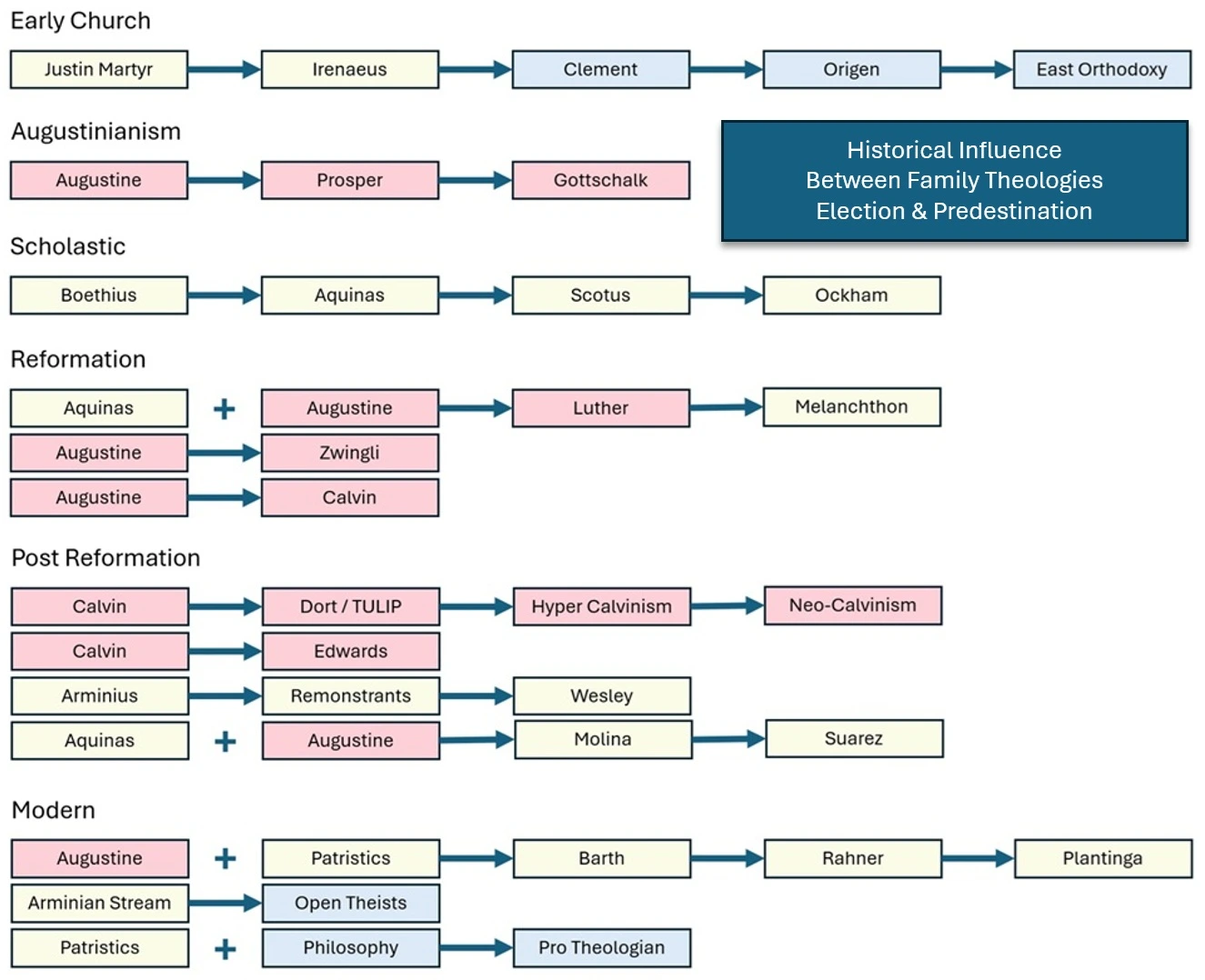
The answer is more nuanced than many assume. There was never a single year in which a deterministic understanding of election, predestination, and the inability of the human will became the doctrine of the entire Christian Church. Rather, this theological framework developed gradually over many centuries. Augustine supplied its earliest mature theological formulation during the early fifth century, but it remained debated and often resisted throughout much of the medieval period. It did not gain widespread institutional influence until the Protestant Reformation, when it was revived through Martin Luther and later systematized by John Calvin into what became the classic Reformed doctrine of salvation.
Following Augustine’s death, his writings exercised extraordinary influence upon the Western Church. Few theologians after the apostles shaped Latin Christianity more profoundly than Augustine. His teachings on original sin, grace, and the necessity of divine initiative became foundational for much of medieval theology, and his authority was frequently appealed to by subsequent generations of theologians. Yet Augustine’s immense influence should not be confused with universal acceptance of every aspect of his mature doctrine of election, predestination, and free will.
Although the Church universally rejected Pelagianism and affirmed mankind’s complete dependence upon God’s grace, it repeatedly stopped short of adopting Augustine’s strongest predestinarian conclusions as the Church’s universal teaching. The Eastern churches never embraced Augustine’s deterministic understanding of election and continued to teach that God’s grace precedes and enables salvation while preserving humanity’s genuine responsibility to respond. Likewise, within the Western Church, Augustine’s later theology concerning unconditional election, irresistible grace, and predestination remained the subject of continuing discussion and, at times, formal ecclesiastical correction.
The historical record further demonstrates that those who most fully embraced Augustine’s stronger predestinarian conclusions represented a comparatively small theological movement rather than the settled consensus of the Church. While Augustine himself continued to be revered as one of Christianity’s greatest theologians, many of his later conclusions concerning unconditional election, irresistible grace, and predestination remained controversial for centuries. Those who most vigorously advanced these deterministic interpretations frequently encountered significant ecclesiastical resistance.
This pattern can be observed in a succession of church councils and synods. The Council of Arles (A.D. 475) affirmed the necessity of divine grace while resisting theological conclusions that diminished meaningful human responsibility. The Second Council of Orange (A.D. 529) decisively rejected Pelagianism and strongly affirmed mankind’s fallen condition together with the necessity of prevenient grace, reinforcing humanity’s complete dependence upon God’s gracious initiative. At the same time, however, the council deliberately refrained from adopting Augustine’s mature doctrine of unconditional predestination or endorsing a deterministic understanding of salvation in which God’s irresistible decree alone determines who will believe. Rather than elevating Augustine’s strongest predestinarian conclusions to the universal doctrine of the Church, Orange affirmed the necessity of grace while leaving many of the more deterministic implications of his later theology unresolved.
The controversy continued into the ninth century through the teaching of the monk Gottschalk of Orbais. Drawing extensively upon Augustine’s later writings, Gottschalk vigorously defended what became known as the doctrine of double predestination, maintaining that God had eternally predestined one group of humanity to salvation and another to condemnation. His views met with decisive opposition. At the Synod of Mainz (A.D. 848), Gottschalk was deposed from the priesthood, publicly flogged, and sentenced to lifelong imprisonment in a monastery. The following year, the Council of Quierzy (A.D. 849) again rejected his formulation of predestination, affirming instead God’s universal salvific purpose and carefully distinguishing God’s foreknowledge from the stronger deterministic conclusions advanced by Gottschalk.
Taken together, these historical events reveal a consistent pattern throughout the early medieval Church. Augustine remained one of Christianity’s most highly esteemed Fathers, and his doctrine of grace profoundly influenced Western theology. Yet the Church repeatedly exercised caution toward the more deterministic implications drawn from his later writings. Those who pressed Augustine’s strongest predestinarian conclusions represented a minority movement, and when those conclusions were advanced most forcefully, they repeatedly encountered formal ecclesiastical opposition. Thus, while Augustine’s mature framework became enormously influential, it did not become the settled consensus of Christendom.
Nevertheless, Augustine’s theological legacy continued to grow. His writings remained the principal point of reference for Western discussions concerning grace, free will, election, and predestination, and theologians continued to wrestle with these questions throughout the medieval period. Although Augustine himself had long been honored as one of the Church’s greatest Fathers, it was not until the closing decades of the thirteenth century that Augustinianism emerged as one of the principal scholastic traditions within the Western Church. Alongside the other great schools of medieval theology, Augustine’s mature understanding of grace, free will, election, and predestination became firmly embedded in the education of future theologians, ensuring that his influence would continue to shape Western theological thought.
This development proved historically significant. When Martin Luther entered the Order of the Augustinian Hermits in A.D. 1505, he entered an educational tradition already deeply immersed in Augustine’s writings. Luther did not discover Augustine independently; rather, he was educated within an intellectual and theological environment saturated by Augustine’s thought. Augustine’s works formed an integral part of Luther’s theological training, and Luther himself readily acknowledged Augustine as one of the Church’s greatest authorities on grace. Historians have frequently observed that Luther was, in many respects, an Augustinian reformer before he became a Protestant reformer.
Consequently, when Luther challenged many doctrines of the medieval Church, he did not do so from a theological vacuum. His understanding of grace had already been formed within an educational tradition deeply shaped by Augustine’s mature writings. In A.D. 1525, Luther published The Bondage of the Will in response to Erasmus, arguing that fallen humanity does not possess the moral ability to turn itself toward God apart from divine grace. This work gave Augustine’s understanding of the inability of the fallen will renewed prominence throughout the emerging Protestant movement. While Luther did not construct as comprehensive a doctrine of election and predestination as Calvin would later develop, he provided the theological bridge through which Augustine’s mature anthropology entered the Protestant Reformation.
Only a generation later, John Calvin would draw even more extensively upon Augustine’s mature writings. Although Calvin consistently maintained that Scripture alone was the supreme authority, he regarded Augustine as one of the Church’s most faithful interpreters of the biblical doctrine of grace and frequently appealed to him in support of his own theological conclusions. Beginning with the first edition of the Institutes of the Christian Religion in A.D. 1536 and culminating in its definitive 1559 edition, Calvin refined and systematically organized Augustine’s mature framework into a comprehensive doctrine of salvation. Fallen humanity was understood to be unable to respond savingly apart from God’s gracious initiative; God unconditionally elected particular individuals to salvation; His effectual call would certainly bring those individuals to faith; the grace producing that faith could not finally be resisted; those whom God elected would persevere to the end; and the eternal destinies of both the redeemed and the lost ultimately fell within God’s sovereign decree.
Through Calvin’s ministry in Geneva, the training of ministers, the publication of Reformed confessions, and the rapid spread of Reformed churches throughout Switzerland, France, the Netherlands, Scotland, England, and portions of Germany, Augustine’s deterministic framework achieved a degree of institutional influence it had never previously possessed. Although Calvin did not originate this theological framework, he organized, refined, defended, and transmitted it more successfully than anyone before him. Consequently, the period extending from approximately A.D. 1525 through the latter half of the sixteenth century represents the clearest historical turning point at which the deterministic interpretation of election, predestination, and the inability of the human will gained a firm institutional foothold throughout large portions of Western Protestant Christianity.
Even then, however, it is important to recognize that this interpretation never became the universal doctrine of the Christian Church. The Roman Catholic Church formally opposed the Protestant denial of human cooperation with grace at the Council of Trent (A.D. 1547), affirming that while God’s grace always precedes salvation, mankind retains the responsibility to cooperate with or resist that grace. Likewise, the Eastern Orthodox churches continued to teach that God’s gracious initiative enables rather than eliminates humanity’s genuine response. Numerous Protestant traditions—including the Anabaptists, Arminians, Methodists, Free Will Baptists, General Baptists, and many other evangelical groups—would likewise reject unconditional individual election and irresistible grace.
This historical progression demonstrates that the debate has never centered upon whether God elects or predestines, for those doctrines have been confessed by Christians from the beginning because they are plainly taught in Scripture. Rather, the historical question concerns the framework through which those doctrines are interpreted. The earliest generations of Christians affirmed election and predestination while also affirming God’s sovereign initiative and humanity’s responsibility to respond. Augustine supplied the earliest extant systematic deterministic framework within Christian theology during the early fifth century. That framework remained respected, debated, and often resisted for more than a thousand years before becoming firmly established within a major branch of Christianity during the Protestant Reformation. Martin Luther reintroduced Augustine’s understanding of the bondage of the will into the heart of the Reformation, while John Calvin refined, organized, and systematized Augustine’s mature theology into the comprehensive framework that became the foundation of classical Reformed theology. Thus, while Augustine laid the theological foundation between approximately A.D. 411 and 430, it was during the Reformation—particularly between A.D. 1525 and 1560—that his deterministic interpretation of election and predestination gained its greatest institutional influence throughout large portions of Western Protestant Christianity.
Click to open or close: Election & Predestination Theological Families
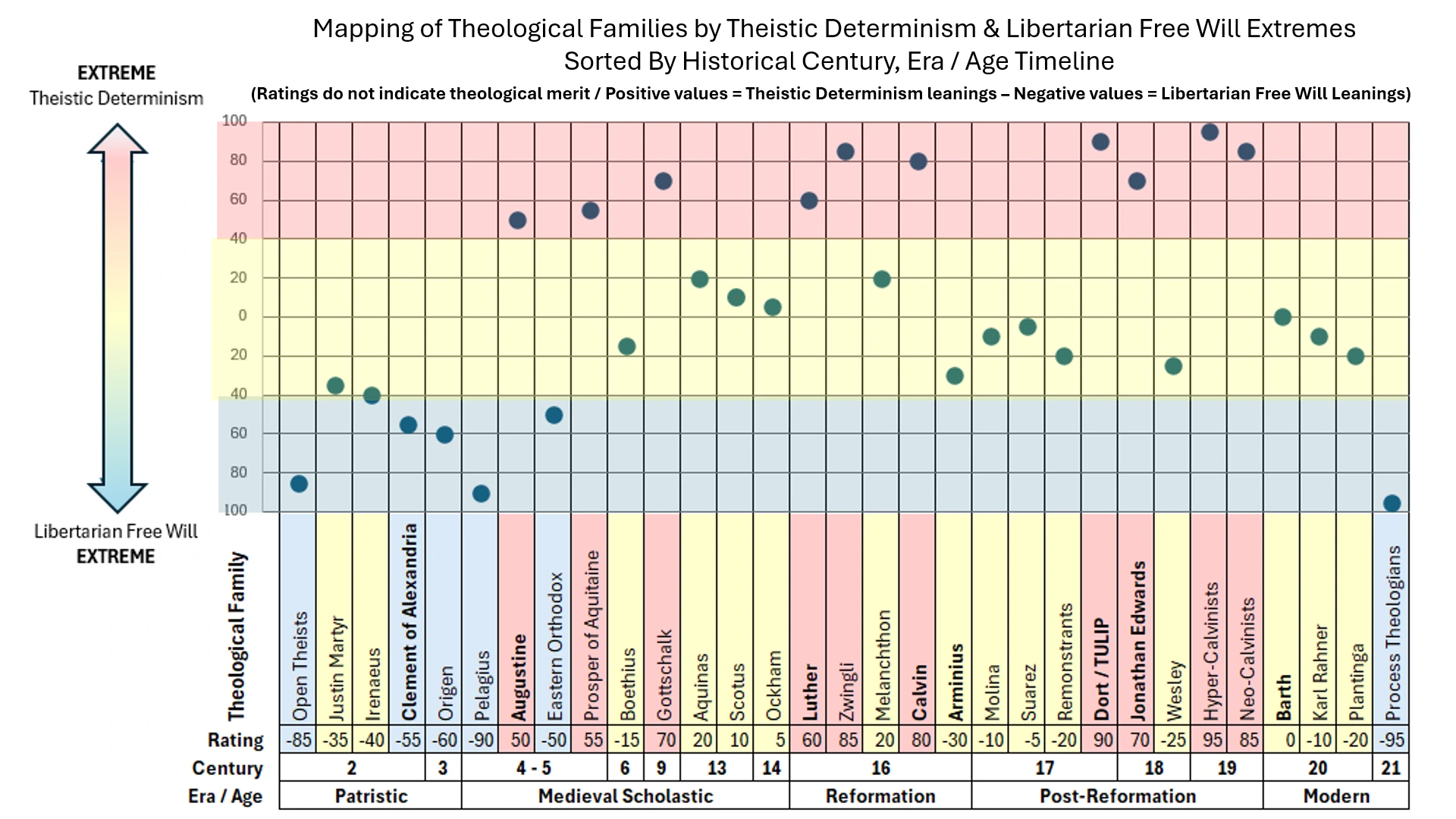
| Figure / Movement | Notes |
|---|---|
| Open Theists | Future free acts not fixed; strong libertarian freedom |
| Justin Martyr | Early Christian emphasis on moral freedom |
| Irenaeus | Free will central to theodicy |
| Clement of Alexandria | Strong synergy; moral freedom |
| Origen | Free will + universal restoration |
| Pelagius | Maximal free will; grace = external help |
| Augustine | Unconditional election; efficacious grace |
| Eastern Orthodox Tradition | Synergism; anti‑deterministic anthropology |
| Prosper of Aquitaine | Strong Augustinian predestination |
| Boethius | Timeless knowledge avoids determinism |
| Gottschalk | Double predestination |
| Aquinas | Predestination affirmed; no double predestination |
| Scotus | Divine will central; moderate determinism |
| Ockham | Divine freedom emphasized; soft determinism |
| Luther | Bondage of the will |
| Zwingli | Strong determinism; divine causality |
| Melanchthon | Early Lutheran synergy |
| Calvin | Double predestination (in some formulations) |
| Arminius | Conditional election; resistible grace |
| Molina | Middle knowledge; libertarian freedom preserved |
| Suarez | Jesuit scholastic; mitigated libertarianism |
| Remonstrants | Anti‑Calvinist response; conditional election |
| Dort / TULIP | Hardest form of Reformed determinism |
| Edwards | Compatibilist determinism; strong sovereignty |
| Wesley | Arminian with strong prevenient grace |
| Hyper‑Calvinists | |
| Neo‑Calvinists | Kuyperian sovereignty emphasis |
| Barth | Christocentric election; avoids determinism |
| Karl Rahner | Transcendental freedom; grace‑cooperation |
| Plantinga | Free‑will defense; libertarian freedom |
| Process Theologians | Radical free‑will emphasis; God does not determine future events |