
SELECTED ARTICLE
Step 1: The First Creation
Estimated time to read:
Click on thumbnail to expand —>
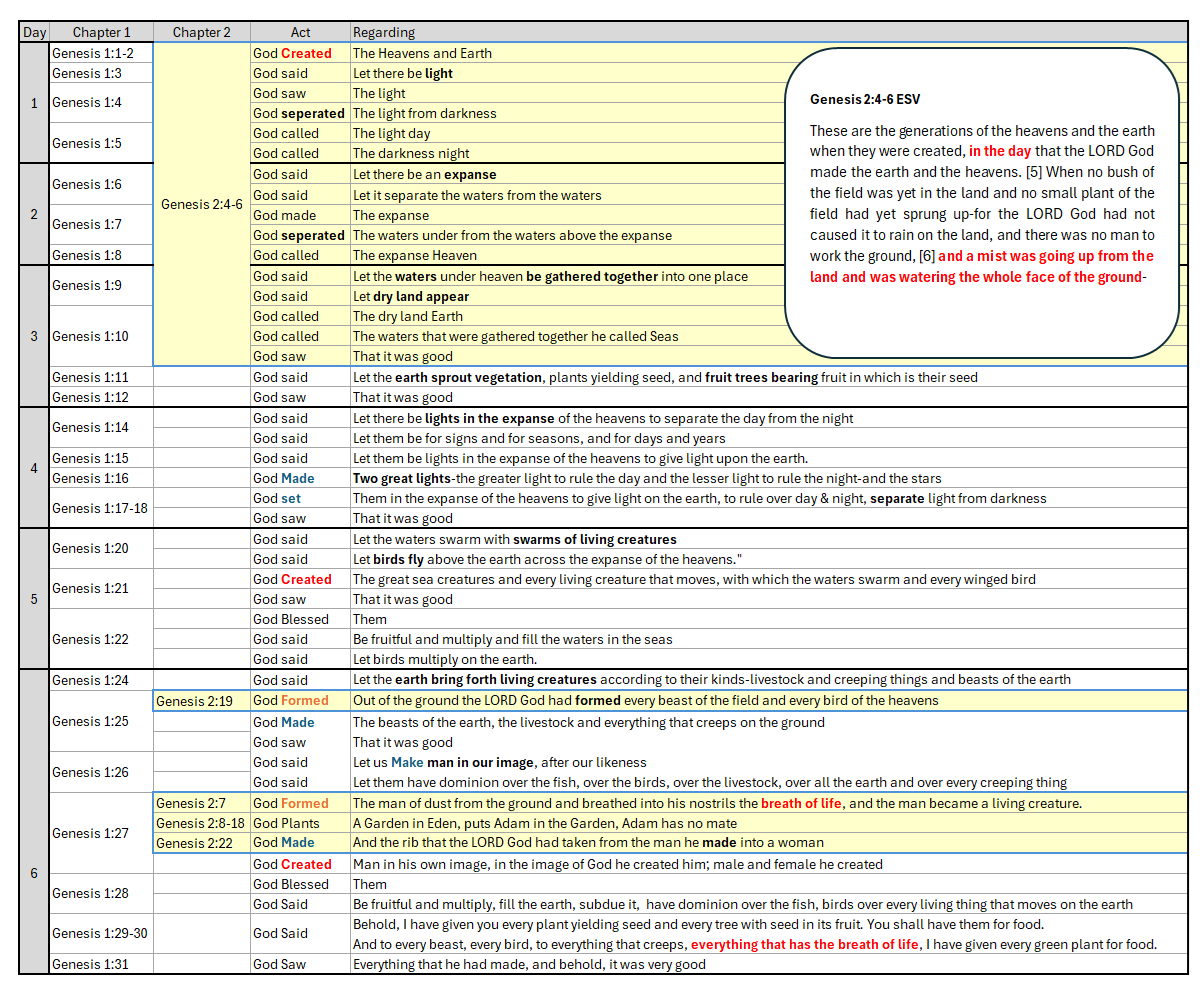
Step 1: Creation ex nihilo
Formed, Made and Created
Adam and Eve were created in the image of God (His nature) they were not created of God’s essence and therefore were not perfect, as per God “is” Perfect. However, although formed from the dust of the Earth, being made living creatures, a little lower than the Angels (Hebrews 2:7-9), they were made “very good”. Adam and Eve were without sin and without flaw as per the perfect purposes of God and His perfect design, in which He “created man in his own image, in the image of God he created him; male and female he created them”. It is important to note that there is a distinguishment made in Genesis between the English word “created” translated from the Hebrew word “bara”, and the English word “made” as translated from the Hebrew word “asah”.
“Created” refers to:
- of something new,
- to bring something into existence, ex nihilo,
- to bring something new & unique into existence which never existed before.
“Made” refers to:
- to do, to act with effect
- to bring about, to use
- to attend to, put in order
- to observe, celebrate
- to acquire (property)
- to perform, practise (as in work on something to improve that thing), prepare, procure, provide, put
- to appoint, ordain, institute
- to accomplish,
- the act of producing or constructing something using & mixing existing materials & substances with a distinct purpose
Therefore, whether God “creates”, ex nihilo, or God creates using the “materia” that He had previously created, in each act of His creating, God creates something entirely “new” and “unique”. He creates something that has never before existed. When Scripture makes an intentional distinction between that which was “created” and that which was “made” (Hebrew “asah”), it should not be understood as indicating some “chronologically sequential process”, as if it was not all “formed”, “made” or “created” in one “instantaneous act”. Instead, it should be both properly contextualized and simply understood, as indicating that which was “made”, was “made” entirely of previously created materia or was procured from something previously created and is therefore not entirely new and unique. The term “formed” (Hebrew “yatsar”) should be understood as to distinguish that which was created and or made to have a formable, shapeable, physical nature from that which was not.
| English | Hebrew | Strong’s # | Meaning |
|---|---|---|---|
| Create / Created | bara | H1254 | of something new, to bring something into existence, ex nihilo or to bring something new / unique into existence which never existed before |
| Make / Made | asah | H6213 | to do, accomplish, The act of producing or constructing something using / mixing existing materials / substances with a distinct purpose, to procure or ordain |
| Built / Made | banah | H1129 | To build or rebuild, establish or cause to continue |
| Form / Formed | yatsar | H3335 | shaping or fashioning, squeezing as in molding of something in existence / clay. |
Tripartite Man | The Image of the Triune God
Take note of Isaiah 43:7 which echoes the same pattern of Genesis 1 & 2, wherein God says that He created, formed and made everyone who is called by His name. These are three different words, each having a distinctive meaning that as I believe are used in indication that in “creating” Adam and Eve in His likeness, that God created man, male and female, to be tripartite. He created human beings who having body, soul and spirit would reflect His triune nature as God the Father, God the Son and God the Holy Spirit (1 Thessalonians 5:23).
Click here to open or close details on body, soul and spirit
Body
The English word “Body” is translated from the Hebrew word “basar”, H-1320 and means a “vessel” or the “temple” for the “soul” and the “spirit”. While the body – which itself has life – should be regarded as nothing less than a master work of God’s design, it was and is but an earthly, temporary vessel (2 Corinthians 4:16). Once our evanescent bodies have served their perfect purpose, they return to dust (Ecclesiastes 12:7). The body is our decaying outer-self, purposed to be a Holy temple with which we should glorify God in testimony, in worship, in service and in living sacrifice (Romans 12:1). The purpose of the interim body – at times referred to as the flesh – is perhaps best illustrated in Leviticus 17:11. where it says “For the life of the flesh is in the blood, and that it was given it for us on the altar to make atonement for our souls.
Soul
The English word “soul” and the English word “creature” are both translated from the Hebrew word “nephesh”, H-5315. It generally denotes life force, personhood, or the self and means, properly a “breathing creature”, an animal or abstractly meaning “vitality” or the “source of material life” that “vitalizes”. This term emphasizes the entirety of a living creature, encompassing emotions, personality, and will. Once God had formed the living body of flesh, He made it a living creature, a living soul (Genesis 2:7).
The English word “breath” is translated from the Hebrew word “neshamah”, H-5397 and means “literally” or “figuratively”, “Inner being”, “thought” and emotion. In its most basic sense, it means the animated “life essence” and “life force”, the “vitality” of the corporeal body. The English word “Breathed” is translated from the Hebrew word “naphach”, H-5301 and means literally to “blow”, to breath, or figuratively, to “blow “, or put “the breath of life “into” a physical body. The expression “breathed into his nostrils the breath of life” is a metaphor. It signifies that God put the living sole inside the living body of Adam. Thus, rendering him a “living creature” and differentiating him (as well as other creatures), from mere living organisms that are without the attributes of the soul. It is, therefore, the living body that has the physical attributes and the five senses, whereas it is the living soul – our inner self – that has the attributes of mind, emotion and will with which we use to make decisions (Deuteronomy 30:19).
The human “soul” is not our physical heart, but it is the heart of who we are, and we are who and what we choose to love (Matthew 22:37). Unlike the body, the soul is not temporary – it will not die – but it is not impervious to ruin (Matthew 10:28). The sole is the bridge between the Spirit and the Flesh and like our bodies, the soul – our minds – need nourishment. Therefore, what we concentrate on, what we meditate on, what we feed our soul matters. A healthy soul is spiritually nourished by the word of God whereas an unhealthy soul is nourished by the worldly desires of the flesh (Galatians 5:17). We should make no mistake of it, the desires of the flesh predominantly conflict with the desires of God, but we should not surrender our souls – our hearts, our minds, our emotions and our will to the flesh. Instead we should surrender ourselves to God, for all that is to His glory is to our benefit (Luke 22:42).
Spirit
The English word “Spirit” is translated from the Hebrew word “ruach” (H-7307). Although it literally means “wind” or “breath,” in context it can also refer to the immaterial life essence within a person—the human spirit or spirituality that enables a person to respond to and commune with God.
While some creatures may display greater intelligence than others, it is the spirit that distinguishes human beings from mere beasts. Scripture also uses ruach to describe the empowering work of God’s Spirit in individuals, as seen in Judges 14:6.
Just as the Father, the Son, and the Holy Spirit each have distinct roles, so too do the body, soul, and spirit of man. The human spirit was designed to be the conduit through which a person connects and communicates with God, receiving spiritual nourishment, guidance, and true life (John 6:63).
The Intended Order of the Human Person was such that the spirit was meant to serve as the bridge between the soul and God, and therefore it was intended to lead the soul. In turn, the soul was meant to lead the body. Ideally, the soul would remain in such close (lock-step) harmony with the spirit that the two would appear inseparable (indistinguishable) in purpose and direction. This would therefore give reason to why some hold to a bipartite view of mans nature – the heart of what and who man is.
Like the soul, the spirit does not die. However, “sin” (NOT God) broke the connection between the human spirit and God. As a result, humanity became separated from God’s spiritual nourishment, strength, and guidance. The spirit no longer functioned as it was intended and thus became, in effect, as good as dead.
Without direction from the spirit, the soul turns instead to the flesh for guidance, and the proper order is reversed. Where the spirit was meant to lead the soul, and the soul the body, now the flesh leads the soul, and the soul drags the spirit behind it.
This helps explain why, since the fall of man, it can be difficult to distinguish between the human spirit and the soul. Once the spirit lost its connection to God, it became overshadowed by the soul—or, in some cases, influenced by evil spirits.
The word of God however – for those who will hear and receive – “is living and active, sharper than any two-edged sword, piercing to the dividing of soul and of spirit, of joints and of marrow, and discerning the thoughts and intentions of the heart” (Hebrews 4:12).
Allowing Genesis to Interpret Genesis
The first chapter of Genesis provides a broad, sequential and cosmic overview of creation over six days. The second chapter provides a more detailed account of the sixth day, focusing on the creation of Adam and Eve, humanity. Therefore, in accordance with the first chapter of Genesis, God created in logical, sequential order:
- The heavens,
- The Earth,
- The fish,
- The birds,
- Human beings (male and female).
These are the only five-things that are distinguished in the first two chapters as being “created”. Each of these things (be they created ex nihilo or with materia that God had already created) ,were created as something new, unique and different from anything that existed before it.
God Created: Heaven & Earth
If we take Genesis at face value of its sequential order, then Genesis 1:1 tells us that the first two things that God created were the heavens and earth. This would mean that Genesis 1:2 is qualifying the first verse by describing the initial state of the earth, not before, but instead after its creation. Thus, when “When God began”, He created (ex nihilo) the earth to be without form, void, with darkness over the deep and in preparation for His Spirit – the Holy Spirit of God that was hovering over the waters – to accomplish all that is revealed thereafter.
Click here to open or close the case for creation ex nihilo
Challenging Creation ex nihilo
Many modern scholars who hold to a literal reading of Genesis 1:1 YLT interpret it as a dependent clause (“When God began” or “When God prepared”) rather than an absolute beginning (“In the beginning”). In simple terms, this interpretation holds that Genesis 1:1 does not read as God having created ex nihilo but instead as God having created ex hylis, using pre‑existing, formless matter and or elements. This of course raises the question of how we are to consider these elements in relation to God? Were they for example:
- Eternal, coexistent with God?
- or were these elements created by God?
Some scholars will claim that a literal reading of Genesis 1:1 does not give reason for choosing the second of the two options. They will often point to several ancient Jewish texts suggesting that some early Rabbis understood Genesis 1:1 as teaching creation ex hylis.
As a personal observation, I suspect some scholars may prefer creation ex hylis because it aligns more easily with theistic evolution (Divinely orchestrated Evolution). By this I mean the attempt, especially within Christianity, to reconcile Darwinian undirected evolution with belief in God. While I would not go so far as to say God could not have created through such a process, I do not believe He did or needed to. One reason is that I believe all God’s acts reveal His truth and glory, and I do not see how a divinely guided evolutionary process spanning billions of years, witnessed only by God, would meaningfully do that. Though many Christians accept theistic evolution as a way to ease tension between science and theism, I do not share that view.
Still, Genesis 1:1 does not require it, and debates over six-day creation, gap theory, or similar positions only distract from discovering what God is revealing through six distinct acts of creation.
The Grammatic Ambiguity of Genesis 1:1
With this said, and to be both fair and intellectually honest, Genesis 1:1 is indeed grammatically ambiguous when considered on its own. Yes, ancient Jewish texts (early rabbinic midrashim) also show that the debate over whether God created ex nihilo or from pre‑existing matter has existed among rabbis for centuries, reaching back as far as 1200 BC. However, this does not give reason for rejecting God’s creating ex nihilo. After all, while we as Christians affirm – Romans 9:4 – that to the Jews belong the adoption, the glory, the covenants, the giving of the law, the worship, and the promises (Scripture), it does not mean that they interpreted Scripture correctly. Despite the fact that anyone one of us – without the advantage of hindsight -could have done the same, the fact remains that the majority of Jewish Pharisees, Sadducees, Priests, and Rabbi’s misinterpreted Scripture and therefore did not recognize Christ as the Messiah. There should be a profound lesson and warning in that for us.
Rabbinic Method of Interpretation
This is in part because of how they interpreted Scripture. To their credit the rabbis would ask themselves, “What does the text teach us?”. They treated Scripture as a living source of wisdom, where every word, letter, and gap could reveal meaning. This created a new “epistemology”—a new way of knowing—where the text was the center of truth. Rabbinic writings often show characters (biblical or rabbinic) thinking about themselves, their actions, or the meaning of the text. This is what scholars mean by “self‑reflexive”. This led to multiple competing ideas about many things including “creation” well into the 3rd century CE.
However, this also meant that Rabbinic interpretation was imaginative, flexible, and not bound by rigid rules. They treated the biblical text as fragmented, meaning each piece could be interpreted on its own without contextualizing it to other pieces of Scripture. Unfortunately, this practice could easily lead to what we today call cherry picking. A practice that some of our most notable preachers, theologians and scholars are fluently engaged in. In short: Rabbinic interpretation was for the most part creative, playful, and was deeply intellectual, but rarely was it balanced with a mechanical or rigid set of rules for interpretation.
Scripture Must Interpret Scripture
While I personally appreciate and support deep, intellectual, and creative interpretation I still hold to the stringent rules that Scripture must be allowed to interpret Scripture so that our understandings fit contextually, progressively, and intact, without any contradiction throughout all Scripture. Likewise, our understandings must uphold – without contradiction – to the immutable perfection of both what God is by His very nature and who God is by His very character. If an interpretation cannot meet that standard, then I personally will regard that interpretation – be it my own or someone else’s – as incomplete or completely wrong.
Progressive Revelation
With all of this said, if we are to claim that God did not create ex nihilo, then we are faced with the difficulty of reconciling such claims with passages – not limited to but including – Hebrews 11:3, Romans 4:17 and John 1:3. Passages that were not available to ancient Rabbis and to this day are not accepted with in Judaism as the inspired word of God. Revelation is progressive and had the early Rabbis had these revelations, some may have interpreted differently. Likewise, if we are going to bring non-canonized texts into the debate then I can just as easily point to 2 Maccabees 7:28 which reads “I beg you, child look at the heavens and the earth and see all that is in them; then you will know that God did not make them out of existing things“.
Lastly, if we are to believe that God took ownership of anything that coexisted with Him – even if inanimate – and was therefore not His to claim ownership of, then we have a much more than Scriptural passages in need of reconciling.
God’s Perspective vs Our Perspective.
God is eternal and Omnipresent, meaning that He is not subject to space, time or temporal succession. Perhaps the easiest way to understand “time” is to simply understand it as that which prevents events from happening all at once. Without chronological sequence of Future, Present, and Past, everything would occur simultaneously in a timeless state best described as an eternal “now”. A state that by the attribute of timelessness, is a state of being without beginning, from everlasting to everlasting, without end.
The attribute of absolute timelessness belongs only to God – Psalm 90:2 -and therefore God is not governed by the properties of His creation. Consequently, He is not subject to the constraints of time. To say that God is not subject to time and the chronological order of events, does not however preclude a logical order of events, which for example would logically dictate that death follows life.
All things created, must by the logical nature of creation, have a beginning and are hence, by the very nature of God’s creating act, subject to time. This is echoed in the first five words of Scripture, “In the beginning God created …”, which refers to both the “time of beginning” of creation and thus the “beginning of time” itself.
It is important to understand this because while Scripture is written for our perspective, it is written from God’s perspective. When we interpret Scripture with our own perspective lenses, solely through the lens of time, we risk clouding our understanding with inaccuracies and paradoxes. Thus, for example we should understand that God simply does not need to, nor does He, traverse time but by our perspective. While we may not comprehend what the absolute timelessness – the now – of God looks like, we should understand that God, without subjection to time, is in no way frozen in some moment of time.
It is by God’s purposes that man is unable to comprehend “now”, even though it is woven into the very nature of our being and the physical dimensions of space and time. It is by God’s design that before visual information can reach our brain and be processed into conscious awareness, what we perceive as “now”, is in reality but only the past (Ecclesiastes 3:11).
In Conclusion
In conclusion, I maintain that regardless of whether Genesis is read as six 24-hour days, six longer periods, or six non-chronological events, Genesis 1:1 presents God’s initial creation of the heavens and the earth as a truth progressively revealed throughout Scripture as ex nihilo. Everything that follows onward of Genesis 1:1 describes God’s subsequent work of ordering, forming, making, and creating within and or onward from that original act.
God Said: “Let there be light”
Looking at Genesis 1:3-5
When God said, “let there be light …” , it was not in reference to the creation of light but instead was either:
- God commanding the electromagnetic radiation (AKA Light) that He had already created when He created the heavens ex nihilo, to illuminate the Earth. This would mean that the stars, the planets, the sun and the moon too were already created in Genesis 1:1, but perhaps their light was not yet able (not yet made manifest) to break through Earths dense atmosphere. OR
- An announcement of the uncreated Spirit of God’s presence and the radiance of His glory being made manifest upon the earth which was, as described in verses 2 to 4 as being “… without form and void, and darkness was over the face of the deep. And the Spirit of God was hovering over the face of the waters. And God said, “Let there be light,” and there was light”.
I personally do not believe the answer has to be one or the other but very well could be both (thus having a dual meaning). This concept of “let“, as in ordaining and or having made “something” manifest is repeated several times and forms a pattern throughout chapters one and two.
God Said: “Let there be an expanse”
Looking at Genesis 1:6-8
Neither is the expanse said to have been created but instead God made or brought the expanse into existence by separating the existing water, the water already created. Some Christian apologists suggest that before the separation of the waters described in Genesis, Earth’s atmosphere may have contained substantial water vapor, originating from the waters below. This vapor could have been dense enough to obscure both the moon and sun, which, were already created in Genesis 1:1. Such atmospheric conditions might have been substantial enough to even affect gravitational interactions, potentially altering tidal cycles as we know them today and thus caused elevated ocean levels to the point that no dry land existed.
God Said: “Let the waters be gathered … & Let dry land appear”
Looking at Genesis 1:9-10
God’s subsequent separation of the waters, by placing some into the atmosphere as clouds, may have by God’s design, allowed winds to disperse them. This process, all of which designed by God, could have allowed the gravitational effects of the sun and moon to push the waters back, resulting in the exposure of land, as referenced in Genesis 1:9-10. Take notice of how God once again uses the word “Let” to command the waters to gather into one place and for dry land to appear. In other words, land already existed below the surface of the water but was only made manifest when the waters were gathered to one place. By this time we should see a pattern emerging wherein just as God had commanded “let there be light“, God was now commanding “let dry land appear“. In both cases and in more to follow, we can see that when God uses variances of the command “Let …” , as in “let there be …”, He is commanding some “thing” that had been previously created or made – but had not yet been made observable or made manifest upon the earth – to now be made manifest upon the Earth.
God Said: “Let earth sprout vegetation”
Looking at Genesis 1:11-13
Click to open or close exert on young earth, old earth, gap theory, day-age theory and literal day interpretations
This passage – particularly the word “sprout” – often ignites a debate between young earth, old earth, gap theory, of day-age theory and literal day interpretations. If the day-age or gap theory is accepted, then God’s creative work is understood as unfolding over extended periods of time. Under these views, those periods broadly correspond to the development of the universe and life within it. These theories or interpretation do not, by themselves, teach evolution. Genesis presents the sovereign God as creating everything according to its kind. Variation within kinds is one matter but the gradual development of one species to another or of life from simpler to more complex forms is another matter. It is my humble opinion, that theistic evolution simply does not fit the Biblical text. While some may find the literal 24-hour-day interpretation easier to support exegetically, the day-age view may seem to align more closely with some scientific findings. In either case, the central claim must remain the same: God created all things by divine decree, and this poses no difficulty for his sovereign power. Unlike atheistic scientific theories, the biblical text repeatedly declares that God created everything by his powerful word.
Taking a page from C.S. Lewis, when ever I am challenged with the question of how old the earth is, my answer is, “I do not know”. While this answer might disappoint those who are adamant that Genesis must be interpreted as six literal 24-hour days, I would remind them that the terms “day”, “morning” and “night” could just as easily be understood – and work – as an allegorical or poetic descriptor for the “beginning”, “end”, and segregation of key points. After all, while “morning” and “evening” can express the beginning and end of a day, so too can they be used to poetically express the “beginning” and “end” of any event or set of events, over any period of time. For example; the “morning”, “twilight” and “evening” of the “day” of one’s life can easily be understood to mean a period of time, as in the “years” that span the beginning and end of one’s life. “How quickly this day has passed from morning to twilight, that soon the evening shall come, and I shall lay down and sleep and this day will have passed”.
The strength or weakness of any of the aforementioned concepts is dependent on its ability to contextually correspond with the truth of Scripture, the truth of God’s nature, His character and the truth of reality. If one finds him or herself cherry-picking or ignoring passages that do not correspond to these truth short of hammering a square plug into a round hole, they may wish to choose another concept. However, and with this said, I am a strong believer that – in most cases – when one has difficulty distinguishing allegorical from literal speech, it is best they take the passage as literal. Neither choosing nor understanding one of the aforementioned concepts over the other is a prerequisite for salvation.
It is not my purpose to argue, promote or to persuade and or dissuade anyone to believe one theory over another, be it “young Earth”, “Old Earth”, “Six-Day Literal Creation”, “Gap Theory”, “Day-Age Theory”, or even the theory of creation through “divinely orchestrated evolution”. It is my personal belief that based on God’s relation to, and perspective of “time”, that God did not need create nor did He create all that He created in any chronological period or sequence of “time”, be it 6 billions years, 6 thousand years, 6 days, 6 minutes or 6 milliseconds. It is for this reason, that I find the discussion or arguments between the various theories to be nothing more than a distraction that keeps us from beholding the true significance of what God is conveying to us in Genesis creation account.
God Said: “Let there be lights in the expanse of the heavens”
- Let them be for signs, for seasons, for days and years
- Let them give light upon the earth”
Looking at Genesis 1:14-15
This conceptual pattern fits perfectly with God’s command “Let there be” made observable or made manifest “lights in the expanse of the heavens …“. It likewise brings clarification to the possible meaning of “God made the two great lights …“.
God Made: “Two great lights…”
Looking at Genesis 1:16-19
In following the context and the pattern that has been established, it would make most sense that “God made the two great lights …” means that God ordained, “the greater light to rule the day and the lesser light to rule the night …“. Thus, this verse is not an indication of “when” God brought the two lights into existence but rather (as per the definition of “asah” – H6213) it is an indication of God’s procuring, putting into order, appointing, and initiating their ordained purpose.
Take note of Genesis 2:5-6 which obviously refers to a period after dry land appeared, suggesting that residual moisture from recently receded waters produced mist when exposed to sunlight, while rainfall had not yet occurred because it had not yet been initiated by God.
God Created: “Living sea creature and birds”
Looking at Genesis 1:20-23
After “CREATION” of the “heavens” and the “Earth”, the next two things that God proclaims to have “created”, are the “sea creatures” and the “birds”. Any biology book will attest to the fact that both fish and birds are composed of earthly materials that include carbon, hydrogen, oxygen, nitrogen, phosphorus, sulfur, and calcium; all the materia that God created ex nihilo (Genesis 1:1). However, instead of being presented with the statement “God made …”, we are presented with the statement “God created …”, and this is to distinguish the fish and birds as being something new, something entirely different and unique in that they were the first creatures, God created to have body and soul.
God Said: “Let earth bring forth livestock, creeping things & beasts”
Looking at Genesis 1:24
God Made: “livestock, creeping things & beasts“
Looking at Genesis 1:25
Genesis does not say that God created the livestock, creeping things or beasts of the Earth, but instead Scripture states that God “made” them. This is because the beasts and the livestock, in the sense of having been formed with an earthly body and made living creatures (to have a soul), were not new and unique to the birds that existed before them.
By the time we have reached these verses we should be able to see a clear and established pattern.
God Said: “Let us make man in our image”
Looking at: Genesis 1:26: God’s ordaining that man be made in His image.
Before proceeding, it is important to clarify the statement “Let us make man in our image”:
- “Let us make” speaks to both God’s ordination and His act of “making” of man.
- “in our image” speaks to God’s triune nature and NOT to His substance. John 4:24
In following the established pattern, it only makes sense that God would NOT say “Let us create man in our image …”. This is because God already existed (has always existed) in a triune nature as God the Father, God the Son and God the Holy Spirit. Therefore, if God were to have said “Let us create man in our image…” then in accordance to the established pattern, it would have meant that man having a tripartite nature would be new and unique, in the sense of having never before existed in a being.
God Formed man from dust, and man became a living creature.
Looking at: Genesis 2:7: God formed man from dust & he became a living creature.
From the dust of the ground” implies that – like the fish, birds, livestock, creeping things and beasts – God formed our bodies from elements of the earth that He had already created. The body is a lifeless shell until God brings it alive with his “breath of life” and it was at that point when man became a living creature, a living soul. While man may have been a new kind of creature, man was still a creature and was in this sense neither entirely new or unique from the previously “created” creatures (fish and birds) or previously made creatures (livestock, creeping things and beasts).
From the Scriptural passages in the first two chapters of Genesis we can ascertain the acts of God
- Forming Man.
- Making Man (making him a creature / a living soul)
God Created: “Man in His image, male and female He created them”
Looking at: Genesis 1:27: Male and female – God created them
While we can read that God created Man, male and female He created them, we are not provided (at least not unambiguously) the details of exactly when or in what specific act God “created” man.
Progressive Revelation of the Tripartite Nature of Man
No where in the Bible will you find the word Trinity or a single verse that says God is three persons in one. We know however that this is the true nature of our triune God because scripture – through its progressive revelation – has manifested this truth of God. It therefore stands to reason that the discovery of man’s tripartite nature would also be progressive. Furthermore, if there be some correspondence between the trichotomy of man’s nature – body, soul and spirit – and the persons of our triune God, it is only expected that the same air of enigma that hangs over the one should hang over the other.
Before the Spirit was given, the human spirit is mentioned only indirectly. Just as the Holy Spirit’s distinct personhood is implied rather than explicitly stated in the Old Testament, the difference between the Psyche and the Pneuma also remains undeveloped. It would otherwise be difficult if the tripart nature of man were described in the Old Testament which only contains implied hints of the plurality of persons in the Godhead. It would thus be only natural that the doctrines and the roles in the nature of God and the nature of man progressively unfold together.
Old Testament hints to the tripart nature of man do exist as early as Genesis, where – as in the pattern presented – God formed man from the dust (formed the body), made man a living creature (the soul) and created man, male and female to have a spirit. He created them.
- To be formed from dust in itself would not make man unique from the animals
- To be made to have body and soul in itself would not make man unique from the animals
- To be created male and female in itself would not make man unique from the animals
- To be made to have spirit in itself would not make man unique from angels
- HOWEVER – to have a body, a soul and a spirit (to be tripartite) would create man to be unique from animals and angels – unlike anything previously created – and would represent the image of a triune God.
As a possible answer to the question “in what specific event did God create man?”, I offer the following:
Man has two nostrils and so when man breaths in, the breath is divided. In other words, the breath of life that God passed through the nostrils of Adam could represent both the natural life (as per life of the soul) and the spiritual life being breathed into Adam at the same time through the same channel. At that very moment Man became (was made) a living creature (a living soul) like the animals but simultaneously was created unique from all other created beings in the sense that he was given to have body, soul and a spirit.
Now it is again important to understand that Adam – the first man – was formed, made and created in the image of God but he was not born or created of God’s essence. Therefore, the spirit that Adam was given to have, was a human spirit, designed to serve as a conduit – a connection – between the individual man or woman and God. In other words, while God – the Holy Spirit – motivated and operated through the conduit of the human spirit, the human spirit must not be confused as being or having the essence of God’s Spirit – the Holy Spirit. As a case in point, consider the demons – fallen angels, Spiritual Beings – often referred to as the “spiritual forces of evil”. These are evil spirits and or impure spirits and are therefore spirits that exist apart from the Holy Spirit.
SUGGESTED READING OF THE ARTICLE: The Angels
Click to open or close Excerpt on Angels
The English word “angel” is derived from the Greek word “angelos,” and the Greek word, in turn, comes from the Hebrew word “Mal’ akh,” which stands for messenger. Throughout Scripture God’s angels are described as heavenly messengers, that act under God’s divine command to serve His perfect purposes and designs and to reflect His goodness, His majesty and His holiness. Angels are pure spirit creatures, created very good by God on the day that He created the heavens and the Earth, ex-nihilo.
Pure Spirits
To say that angels are pure spirit beings is not to say that angels are of the same substance or essence of God. God is not an angel, and angels are neither an extension of God nor are they gods themselves. Scriptural passages that describe individuals who saw “the angel of the Lord”, as having seen God are best understood as theophanies or Christophanies, manifested appearances of God (Judges 13:21-22).
Therefore, to say that angels are pure spirit beings is simply to say that angels are incorporeal creatures that inhabit the spiritual realm and as all creatures – having a beginning – angels are subject to both some form of time and space and are therefore neither Omnipresent nor eternal, as in having always existed.
Without Body
Although angels are capable of being temporarily manifest in various physical forms, angels – by the nature of spirit – (could be said to have a soul) are without bodily form and are therefore invisible. Hence, angels are genderless, they do not marry nor do they procreate and while angels are neither immortal nor incorruptible, neither do they -naturally – die or decay. Angels were given to have the attributes of personhood, will and emotion and they were endowed with wisdom, intelligence and power nearer in perfection and nature to God, than any other being created from nothingness. The implication of Hebrews 2:6-7 is not that man will become like or equal to the angels. Humans will never become angels after they die, and angels will never become humans. Instead, the implication is that man will surpass the angels in glory and honor, in relationship, worship and service to God.
Angels Have Limitation – Not Perfect
On the premise that God cannot create from nothingness – not derived of Himself – something that is equal to or greater than Himself, it follows then that angels may be considered the greatest being God can create ex-nihilo. Many of the early church fathers – like Thomas Aquinas – understood angels to be the highest in hierarchy of God’s created beings. With this said, let’s say that the heavenly creatures known as angels – “for now” – have greater ability to withstand, endure and draw nearer – have greater exposure – to God’s full glory than we as mere fleshly humans. However, even their exposure to and comprehension of God’s infinite full glory is limited (1 Peter 1:12). These limitations are equally illustrated in Isaiah’s prophetic vision in which he saw seraphim – a type of angel – standing in close proximity to God and covering their faces and feet with their wings (Isaiah 6:2). This passage not only expresses their reverence and awe of God, but it also denotes their act of having to shield themselves from the radiance of God’s glory.
Now let’s go to the extreme among the angels and say that Lucifer – once an angel – who prior to his fall from grace and becoming Satan –represented the absolute highest order of being that God can create from nothingness, ex-nihilo (Ezekiel 28:12-15). While this passage addresses the king of Tyre, it provides a dual reference to Satan, the fallen spirit being who clandestinely operated behind the king of Tyre. The phrase “seal of perfection” suggests not that Lucifer was perfect as God is perfect but instead Lucifer was the epitome of an entity created very good, without flaw as per God’s perfect design and perfect purposes (Ezekiel 16:14). That Scripture describes Lucifer as having walked “in the midst of stones of fire” could be understood to mean that – in terms of hierarchy, the angel known as Lucifer – from among all created beings – had the most intimate knowledge, access and exposure to God’s glory.
Despite angels having greater, more intimate knowledge and exposure to God’s full glory, Lucifer and one third of the angels chose to reject and rebel – do mutiny – against God. Surely, unless one believes angels to somehow be inane – to have less intelligence or less knowledge and exposure to God’s glory than humans – one would be more than hard-pressed to explain how Satan and one third of these otherwise super intelligent beings – if having had unlimited knowledge of and exposure to the full glory of God – could have ever considered rebellion against God to be anything but futile. Therefore, when we read verses that describe angels as having seen the face of God, they must be understood as an idiom – a Hebrew expression – used to convey unmediated communication and not unlimited knowledge or exposure to the infinite glory of God (Matthew 18:10-11).
Fallen Angels Cannot be Redeemed
For now, the heavenly creatures – spirit beings – known as angels have by their very nature, greater knowledge and exposure to God’s full glory than we have as corporeal creatures limited by flesh. Although Satan and demons are no longer regarded as angels, no longer messengers of, connected with or in communion with God and even though they may be considered dead, cut-off to God, they still exist as spirit beings. Angels of God need no salvation, Satan and his army of demons are without any possibility of salvation.
Angels were from the beginning created as Spirit Beings to have greater exposure and knowledge of God’s glory than creatures of flesh. With that greater ability, greater exposure, greater awareness, greater wisdom and greater knowledge comes greater responsibility. With greater responsibility comes greater accountability and liability (Luke 12:48). Angels, being created incorporeally – without body, without flesh – means there is no physical life in which one can give in payment for the debt of sin. There is no physical life to give in sacrifice. In other words, if God were to incarnate Himself as an angel, He would be incarnate as a being that cannot be put to death and therefore He could not make Himself a sacrifice for the sins of the fallen angels. Therefore, Fallen Angels – by their very nature of being spirit / without body – cannot be redeemed.
Thus, the first man Adam formed from dust, made alive by the breath of God and created in the image of God was created with a living Spirit and it is this Spirit that acts as the conduit between man and God. To be without the spirit, is to be spiritually blind / spiritually dead, thus rendering the human being weakened and to be reliant on the 5 senses of the living body (the flesh) and the emotions, the mind, the conscience and the will of the living soul, now taking its direction from the flesh.
Click here to open or close interesting note on translational loss
As a short side note, sometimes, things get lost in our English translations of the Bible and unless we endeavor to research the original words and their meanings, we can often miss a profound significance behind those words. For example, Although not distinguishable in our English translations, the word “made” as used in Genesis 2:22. Here, the word “made” is not translated from the Hebrew word “asah” but instead it is translated from the Hebrew word “banah” which as applied to the making of Eve, more fittingly means “To build or rebuild, establish or cause to continue”.
Given Communicable Attributes of God
While to be made in God’s image primarily speaks to mans tripartite nature of having body, soul and spirit, this was not the only attributes that God shared of Himself with Adam and Eve. God also created Adam and Eve to reflect His communicable attributes. These are transmissible attributes, that even though only sharable in lesser degree, differentiate that which is made in His likeness from that of a machine / robot, beast or inanimate object. Thus, created in His image, Adam and Eve (Humankind) were given to have the attributes of life (soul), intellect, benevolence (love), and to have a relational nature with God and with each other. They were given to have the purposive (intentionality) and the autonomy, often called “Free Will”, necessary to have moral agency, and to be vested with the glory, the honor and the authority to represent God in their dominion / stewardship over the Earth.
Given Commandments
Thus, God (Genesis 1:28) blessed Adam and Eve and “commanded” them to:
- To be fruitful and multiply and fill the earth
- To subdue the Earth,
- To have dominion over the fish of the sea and over the birds of the heavens and over every living thing that moves on the earth
These were not mere suggestion but instead were as much commandments from God as was the commandment not to eat from the The Tree of Knowledge of Good and Evil. Take note that the English word “subdue” is translated from the Hebrew word “kabash”, H3533 and means to bring into bondage, to conquer, to make subservient, to dominate, and to tread down or tread on.
Given Responsibility & Accountability
For some Christians the term “free will” can be problematic when applied to human beings. Human will, after all, is in all practicality dependent upon external constraints, of available (possible & known) options and other factors that are all beyond human control. Adam and Eve for example, had no more the ability to “intentionally choose” to live ethical lives than they had ability to “intentionally choose” to grow physical wings, without God providing them the means, the method, the option, the awareness and thus the ability to do so. It is for this reason; I make the distinction between ”freedom of will” and “freedom of action”, because moral agency is defined as the response ability to freely act with reference to what is right and wrong and to be held accountable for the action. . In further clarification, the English word “responsible” comes from the Latin word “responsus”, meaning commitment / moral obligation of a moral agent to respond (Response Ability) in action or inaction, to do what is right and fulfill a given duty. Today, many regard being “responsible” to mean accepting personal ownership of a duty, wherein the unfulfillment of responsibility leads to internal feelings of guilt and shame. However, the English word “accountable“, dates back to the 14th century where it was formed in the combination of the English words “account” and “able“, meaning “liable“ or “liability”. Liability is the obligation (responsibility) of lawful authority to demand justice, to call / to hold into account and levy unto an individual or an entity, the fitting consequence (debt) for the damages or injuries caused by their dereliction of duty, the willful act of misconduct / wrongdoing / disobedience or the willful / gross act of neglect (inaction) of a given responsibility. Accountability must be demanded and it must be certain, for if it is to be more than idle / meaningless words, then fitting consequences must accompany the accountable actions and or inactions (Hosea 10:4).